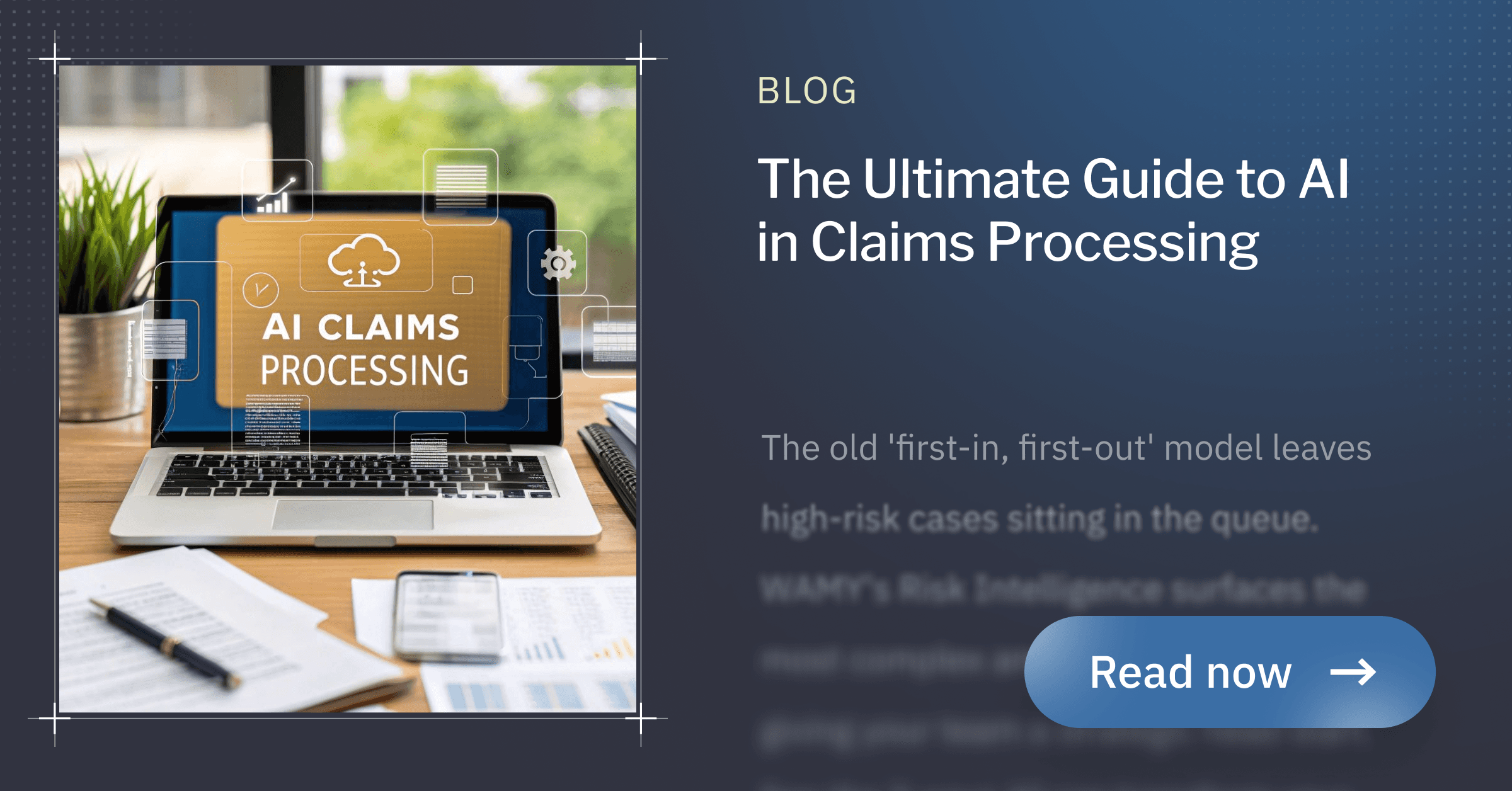
When people talk about AI in claims processing, what they're really talking about is using smart technology to automate and accelerate the tedious, manual work that slows everything down—data entry, document analysis, and even initial decision-making.
It's about transforming a sluggish, paper-heavy workflow into a fast, accurate, and efficient system. The result? Claims that once took days or even weeks to resolve can now be handled in a matter of hours or minutes.
From Hours to Minutes with AI Claims Automation
Think of the traditional claims journey as a winding country road. It's full of stop signs, manual checkpoints, and plenty of opportunities for wrong turns. An adjuster gets a new file—a chaotic jumble of photos, police reports, medical records, and invoices—and has to start the painstaking process of sorting, reading, and connecting the dots.
This manual slog isn't just slow. It’s a breeding ground for human error, inconsistencies, and costly delays that frustrate everyone from the claimant to the carrier.
Now, imagine that same journey on a high-speed expressway. That’s the reality of AI-powered claims processing. Instead of a person manually sifting through documents, an AI platform ingests the entire file in an instant. It reads, understands, and organizes everything, flagging missing information and highlighting critical evidence in seconds.
The Old Way vs. The New Reality
The difference between these two approaches is night and day, and it gets right to the heart of AI's value.
Traditional Pain Points: The old model is buried under a mountain of administrative work. Adjusters often spend up to 70% of their time on non-core tasks like data entry and document review. This not only inflates operational costs but also drags out cycle times, hurting both customer satisfaction and the bottom line.
AI-Driven Efficiency: AI completely flips this ratio. It takes over the repetitive, low-value work, freeing up adjusters to focus on what humans do best: critical thinking, complex negotiation, and genuine customer communication. They’re no longer paper-pushers; they're strategic decision-makers.
By automating the most time-consuming parts of claims handling, AI doesn’t just make things faster. It fundamentally changes the role of the claims professional, elevating their work and driving better outcomes across the board.
This shift from a manual, error-prone system to an intelligent, automated one isn't some futuristic fantasy. It’s a practical solution available today, tackling the industry’s most persistent challenges. For a deeper dive, you can learn more about automating insurance claims processing in our comprehensive guide.
By taking on slow cycle times and inconsistent outcomes head-on, AI is setting a new performance standard for carriers, TPAs, and legal teams throughout the P&C world.
How AI Claims Platforms Actually Work
To really get a handle on what AI in claims processing can do, you need to look under the hood. It’s not a single magic button; it's a series of smart, connected capabilities working in concert. The goal is to take a chaotic flood of information and turn it into structured, actionable insights for your team.
Think of it less like a simple calculator and more like an entire team of expert analysts working at the speed of software.
At its heart, an AI claims platform automates the cognitive-heavy lifting that has always bogged down adjusters. The process kicks off the second a new claim file lands, ingesting a messy mix of documents—photos, police reports, medical records, you name it—and immediately starts making sense of it all.
This isn't just about scanning paper. It's about understanding context, identifying what matters, and getting the raw data ready for intelligent analysis.
Intelligent Triage and Automated Intake
The first job is Intelligent Triage. In a typical workflow, a person has to open every single file just to figure out what it is, how urgent it is, and who needs to see it. An AI platform does all of that instantly.
Using technologies like Natural Language Processing (NLP) and computer vision, the system can:
Categorize documents: It knows a police report isn't a medical invoice, and neither is a photo of property damage.
Prioritize claims: It flags high-severity or complex claims for immediate human attention based on rules you set or patterns it has learned.
Route files: It automatically pushes the right documents to the right people, whether that's your subrogation unit or a specialized liability team.
This automated sorting smashes the initial bottleneck, getting claims moving the moment they arrive. It’s the difference between a mailroom where every letter is opened by hand and one where an automated sorter directs everything to the right desk in seconds.
The flowchart below shows the dramatic contrast between the old, slow manual process and the accelerated, AI-powered workflow.
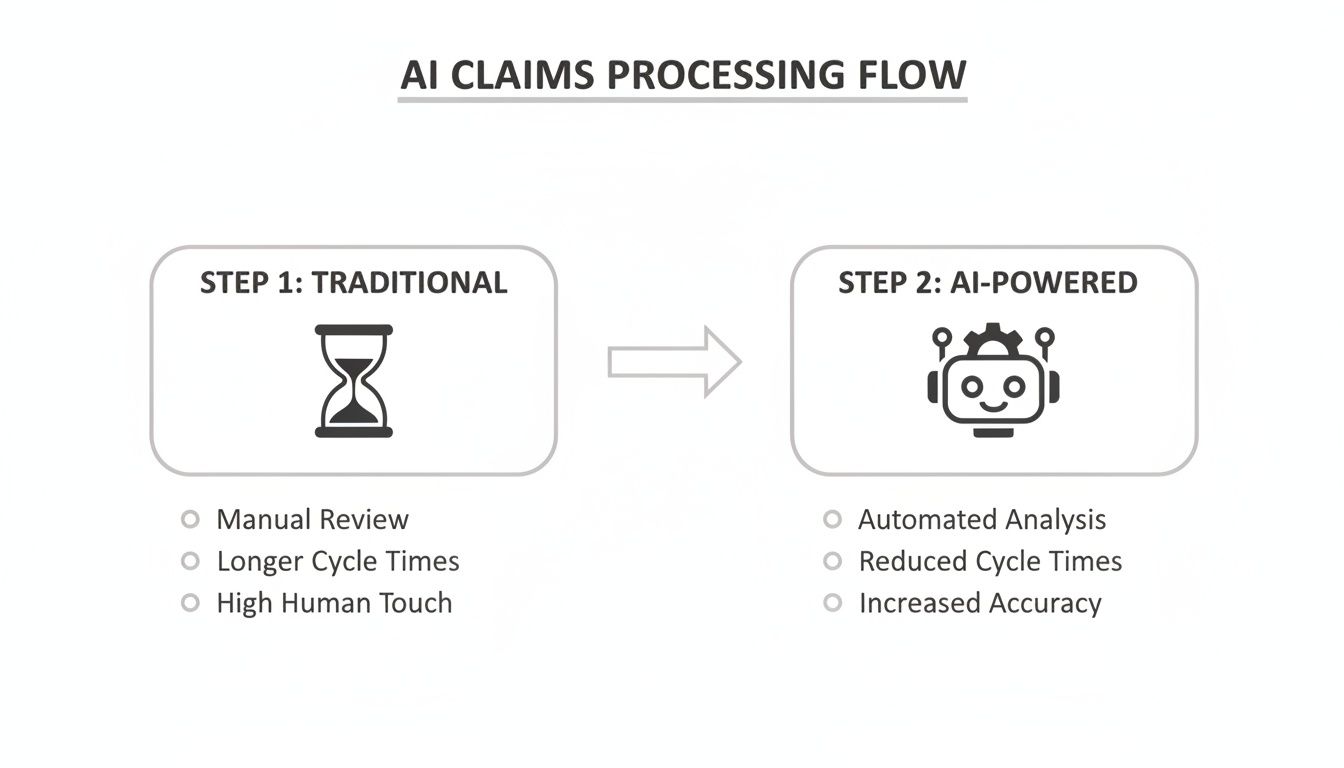
As you can see, AI compresses a clunky, delay-prone process into a direct and efficient pathway, which is key to shortening claim cycle times.
Evidence Tagging and Proactive Gap Detection
Once a claim is triaged, the next crucial step is organizing the evidence. This is where Automated Evidence Tagging shines. Picture an expert assistant who reads every single document and tags the key information—things like "date of loss," "admitted fault," or "medical treatment"—to create a structured, searchable case file.
This is fundamental to building a clear picture of the claim. To see exactly how this works in the real world, check out our guide on AI document review for P&C claims.
At the same time, the AI is performing Proactive Gap Detection. It acts like a seasoned partner double-checking your work, spotting what’s missing before it causes a problem. It might flag that a police report is mentioned but not attached, or that you have a medical bill but not the corresponding treatment record. This lets adjusters request missing info right away, preventing weeks of delays down the road.
This shift from reactive problem-solving to proactive information gathering is a cornerstone of efficient claims management. It ensures adjusters have a complete, decision-ready file from the start.
AI-Powered Risk Scoring and Decision Support
With a structured and complete file, the AI can now deliver a powerful first-pass analysis. Using predictive analytics, the platform generates a Risk Score that flags the claim's complexity, its potential for litigation, or the likelihood of fraud.
This isn't about replacing an adjuster's judgment. It's about arming them with data-driven insights to make faster, more consistent decisions. They can immediately see which claims are straightforward enough to settle quickly and which ones demand a deeper dive.
To illustrate the difference, here's a direct comparison of the old way versus the new.
Manual vs AI-Powered Claims Processing: A Head-to-Head Comparison
This table breaks down how specific tasks are transformed when you move from a traditional, labor-intensive approach to an AI-driven one.
Claims Task | Traditional Manual Process | AI-Powered Process |
|---|---|---|
Intake & Triage | An administrator manually opens, reads, and routes each document. Highly prone to backlogs. | AI automatically categorizes and routes documents in seconds. High-priority claims are flagged instantly. |
Data Extraction | Adjusters manually re-key information from PDFs and images into the claims system. Tedious and error-prone. | AI extracts key data points automatically, populating the file with structured, accurate information. |
Evidence Review | Adjusters spend hours reading through hundreds of pages to find critical facts and evidence. | AI tags key evidence, creates summaries, and builds a searchable timeline, surfacing critical info in minutes. |
Gap Detection | Missing documents are only discovered when an adjuster finally gets to the file, often weeks later. | AI proactively identifies missing information upon intake, allowing for immediate follow-up. |
Risk Assessment | Relies entirely on the individual adjuster's experience and intuition, leading to inconsistency. | AI generates a data-driven risk score, providing objective insights to guide decision-making. |
The contrast is clear: AI doesn't just speed up old tasks, it fundamentally changes how work gets done, shifting the focus from manual labor to strategic decision-making.
By bringing these capabilities together, AI creates a claims workflow that is not only faster but far more accurate and reliable.
Real-World AI Use Cases in P&C Insurance

Let's move from theory to reality. The true power of AI in claims processing really comes to life in the property and casualty (P&C) sector, where it’s tackling some of the industry's toughest, most persistent challenges. We're not talking about small, incremental gains here. We’re talking about solving problems that were once considered logistical nightmares, from responding to catastrophic events to untangling complex liability disputes.
This technology is making a real difference for everyone involved—carriers, third-party administrators (TPAs), and legal teams. Its flexibility is its greatest asset, offering specialized solutions for completely different scenarios.
The market numbers back this up. In P&C, AI is dominating the claims space, driving a massive 58.50% of the total AI in insurance market revenue. This isn't a coincidence. It speaks directly to AI's unique ability to handle the specific headaches of P&C, like visual damage assessment, fraud detection, and catastrophe modeling. As the global AI in insurance market is forecasted to rocket from $8.13 billion to $79.89 billion by 2032, you can bet P&C applications will be fueling a huge part of that growth. If you want to dig deeper into the numbers, you can read the full research about AI in the insurance market.
Managing High-Volume Catastrophe Claims
When a major hurricane, wildfire, or flood hits, the tidal wave of claims can bury even the most prepared carriers. The old playbook of deploying armies of adjusters to inspect thousands of properties can drag on for weeks, if not months. This leaves policyholders in a terrible limbo and sends operational costs through the roof.
AI flips that script entirely.
Picture this: a hurricane makes landfall. Instead of waiting for the all-clear, an insurer can deploy AI paired with aerial and satellite imagery to get an initial damage assessment across an entire devastated region—often in a single day. Computer vision models, trained on millions of images, can pinpoint specific types of damage with incredible accuracy.
Rapid Triage: The AI can instantly tell the difference between a roof with a few missing shingles and one that's completely collapsed, allowing the carrier to triage claims on the spot.
Faster Payments: For properties with obvious, catastrophic damage, the system can authorize initial payments almost immediately. This gets critical funds into the hands of affected families faster than ever before.
Smarter Resource Allocation: Field adjusters aren't just sent out into the chaos anymore. They are dispatched strategically to the properties that actually need an expert, hands-on inspection, making them far more effective.
This transforms catastrophe response from a reactive, logistical nightmare into a proactive, data-driven operation. It’s about delivering real help when it’s needed most, at a scale that was simply impossible before.
This use of AI isn't about replacing people. It's a perfect example of technology augmenting human expertise. The AI handles the brutal, high-volume analysis, freeing up adjusters to manage the nuances of each claim and provide the crucial human touch.
Untangling Complex Subrogation and Liability Cases
Beyond property damage, AI is fast becoming a go-to tool for legal teams and TPAs wrestling with messy liability and subrogation cases. These claims are notorious for being buried under mountains of documents—police reports, witness statements, medical records, expert opinions, you name it.
Manually sifting through thousands of pages to build a solid evidence package is an excruciatingly slow and error-prone process. An attorney or adjuster could burn dozens of hours just trying to get the timeline straight.
Now, an AI claims intelligence platform can ingest that entire case file and, in minutes, spit out a structured, actionable summary. It can:
Build an Interactive Timeline: The AI pulls out key events and dates from every single document and arranges them chronologically, giving you a crystal-clear overview of the case from start to finish.
Tag Critical Evidence: It automatically flags evidence directly related to liability, damages, and causation, linking each piece of data back to its original source document.
Spot Contradictions: By analyzing all witness statements and reports at once, the AI can highlight inconsistencies that a human reviewer, working sequentially, might easily miss.
For a law firm going after subrogation, this means building an airtight demand package in a fraction of the time. For a TPA defending a liability claim, it means they can quickly size up their exposure and map out a smarter defense. AI delivers the clarity and structure needed to navigate even the most tangled cases with confidence.
Boosting Accuracy with AI-Driven Fraud Detection

Insurance fraud is a multi-billion-dollar problem that bleeds the industry dry. For decades, the fight against it has been a cat-and-mouse game, with carriers relying on human intuition and a checklist of known red flags—like a suspicious claim filed moments after a policy change. But fraudsters have gotten smarter, and those old-school methods just don't cut it anymore.
Today, AI in claims processing represents our most sophisticated defense yet. It's a massive leap beyond simple rule-based systems, capable of identifying complex, interconnected fraud patterns that are almost invisible to the human eye. Think of it as upgrading from a security guard with a flashlight to a full-blown surveillance network that sees everything at once.
AI algorithms can tear through millions of claims in seconds, learning the subtle signatures of both legitimate and bogus behavior. This is supercharging fraud detection efforts across the entire industry.
Beyond Red Flags to Pattern Recognition
A traditional system might flag a single suspicious detail. That's helpful, but limited. AI connects the dots across massive, unrelated datasets to uncover organized fraud rings and nuanced deception. It performs checks that are simply beyond human scale.
For instance, an AI platform can:
Analyze Digital Media: It can instantly detect metadata anomalies in photos or videos, flagging images that have been digitally altered to inflate the damage.
Cross-Reference Data: AI can check a claimant’s details against public records, social media profiles, and internal claims history to spot inconsistencies or hidden connections to other claimants.
Identify Unnatural Patterns: The system can recognize if a specific body shop, medical provider, or attorney shows up with unusual frequency in high-payout claims—a classic sign of a potential fraud ring.
This deep analytical power allows AI to catch fraud that would have sailed right through in the past. It delivers a level of scrutiny that's both incredibly broad and minutely detailed.
The Human-in-the-Loop Advantage
It's crucial to understand that AI doesn't just make cold, unilateral decisions or automatically deny claims. Instead, it acts as an intelligent partner for human investigators. The model’s main job is to surface high-risk claims and provide a clear, evidence-backed reason for its suspicion. We call this the “human-in-the-loop” model.
This collaborative approach is what makes it work. The AI presents the evidence and highlights the anomalies, but the final judgment always rests with a skilled professional who can apply context, nuance, and ethical consideration to the case.
This synergy lets fraud teams focus their expertise where it matters most. Instead of wasting hours sifting through hundreds of low-risk files, they can pour their energy into the claims that truly demand a deeper look. For organizations ready to take this step, understanding how to apply an AI claim score is a critical first move.
The industry is adopting this technology at a breakneck pace because it gets results. Fraud detection is one of AI's standout applications, with adoption rates soaring to 92% in health, 88% in auto, and 70% in home insurance. In the P&C world, where visual claims and catastrophe events create ripe opportunities for duplicate or exaggerated submissions, AI is a game-changer. The algorithms dissect documents and images to flag oddities in real-time, drastically reducing leakage and manual reviews. As a result, leading insurers have seen settlement times cut by over 35%, partly due to these superior fraud checks.
And here’s the kicker: by fast-tracking the validation of legitimate claims, this AI-powered approach delivers a massive benefit for honest policyholders. It clears the way for faster payments and a far better experience, proving that a strong defense against fraud ultimately improves service for everyone.
Your Roadmap to Implementing AI in Claims
Bringing AI into your claims operation isn't like flipping a switch. It’s more like paving a new, smarter road for your team to travel on. It demands a clear-eyed plan that accounts for your technology, your data, and most importantly, your people.
A successful rollout really boils down to three critical pillars: getting your data ready, nailing the system integrations, and leading your team through the change. Get these right from the start, and you'll have a much smoother ride and see a real return on your investment much faster.
Let’s break down what each of these pillars looks like in practice.
Pillar 1: Data Readiness and Preparation
The first question I always hear from leaders is, "Is our data clean enough for AI?" It's a fair question, especially since older AI models needed perfectly structured, labeled data to even function. But modern AI claims platforms are built for the real world. They're designed to handle the messy, unstructured reality of P&C claims right out of the box.
Think of it like this: you don't need to organize your chaotic garage before hiring a professional organizer. Their entire job is to make sense of the mess. In the same way, a top-tier AI platform is engineered to ingest, read, and structure your raw, mixed-format claim files—PDFs, photos, emails, scanned documents—without a massive data cleanup project beforehand.
The key takeaway here is that data readiness is less about pre-cleaning your files and more about ensuring the AI platform has secure access to them. The system’s whole purpose is to create structure from chaos, not demand perfection from the get-go.
Pillar 2: Seamless System Integration
Your claims management system (CMS) is the heart of your operation. Any new technology has to plug into it without causing a massive headache. The days of clunky, year-long integration projects are thankfully behind us. Modern AI platforms are designed to be plug-and-play, using Application Programming Interfaces (APIs) to build a seamless bridge between your systems.
An API is basically a universal translator, letting your CMS and the AI platform speak the same language and swap data in real time. This connection opens up some powerful, hands-off workflows:
Automated Data Sync: When a new claim is opened in your CMS, the API can instantly push all the related documents over to the AI platform for analysis.
Intelligent Data Push: Once the AI has tagged evidence, flagged gaps, or generated insights, the API can push that structured data right back into the correct fields in your CMS.
This two-way street kills manual data entry, breaks down information silos, and gives your team a single source of truth. The result is a unified workflow where the AI feels like a natural extension of your existing tools, not some clunky, bolted-on solution.
Pillar 3: Effective Change Management
Technology is only half the battle. Getting your team on board is the other, more critical half. The fear that AI is coming to take jobs is real, which is why it's so important to frame this change the right way, right from the start. The goal isn’t to replace adjusters; it’s to empower them by getting rid of the most tedious parts of their work.
Start by zeroing in on the biggest pain points in your current workflow. Is it the mind-numbing hours spent reviewing documents? The constant back-and-forth chasing missing information? Position the AI as the direct answer to those problems.
Here are a few proven strategies for getting your team to embrace the change:
Communicate the "Why": Make it clear that the AI is a tool to free them from low-value, repetitive tasks. This allows them to focus on the work that actually requires their expertise—negotiation, complex problem-solving, and genuine customer interaction.
Highlight the "WIIFM" (What's In It For Me?): Show them exactly how this technology will make their day-to-day less frustrating and more rewarding. Frame it as a tool that helps them close claims faster, hit their targets, and deliver better outcomes for policyholders.
Involve Them Early: Kick things off with a pilot program. Hand-pick a small group of your most respected, high-performing adjusters. When you turn them into internal champions who can vouch for the tool's benefits, that's the most powerful way to build trust and get the rest of the team excited.
Choosing the Right AI Partner and Measuring Success
Picking a technology vendor for AI in claims processing isn't like buying off-the-shelf software. It's a strategic partnership. The right partner becomes a true extension of your team, helping you drive efficiency and get consistent outcomes day in and day out. But in a market full of noise, how do you tell the real innovators from the hype?
Start with deep domain expertise. A vendor that truly speaks the language of P&C insurance—one who gets subrogation, liability, and catastrophic loss without needing a cheat sheet—will deliver a solution that fits right into your workflow from day one. Generic, one-size-fits-all AI platforms almost always stumble because they lack this specialized, hard-won knowledge.
Key Criteria for Vendor Selection
To make a smart decision, you need to evaluate potential partners against a firm set of non-negotiables. Your checklist should hit on both their technical chops and their business alignment to make sure this is a relationship built to last.
P&C Domain Expertise: Does the vendor actually understand your world, from complex auto liability to nuanced property damage claims? Their AI models should be pre-trained on mountains of relevant P&C data, not generic business documents.
Enterprise-Grade Security: This is non-negotiable. Look for vendors with serious certifications like SOC 2 Type 2 and a demonstrated commitment to HIPAA readiness. Your claims data is incredibly sensitive, and security can't be an afterthought.
Ease of Integration: The platform has to play nicely with your existing Claims Management System (CMS) through modern, flexible APIs. A clunky, painful integration can kill a project before it even gets off the ground.
Scalability and Performance: Can their system handle your current claims volume and, more importantly, grow with you? Don't just take their word for it—ask for real-world case studies and performance benchmarks to back up their claims.
Choosing a partner is a lot like hiring a key employee. You need someone with the right skills, a deep understanding of your industry, and the ability to mesh with your existing team and processes.
Measuring the True Impact of AI
Once your AI solution is up and running, proving its value is everything. Sure, cutting operational costs is a clear win, but the real ROI of AI goes much deeper than just trimming expenses. You need to measure what actually moves the needle for your business.
Focus on a balanced scorecard of Key Performance Indicators (KPIs) that tell the whole story—capturing gains in efficiency, quality, and the policyholder experience. These are the metrics that will help you build a powerful business case and show the ongoing value your AI partner delivers.
Here are the essential KPIs you should be tracking:
Claim Cycle Time: Measure the average time from First Notice of Loss (FNOL) to final payment. A significant drop here is one of the clearest signs that AI is making a real impact on your team's efficiency.
Adjuster Productivity: Keep an eye on the number of claims managed per adjuster. The goal of AI is to empower each person to handle a larger or more complex caseload without hitting burnout.
Customer Satisfaction (CSAT): Always monitor policyholder feedback. Faster, more transparent claims processing almost always translates into happier, more loyal customers.
Outcome Consistency: Dig into your settlement data. Are decisions becoming more uniform and tightly aligned with your company's guidelines? This is key to reducing leakage and staying ahead of compliance risks.
Questions We Hear All the Time About AI in Claims
Even the most forward-thinking claims leaders have practical, boots-on-the-ground questions before they bring in a new platform. We get it. Here are some of the most common questions that come up in our conversations, along with some straight answers.
Is AI Going to Replace Our Adjusters?
Nope. The goal isn't replacement; it's augmentation. Think of AI as the ultimate assistant for your claims team.
It’s designed to take on the mind-numbing, repetitive work—sorting through thousands of documents, flagging missing information, and handling basic data entry. This frees up your experienced adjusters to focus on the high-value work that actually requires their expertise: complex negotiations, critical judgment calls, and building relationships with policyholders.
How Can We Trust an AI Platform with Our Sensitive Claims Data?
Security isn't an afterthought for enterprise-grade AI platforms; it’s a foundational requirement. Reputable vendors invest heavily in security and compliance protocols, like achieving SOC 2 Type 2 certification. This isn't just a piece of paper—it's a rigorous, independent audit that validates a vendor's controls for protecting sensitive customer data.
When claims involve medical information, HIPAA readiness is another non-negotiable. All your data is typically encrypted—both when it's being sent and when it's stored—and protected by strict access controls. Frankly, it’s often far more secure than the legacy, paper-based systems of the past.
Ultimately, AI is here to empower your human experts. The technology handles the rote, administrative grind, which allows your adjusters to apply their critical thinking where it truly matters—delivering fair, fast, and accurate outcomes for your policyholders.
What Kind of Implementation Timeline Are We Really Looking At?
Forget the horror stories of multi-year legacy software projects. Modern, cloud-based AI platforms are built for speed and can be up and running in a matter of weeks to a few months, not years.
The exact timeline will, of course, depend on the complexity of your current systems. But platforms built with flexible APIs are designed to integrate smoothly with the Claims Management System (CMS) you already use. This makes the transition much cleaner and gets you to a positive ROI that much faster.
Wamy turns your raw claims data into confident, audit-ready decisions. Reduce manual work by up to 77% and resolve claims four times faster with an AI platform built for P&C. Schedule your personalized demo today.