What was once a manual, painstaking process is now being transformed by artificial intelligence. At its core, AI document review is about using smart technology to automatically read, understand, and organize huge volumes of claims information.
Think of it this way: instead of an adjuster spending hours, or even days, sifting through police reports, medical bills, and photos, AI acts like a digital paralegal. It takes a chaotic mess of unstructured data and turns it into a neatly organized, actionable claims file in minutes.
From Manual Chaos to Automated Clarity
Picture the desk of a seasoned property and casualty (P&C) claims adjuster just a few years ago. It’s likely buried under a mountain of paper for a single complex claim: police reports, witness statements, dense medical records, repair estimates, and a stack of photos. Every piece is critical, but connecting the dots is a slow, manual grind that’s wide open to human error.
This has been the reality of claims processing for decades—a major bottleneck that drains resources and slows down resolutions for everyone.
This old-school approach isn't just inefficient; it's expensive. Adjusters and their support teams burn a massive amount of time on low-value clerical work—think data entry and document sorting—instead of the high-value work they were hired for, like analysis, negotiation, and strategy. The risk of one crucial detail getting lost in a thousand-page file is always there, potentially leading to a bad settlement, a compliance headache, or a missed chance to recover costs.
The Modern Solution to an Old Problem
AI document review was built to fix this exact problem. And it's not just about finding keywords. Modern AI systems read and comprehend content with a near-human level of context.
It's like having a team of tireless digital assistants who can process an entire claims file in the time it takes to grab a cup of coffee. They don’t just turn paper into pixels; they understand what it all means, identify key people and facts, flag inconsistencies, and summarize what’s most important.
This capability is driving a market that’s growing at an incredible pace. The Document AI sector, which powers these review functions, is set to jump from USD 14.66 billion in 2025 to USD 27.62 billion by 2030. That kind of growth tells you there’s a huge demand for tools that can make sense of complex insurance documents like PDFs, forms, and images. For a deeper dive, you can explore more data on the Document AI market's growth and what’s behind it.
Comparing Manual vs AI-Powered Document Review
When you switch from a manual system to an AI-powered one, the change in day-to-day operations is massive. The table below breaks down the shift, showing how everything from initial intake to final decision-making gets a major upgrade.
Process Step | The Traditional Manual Approach | The Modern AI Approach |
|---|---|---|
Initial Intake | Staff manually download, print, and sort documents from various sources like email and portals. | AI automatically centralizes all incoming documents into a single, organized digital workspace. |
Data Extraction | Adjusters read through every page to find and manually enter key data points into the CMS. | AI reads documents, extracts relevant data (names, dates, policy numbers), and populates system fields. |
File Triage | An experienced adjuster reviews the file to assess complexity, assign it, and identify next steps. | AI provides an initial risk assessment, flags missing information, and suggests a priority level instantly. |
Evidence Review | The team visually inspects photos and reads reports one by one to build a narrative. | AI tags photos, analyzes text for sentiment, and connects related pieces of evidence automatically. |
By automating these foundational steps, AI document review completely changes the role of the claims professional. They’re no longer just information gatherers. They become strategic decision-makers, armed with organized, reliable, and instantly accessible data. This shift is the first real step toward a faster, more accurate, and far more efficient claims operation.
How the Core Technology Actually Works
Stepping into the world of AI document review can feel a bit like opening a black box. You know it works, but the mechanics inside seem overwhelmingly complex. The good news? You don't need a Ph.D. in computer science to get the gist of it. When you break it down, the technology is really just a series of coordinated jobs that turn a chaotic pile of documents into structured, actionable intelligence.
Think of it as an assembly line for information. Each station has a specialized role, and together, they turn raw materials—your claim files—into a finished product: a clear, organized case ready for an expert's eyes. This goes far beyond simple keyword searching; it's about building genuine comprehension from the ground up.
This journey from disorganized data to structured insight is powered by a handful of core technologies working in sync.
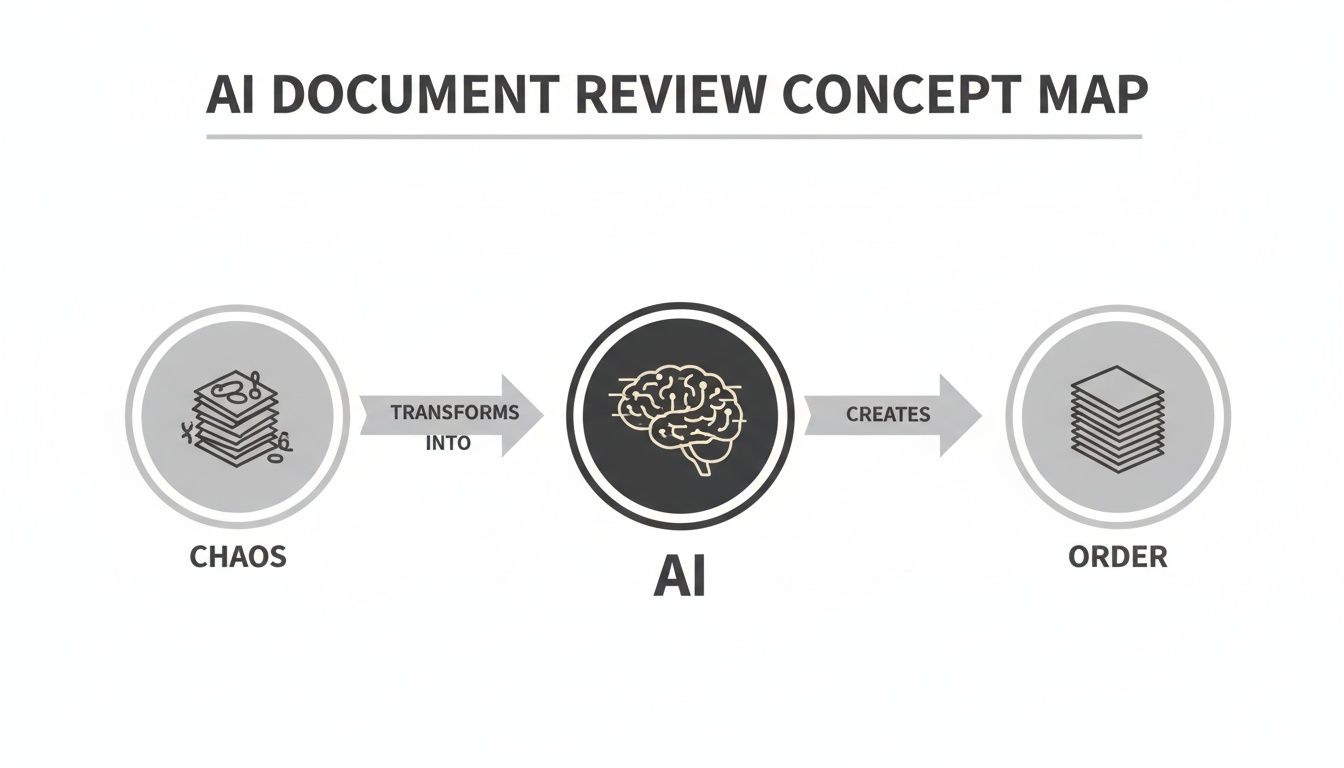
As you can see, the AI acts as the engine that ingests messy, unstructured files and produces clean, easy-to-review outputs. This is the foundation of an efficient claims operation.
The Eyes of the System: Optical Character Recognition
The whole process kicks off with getting the data into a readable format. Many claim documents aren't clean digital text. They’re scanned police reports, photos of damaged property, or even handwritten witness notes. This is where Optical Character Recognition (OCR) comes in, acting as the system's "eyes."
OCR technology scans an image of a document and converts any text it finds into machine-readable digital text. It’s the foundational step that turns a static picture of words into something the AI can actually work with. Without solid OCR, a blurry photo of a witness statement is just a useless image, its critical contents locked away.
The Brain of the System: Natural Language Processing
Once the documents are digitized, the real "thinking" begins. Natural Language Processing (NLP) is the brain of the operation. It's the branch of AI that teaches computers to understand and interpret human language, with all its messy nuances, context, and quirks.
NLP is responsible for several critical tasks:
Entity Recognition: This is how the AI identifies and classifies key pieces of information—names of people, locations, dates, policy numbers, and specific medical terms. It’s what tells the system "Dr. Smith" is a person and "123 Oak Street" is an address.
Sentiment Analysis: NLP can also gauge the tone of a document. For instance, it can figure out if a witness statement is neutral, negative, or positive, offering subtle but important clues about the case.
Topic Modeling: Give the AI a big pile of documents, and it can identify the main themes or topics being discussed. This is a huge help for categorizing files automatically.
By applying NLP, the system moves from just seeing words to understanding their meaning and relationship to one another. This is the difference between finding the word "injury" and understanding that a specific person sustained a particular type of injury on a specific date.
The Experience Engine: Machine Learning
If NLP is the brain, then Machine Learning (ML) is the experience engine that gets smarter over time. ML algorithms are trained on massive datasets—in this case, millions of past P&C claims documents. By analyzing all that historical data, the system learns to recognize the patterns associated with different claim types, risks, and outcomes.
This is what gives the platform its predictive muscle. For example, an ML model can learn to spot the tell-tale signs of a potentially fraudulent claim because it has seen thousands of similar examples before. It isn't just following a rigid set of rules; it's making an educated guess based on accumulated experience. This constant learning allows the AI to become more accurate and efficient with every document it reviews.
The Visual Interpreter: Computer Vision
Finally, not all evidence is text. A modern P&C claim file is packed with visual data: photos of vehicle damage, videos from security cameras, or satellite imagery of a property. Computer Vision is the AI technology that analyzes and makes sense of these images and videos.
Instead of an adjuster having to manually sift through hundreds of photos, computer vision can:
Automatically tag images by content (e.g., "vehicle," "water damage," "roof").
Detect the severity of damage in a photo.
Extract text from images, like pulling a license plate number from a picture of a car.
Together, these four technologies—OCR, NLP, ML, and Computer Vision—form a powerful, collaborative system. They work in concert to deliver a comprehensive understanding of a claim, turning a mountain of unstructured data into the clear, organized intelligence your team needs to make faster, more confident decisions.
What Are the Real-World Benefits for Your Team?
Bringing AI document review into your claims operation isn't just a tech upgrade; it's a strategic shift that delivers a serious business impact. By automating the most grinding, labor-intensive parts of claims processing, you free up your best people to do what they do best: think critically and make sound judgments. This directly pumps up efficiency, drives accuracy, and boosts your bottom line.

It’s about turning your adjusters and paralegals from data miners into strategic analysts. Let's dig into the four key benefits this unlocks for P&C claims teams.
Slash Claim Cycle Times
The single biggest drag on any claims process is the time it takes to manually wade through, read, and organize incoming files. An AI platform automates that entire front-end slog, from data entry to initial triage, compressing review times from days down to minutes.
When an adjuster picks up a new claim, the AI has already read every single page, pulled out the key information, and flagged the critical details. They can jump straight into the real work of analysis and decision-making instead of getting buried in clerical tasks. Faster resolutions don't just cut operational costs—they are a massive driver of policyholder satisfaction.
Dial-Up Accuracy and Compliance
Let's be honest: human error is a fact of life in manual document review. A single missed detail in a thousand-page file can spiral into incorrect payouts, compliance headaches, or missed subrogation opportunities. AI puts a stop to that by applying a consistent, unblinking set of rules to every document, every time.
The system never gets tired or distracted. It enforces your organization's standards with perfect consistency, making every file audit-ready from the moment it arrives. This rock-solid accuracy provides a defensible foundation for every decision, slashing the risk of costly downstream corrections and regulatory blowback. If you're looking to sharpen these early steps, check out our guide on smarter claims triage and decision support with AI.
By standardizing the initial review, AI creates a reliable single source of truth for every claim. This consistency is the bedrock of a scalable and compliant claims operation, ensuring every file is handled with the same high level of scrutiny.
Get Proactive on Fraud and Risk
Seasoned adjusters develop a gut feeling for spotting red flags, but even the best can’t see subtle patterns hidden across mountains of data. AI document review systems are built for this. They analyze claim details against millions of historical data points to surface anomalies a human would almost certainly miss.
The system can instantly flag suspicious patterns, such as:
Conflicting stories or details across different documents.
Similarities to known fraudulent claims in the system.
Key information that's missing but is normally present in similar cases.
This gives your team a head start, allowing them to investigate high-risk claims early. You can stop fraudulent payouts before they happen and build a much stronger defense for potential litigation.
Drive Down Operational Costs
The financial upside of faster, more accurate claims processing is huge. While document review is non-negotiable, it has always been a major cost center. In the related world of eDiscovery, for example, document review can eat up 70-80% of total costs. It’s no surprise that leading firms are now using AI to cut review times by as much as 75%. You can learn more about the economic impact of AI on legal processes.
For P&C carriers, that efficiency translates directly to the bottom line. Faster resolutions mean a lower cost-per-claim. Better accuracy and fraud detection mean you minimize improper payouts and expensive litigation. At the end of the day, an AI document review platform lets you scale your capacity and handle more claims without having to grow your headcount.
A Practical Guide to AI Implementation
Bringing AI document review into your operation isn’t like flipping a switch and hoping for the best. It’s a strategic move that demands a clear plan. For claims and legal leaders, a thoughtful rollout is the difference between buying a tool and gaining a real operational advantage that empowers your team from day one.
Successfully integrating an AI platform hinges on a smart roadmap. It starts by identifying your biggest headaches and ends with your team enthusiastically using the new system. Rushing it leads to frustration, but a measured approach guarantees a smoother transition and a much faster return on your investment.
This five-step framework will help you bring AI into your claims workflow, ensuring you pick the right solution and set it up for long-term success.
Start With a Specific Problem
Before you look at a single piece of software, look at your own shop. Where are the real bottlenecks? What repetitive, soul-crushing tasks are eating up your team's day? Nailing down a specific, high-impact problem is the most critical first step you can take.
Common starting points we see include:
Slow First Notice of Loss (FNOL) Processing: If the initial intake and data entry are causing delays right out of the gate, you need a solution that’s a rockstar at pulling data from all sorts of documents automatically.
Subrogation Leakage: Are you leaving money on the table? An AI that can instantly spot third-party liability in police reports and witness statements is a must-have.
Inconsistent Triage: If claims are getting routed inefficiently, look for an AI that provides instant risk scoring and complexity analysis to get the right file to the right adjuster, every time.
When you define the problem first, you can judge vendors on their ability to solve it—not just on a long list of shiny features.
Evaluate Platform vs. Point Solution
Next, think about scope. Do you need a niche tool that solves one specific problem, or do you need a comprehensive platform to manage the entire document lifecycle? A point solution might be great for a single task, like redacting PII, but it often creates new data silos that cause headaches down the road.
A comprehensive platform, like Wamy, is built from the ground up to be an end-to-end system. It centralizes intake, analyzes evidence, scores risk, and even helps with drafting correspondence, all in one place. For most P&C operations, a platform delivers far greater long-term value by breaking down operational barriers instead of building new ones. For a deeper dive into the financial benefits, our guide on automating insurance claims processing is a great resource.
Prioritize Security and Compliance
When you're dealing with sensitive claims information, security isn't just a feature—it's everything. Any AI partner you consider has to prove they take data protection seriously. This goes way beyond marketing fluff; you need to see the proof.
Look for key industry certifications that validate a vendor's security posture. SOC 2 compliance is the gold standard for SaaS companies, confirming they have rigorous controls in place to protect customer data. If you handle medical records, HIPAA readiness is an absolute must.
Don't treat security like a checkbox. Make it a core pillar of your evaluation to protect your organization and, most importantly, your clients.
Plan for Seamless Integration
Your new AI tool can't live on an island. To get the most out of it, it needs to talk to your existing Claims Management System (CMS) and other core software. A clunky workflow that forces adjusters to constantly jump between systems is a surefire way to kill adoption.
Bring up integration capabilities early in your conversations with vendors. The best platforms have robust APIs or pre-built connectors that make syncing data easy. This ensures the insights the AI generates are right where your team already works, creating a fluid and natural process.
Focus on Team Adoption
Finally, never forget that technology is only as good as the people who use it. You need to position the AI as a powerful assistant—one designed to eliminate tedious work, not replace skilled professionals. The whole point is to augment your team's expertise, freeing them up to focus on the high-value, strategic work that requires a human touch.
Provide solid training, celebrate early wins, and find champions within your team who can show everyone else how the tool makes their job easier. When adjusters see the AI as something that helps them close claims faster and more accurately, adoption will take care of itself.
Choosing the Right AI Document Review Platform
Picking an AI document review platform is a lot more than just a software purchase; it's a strategic partnership. The market is crowded, and cutting through the noise to find a solution that actually delivers requires a clear framework. Forget the flashy features for a moment—your evaluation should laser-focus on how a platform solves your most persistent, day-to-day operational headaches.
Think of it like hiring a specialist. If your team is drowning in manual data entry, you don't just need a generalist. You need an expert specifically trained to understand the complex, nuanced language of P&C claims documents. That domain-specific expertise is the first and most critical filter for choosing the right partner.
Evaluating Core Capabilities
The right platform should feel like an extension of your team—one that anticipates needs and clears roadblocks before you even hit them. As you look at different solutions, center your questions around the features that directly attack your biggest bottlenecks and risks.
First, look for a system built around a centralized intake process. A top-tier platform should be able to seamlessly pull in documents from any source—email, portals, direct uploads—and consolidate everything into a single, organized workspace. This alone puts an end to the chaos of scattered files from day one.
Next, demand actionable intelligence, not just data extraction. Does the platform give you a contextual first-pass assessment with a risk or confidence score? Can it automatically flag inconsistencies and missing items? This is the difference between a simple data entry tool and an intelligent assistant that helps you prioritize and strategize.
Must-Have Features Mapped to Your Challenges
To make your evaluation more concrete, it's helpful to connect your daily operational pain points directly with the essential features that solve them. This approach ensures you choose a solution that delivers tangible, measurable value right out of the gate.
When you're vetting potential AI partners, a simple checklist can keep you focused on what truly matters. It helps you map the real-world problems your team faces to the specific capabilities that will make their lives easier and your operations more efficient.
Checklist for Evaluating AI Document Review Platforms
Use this checklist to assess potential AI solutions by mapping common operational challenges to the essential features that solve them.
Common Pain Point | Essential Feature to Look For | Why It's a Game-Changer |
|---|---|---|
Endless manual data entry from PDFs, scans, and emails | Domain-Specific AI Models specifically trained on P&C claims and legal documents. | This ensures the AI understands the unique terminology and context of your files, leading to much higher accuracy than a generic tool. You can explore why general AI tools can be risky for P&C firms in our detailed guide. |
Inconsistent reviews and missed details | Human-in-the-Loop Validation Workflows that allow your team to easily review, approve, or correct the AI's output. | This creates a perfect blend of AI speed and human expertise, ensuring every final decision is both fast and defensible. It builds trust and maintains quality control. |
Concerns about data security and client privacy | Enterprise-Grade Security Certifications like SOC 2 and HIPAA readiness. | These third-party validations are non-negotiable. They prove the vendor has rigorous controls to protect your sensitive claims data, safeguarding your firm and your clients. |
By focusing on these core capabilities, you're not just buying software; you're investing in an operational asset that will grow with you.
By focusing on these core capabilities—domain expertise, actionable intelligence, human-in-the-loop workflows, and robust security—you can confidently select an AI document review partner that acts as a true operational asset.
The market for these tools is exploding. In the legal AI space alone, the document drafting and review segment was valued at USD 206.4 million in 2024 and is projected to hit USD 549.5 million by 2030. This growth reflects a massive shift, with AI adoption in legal practices jumping from just 19% in 2023 to 79% in 2024. You can discover more insights about the legal AI market to see the trends driving this change. Your goal is to invest in a solution that not only keeps pace but puts you ahead of the curve.
Still Have Questions? Let's Clear Things Up.
Adopting any new technology is a big step, and it’s natural to have questions. When it comes to something as critical as claims, you need straight answers. For P&C and legal pros weighing AI document review, let's tackle the most common concerns head-on.
Building confidence starts with clarity. The goal isn't to replace your team’s hard-won expertise, but to give them a serious upgrade. Think of this technology as a tool designed to serve your best people, clearing away the repetitive work so they can focus on what actually matters—making smart, defensible decisions that close claims fairly and fast.
Is This Technology Going to Replace Our Adjusters or Paralegals?
Absolutely not. That’s probably the biggest myth out there. This technology is built to augment your team, not replace it. It’s brilliant at automating the tedious, low-value work that eats up so much time, like sorting through stacks of documents or manually keying in data.
When you automate that grind, you free up your skilled professionals to focus on the high-impact work that requires human judgment: digging into complex analysis, driving a tough negotiation, or managing client relationships. It’s like giving every expert on your team a hyper-efficient assistant who handles the grunt work, letting them put their knowledge where it counts.
How Accurate Is This AI? Can We Actually Trust What It Puts Out?
The leading platforms are incredibly accurate because their AI models aren't generic; they’ve been trained on millions of industry-specific documents. They know the difference between a police report, a medical record, and a policy form inside and out. But more importantly, the best systems are designed with a "human-in-the-loop" philosophy.
The AI does the heavy lifting—reading, sorting, and flagging key information—but your team always has the final say. They can quickly review and validate the AI’s work, creating the perfect blend of machine speed and human oversight. The result is a reliable, audit-ready process you can stand behind.
This partnership approach is what builds trust and keeps you in complete control of every final decision.
What About Our Sensitive Client and Claims Data? Is It Secure?
Data security is non-negotiable. Any vendor worth their salt will treat it as their absolute top priority. When you’re looking at different platforms, don’t just take their word for it—ask for proof.
A top-tier platform will have the certifications to back up its security claims. Here's what to look for:
SOC 2 Certification: This is the gold standard for software companies. It’s an independent audit that confirms they have rock-solid processes for managing and protecting customer data.
HIPAA Readiness: If you handle any protected health information (PHI), this is a must-have. It shows the platform is built to safeguard sensitive medical data and keep you compliant.
Think of these certifications as your assurance that a vendor follows the strictest security protocols. It means they’re a partner you can trust with your firm's and your clients' most sensitive information.
Ready to see how an AI workforce built specifically for the P&C industry can transform your claims process? Wamy centralizes intake, organizes evidence, and delivers the insights your team needs to resolve claims up to four times faster. Discover how Wamy can lower your cost per claim today.