
In the legal world, a virtual assistant isn't just one thing. It can be a highly skilled remote professional handling client calls and scheduling, or it can be a powerful AI platform that digests and drafts documents in minutes. At their core, these assistants—both human and AI—give law firms the support they need to operate more efficiently and scale their practice.
The New Blueprint for Modern Law Firms
The old model of in-house-only support staff is quickly becoming a relic. Today, law practices of all sizes are realizing that virtual assistants for attorneys aren't just a way to cut costs; they're a core strategic advantage. The modern approach blends the expertise of skilled remote professionals with the raw power of intelligent AI to manage everything from the first client call to complex document review.
This hybrid model is proving essential for firms drowning in high-volume work, especially in demanding fields like P&C claims and document-intensive litigation. The shift is already well underway. An estimated 80% of law firms are now using some form of virtual assistant service, whether that’s a remote paralegal, a legal assistant, or an administrative specialist. This isn't just a temporary fix—it's a fundamental move toward a more permanent, efficient way of running a firm. You can find more on this trend in this detailed analysis of virtual assistant usage in law firms.
Building an Agile and Competitive Practice
By handing off the right tasks, attorneys can claw back countless hours once lost to non-billable administrative work. This frees them up to pour their energy into what really matters: case strategy, client counsel, and courtroom advocacy. The ripple effect goes beyond just one attorney's productivity; it makes the entire firm more nimble and responsive.
The key advantages here are pretty clear:
Enhanced Scalability: A firm can instantly scale its support team up or down to match a fluctuating caseload without the financial drag of hiring full-time staff.
Improved Client Responsiveness: With administrative burdens lifted, attorneys have more bandwidth for client communication, which is a huge driver of satisfaction.
Strategic Focus: Delegating routine work lets legal professionals concentrate on billable hours and the strategic initiatives that actually grow the practice.
This isn't just about outsourcing. It’s about completely redesigning your firm’s operational core. When you pair human expertise with AI-driven automation, you build a workflow that is both incredibly intelligent and exceptionally efficient—setting the stage for real, sustainable growth.
This guide will break down exactly how to build a more resilient and competitive law firm using this model. You might also be interested in seeing how AI transforms the entire legal process from intake to trial.
Choosing Your Ideal Legal Support Model
When it comes to getting the right kind of support for your law firm, it's crucial to understand that not all virtual assistants are created equal. The choice really boils down to two distinct—but increasingly complementary—models: the human virtual legal assistant and the AI-powered assistant. Figuring out the strengths of each is the first step toward building a smarter, more efficient practice.
A human virtual assistant is essentially a highly skilled remote paralegal or legal secretary. They bring uniquely human qualities to the table—empathy, nuanced communication, and the ability to solve complex, unexpected problems. This makes them perfect for tasks that require a personal touch, like managing client relationships, handling sensitive calls, or coordinating schedules between multiple parties where things can change at a moment's notice. They’re masters at reading between the lines and navigating unpredictable situations that require real judgment.
The Rise of AI-Powered Legal Assistants
An AI assistant, on the other hand, operates more like a high-speed analyst. It’s built to master repetitive, data-heavy tasks with incredible speed and precision. A tool like Wamy Companion isn't here to replace human intuition; it's designed to take on the high-volume, structured work that bogs down legal and claims professionals.
These AI platforms are absolute workhorses in a few key areas:
Document Triage: They can automatically sort and categorize thousands of documents—from discovery files to claims evidence—in minutes, not days.
Data Extraction: AI can pull out critical information like names, dates, policy numbers, and key facts from dense reports and forms, all without the risk of human error.
Initial Drafting: They can generate solid first drafts of routine correspondence, summaries, or reports based on structured data, giving attorneys a huge head start.
To help clarify the roles, let's break down where each type of assistant shines.
Human vs AI Virtual Assistants A Quick Comparison
The table below offers a quick look at the core strengths of human and AI assistants, helping you see where each fits best within a modern legal or claims workflow.
Feature | Human Virtual Assistant | AI Virtual Assistant (e.g., Wamy) |
|---|---|---|
Core Strength | Empathy, judgment, complex problem-solving | Speed, accuracy, data processing at scale |
Ideal Tasks | Client communication, scheduling, final reviews | Document sorting, data extraction, first drafts |
Communication | Nuanced, personal, and adaptive conversations | Structured, data-driven, automated alerts |
Scalability | Limited by individual bandwidth | Nearly infinite; handles massive volumes easily |
Best For | High-touch, relationship-focused work | High-volume, repetitive, data-intensive tasks |
As you can see, the real magic isn't in choosing one over the other. It's about blending their strengths.
The real power isn't in an "either/or" choice but in creating a hybrid team. This modern workflow combines the strategic oversight and client management skills of a human VA with the tireless analytical power of AI.
This is exactly how today's most forward-thinking firms are structured. They build a connected ecosystem where attorneys, human assistants, and AI work together seamlessly.
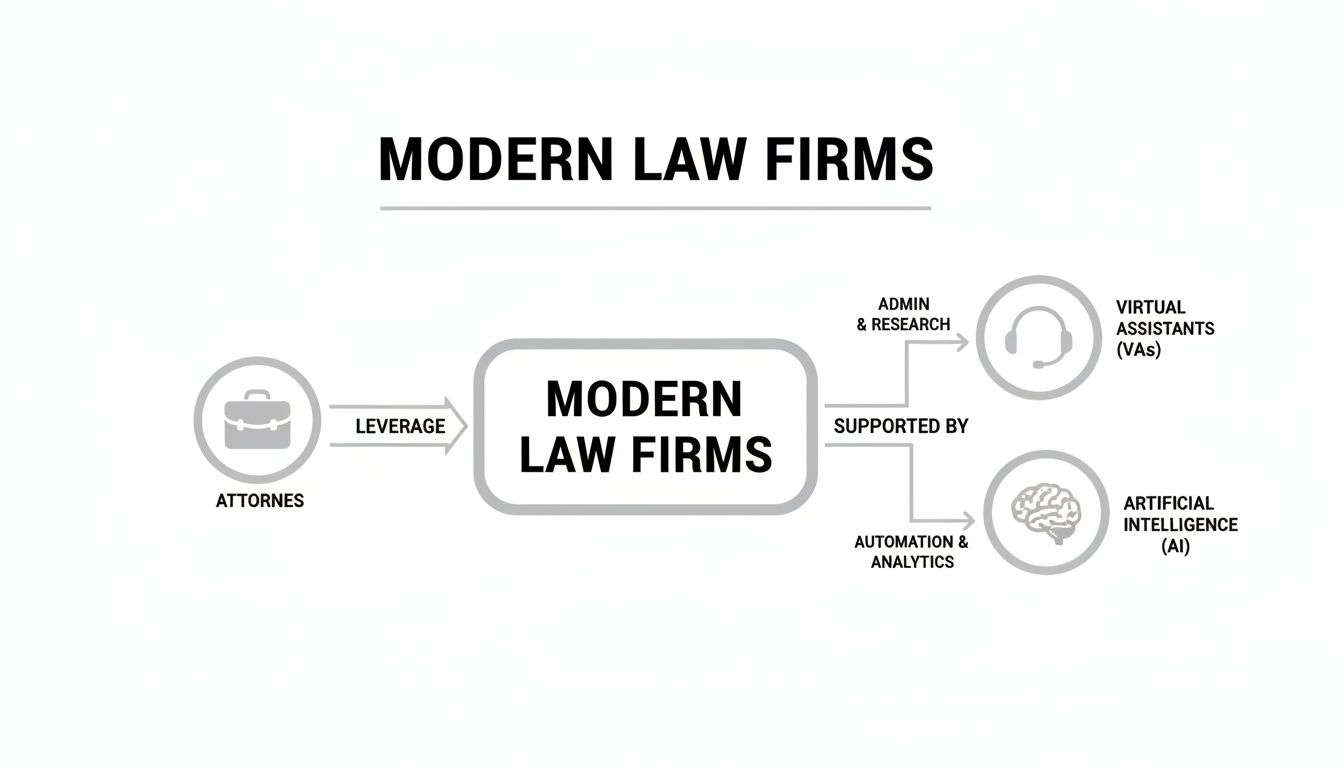
As the diagram shows, the most effective setup places attorneys at the core of strategy. Human VAs handle the client-facing and administrative heavy lifting, while AI automates the backend data processing and analysis.
Creating a Hybrid Legal Team
Let's walk through what this looks like in practice. Imagine a new P&C claim comes in.
The AI assistant instantly ingests all the related documents, flags that a key police report is missing, and drafts an initial claim summary. From there, your human virtual assistant takes over. They review the AI's output, call the client with a personalized and empathetic message to request the missing report, and then schedule the next steps on the attorney's calendar.
This intelligent partnership frees up attorneys to focus purely on high-value legal strategy, knowing that both the routine data crunching and the critical human touchpoints are handled. It’s a powerful model where virtual assistants for attorneys—both human and AI—work in concert to create a workflow that is both incredibly smart and built to scale.
What Can You Actually Hand Off to a Virtual Assistant?

Effective delegation is what separates a bogged-down law firm from an efficient one. The right virtual assistants—both human and AI—can take a surprising amount of work off your plate, freeing you up for high-value legal strategy and client work. This isn't just about hiring a remote secretary; it's about building an operational engine that runs smoothly in the background.
Think about the entire client journey. A human virtual assistant is perfect for the personal interactions that build trust from the get-go. They can handle initial intake calls, schedule appointments and depositions, and manage follow-up communications with genuine empathy. This makes clients feel heard and supported from day one.
Meanwhile, an AI assistant like Wamy Companion can supercharge the work happening behind the scenes. It can automatically sort incoming documents, tag key evidence in discovery files, and draft routine letters or emails from templates. This hybrid approach lets your firm be both highly responsive and incredibly organized.
Managing the Case and Claims Workflow
In the world of P&C claims and document-heavy litigation, organization is everything. Virtual assistants for attorneys are masters of case management, making sure nothing slips through the cracks. They build a solid, structured foundation for every single matter.
Here’s a quick look at how they manage those critical workflows:
Evidence and Document Organization: A human VA can meticulously organize digital case files, while an AI assistant can automatically categorize and tag thousands of pages of discovery or claim documents in just a few minutes.
Documentation Collection: Need a police report, medical records, or a signed affidavit? A human VA can make the calls and send the follow-up emails to clients, opposing counsel, or third parties until the document is secured.
Initial Summaries and Chronologies: AI can generate a solid first draft of a deposition summary or medical history timeline. A human VA can then step in to refine it, adding crucial context and flagging key details for your review.
By delegating these foundational tasks, attorneys can start their case review with a well-organized file and a clear summary of the facts. This dramatically cuts down on non-billable prep time and allows them to dive right into legal analysis and strategy.
Administrative and Financial Support
Beyond the direct case work, virtual assistants are a lifeline for the essential admin and financial tasks that keep a firm afloat. Handing off these responsibilities ensures operational consistency and, just as importantly, improves your cash flow.
These tasks often include things like:
Billing and Invoicing: Tracking billable hours, preparing and sending client invoices, and politely following up on any outstanding payments.
Calendar Management: Juggling court dates, client meetings, and discovery deadlines to make sure there are no painful scheduling conflicts.
Client Communication: Answering routine client questions ("When is my deposition?") and providing status updates, ensuring clients never feel left in the dark.
Ultimately, bringing virtual assistants for attorneys onto your team isn't about replacing core legal staff. It's about intelligently augmenting them. By offloading these specific, well-defined tasks, you empower your legal professionals to focus their expertise where it truly counts—practicing law and winning cases for your clients. This strategic approach to delegation is the blueprint for a more productive and profitable modern law firm.
Getting AI Assistants Running in Your Law Firm
Bringing new technology into a law firm can feel like a massive project, but with the right game plan, integrating AI-powered virtual assistants for attorneys is not only manageable but incredibly rewarding. The idea isn’t to rip and replace everything overnight. Instead, the smart move is a phased rollout that goes after your biggest headaches first, guaranteeing a smooth transition and an immediate payoff.
So, where do you start? Look for the biggest bottlenecks in your workflow. Is your team buried in documents during discovery? Are you spending too many hours on initial case assessments or client intake? Pinpointing these pain points lets you deploy AI where it will make the biggest difference right away. This approach shows your team clear, immediate benefits and builds the momentum you need for broader adoption.
The integration of AI assistants is fundamentally changing how legal professionals handle their caseloads, especially in claims and litigation. While 80% of law firms already use some type of virtual assistant, the AI picture is a bit more nuanced. Right now, 55% of law firms use generative AI tools, but that number jumps to 81% for in-house legal teams—a pretty significant 26-point gap. Individual attorneys, however, are moving faster, with 31% using AI on their own for work. You can find more data in the latest analysis of AI perspectives in the legal field.
Building a Connected Legal Workspace
A successful rollout hinges on making AI feel like a natural extension of how you already work—not some clunky, separate tool you have to fight with. This means picking tools that plug right into your current case management software and other essential systems. For example, a platform like Wamy can be set up to automatically grab documents from your email and client portals, pulling everything into a single, intelligent workspace.
Think about a litigation workflow powered by a tool like Wamy's AI Document Drafting:
Automated Intake: Case documents get collected and sorted automatically.
Intelligent Analysis: The AI scans the files, pulls out the key facts, and flags any missing information.
Drafting Assistance: With the evidence organized, the attorney can use the AI to create a first draft of a motion or summary.
This isn't about replacing legal expertise; it's about amplifying it. By connecting AI to your core systems, you create a unified environment where routine data work is automated, freeing up attorneys to do what they do best: focus on strategy and analysis.
Ensuring Your Team Is On Board and Successful
Finally, a great rollout is about people, not just technology. Proper training is absolutely essential to make sure your team knows how to use the new tools effectively and feels confident doing so. It’s always a good idea to start with a small pilot group to iron out any wrinkles before you go firm-wide.
To know if it's working, set clear metrics from day one. Is the goal to cut document review time by 50%? Or maybe you want to slash the time it takes to write up initial case summaries? Tracking these key performance indicators (KPIs) will show you a tangible return on your investment and make the case for putting even more resources behind AI-powered assistants. You can learn more about how an AI paralegal can support claims and legal work in our detailed guide.
What's the Real ROI on Virtual Legal Support?
Bringing virtual assistants into your practice is about much more than convenience—it delivers a hard, measurable return on investment that shows up right on your firm's bottom line. The real value isn't just about shaving off a few dollars here and there. It's about fundamentally reshaping how your firm operates by cutting costs, winning back time, and sharpening accuracy.
The most obvious win is direct cost reduction. Hiring a full-time, in-house paralegal comes with a ton of overhead: salary, benefits, payroll taxes, office space, and equipment. Virtual assistants, on the other hand, work on a flexible model. You're only paying for productive hours, which completely removes the financial weight of a full-time employee and can save you thousands every year.
The Value of Reclaimed Time
For a law firm, time is the most precious commodity, and this is where virtual assistants make their biggest impact. By automating or delegating routine, non-billable grunt work—think document review, scheduling, and initial data entry—you can free up hundreds of attorney hours. That reclaimed time can be poured directly into high-value, strategic work that only an attorney can do, like shaping case strategy, counseling clients, and appearing in court.
When you offload the administrative burden, attorneys can finally shift their focus from managing tasks back to practicing law. This pivot doesn't just make for happier lawyers; it directly expands the firm's capacity for billable work without adding to the payroll.
This newfound efficiency leads to tangible business results. Organizations using AI-enhanced platforms are reporting they can collect claim documents up to 77% faster and wrap up claims up to four times faster. While many US law firms were still on the sidelines with AI in late 2024, the ones that jumped in gained a serious advantage. In the first half of 2025, these tech-forward firms saw revenues climb 11.3% and partner profits shoot up 13.7%. The numbers prove a direct line between virtual support and financial growth. You can dive into more findings on AI adoption in law firms here.
Boosting Accuracy and Outcomes
Finally, the ROI gets a massive boost from improved accuracy. AI-powered virtual assistants are built to handle repetitive data tasks with near-perfect precision, which dramatically cuts the risk of human error in document analysis or data extraction. Fewer mistakes mean fewer delays, less rework, and stronger, more reliable case files. For more on this, check out our guide on effective time tracking for attorneys using modern AI tools.
When you combine lower costs, maximized billable hours, and dead-on accuracy, you create a powerful financial engine for any modern legal practice.
Upholding Security and Ethical Standards

For any attorney, protecting client data and upholding ethical duties are the twin pillars of the profession. They are absolutely non-negotiable. When you bring virtual assistants for attorneys into your workflow, those obligations don't just vanish—they simply extend to your remote team and the technology they use.
With a human virtual assistant, the lines of responsibility are pretty clear. The supervising attorney is always the one accountable for their work. This means you have a professional duty to keep a close eye on things, preventing any action that could even hint at the unauthorized practice of law. Your VA can absolutely draft documents and manage calendars, but all legal advice and final judgments have to come from you.
A virtual assistant, whether human or AI, is an extension of your firm's operational arm—not its legal mind. Clear boundaries, robust supervision, and informed client consent are essential to maintaining ethical integrity and professional responsibility in a remote support model.
Vetting AI for Security and Compliance
When you start integrating AI-powered assistants, the security conversation shifts to the tech itself. Handing over sensitive client information to a platform requires a serious level of scrutiny. You have to be certain the provider has ironclad security measures in place to protect data, both when it's moving and when it's stored.
These aren't just nice-to-have features; they're mandatory for any legal tech you consider.
End-to-End Encryption: This ensures that from the moment you send a document to the moment it's opened, it’s completely unreadable to anyone without authorization.
Robust Data Privacy Policies: The platform must be transparent about how your data is used, stored, and protected from ever being misused.
Regulatory Compliance: Look for platforms that meet recognized industry standards. For example, a platform like Wamy is SOC 2 certified, which demonstrates a real commitment to enterprise-grade security and operational controls.
This level of verification is critical. Opting for a consumer-grade tool instead of a secure, enterprise-ready platform is just asking for trouble, creating unacceptable risks for your firm and your clients. Before you sign on with any service, do your homework to confirm it lines up with your professional and ethical duties.
A Practical Vetting Checklist
To protect your practice, it pays to have a structured approach when you're evaluating any virtual assistant service, be it human or AI.
Review NDAs and Contracts: Make sure every agreement spells out confidentiality requirements, who owns the data, and the security protocols in place.
Verify Security Certifications: For AI tools, you want to see certifications like SOC 2 or HIPAA-readiness. They're proof the platform adheres to strict security standards.
Confirm Supervision Protocols: With human VAs, map out clear workflows for how tasks are assigned, reviewed, and approved to ensure proper oversight.
Obtain Client Consent: Always let your clients know you’re using virtual assistants for administrative or paralegal support and get their consent, especially when sensitive information is involved.
By making security and ethics the foundation of your selection process, you can bring on virtual support with confidence, without ever compromising the trust your clients have placed in you.
Answering Your Key Questions
Bringing any new resource into your firm, whether it's a person or a platform, naturally comes with questions. It’s a critical part of due diligence. We’ve gathered some of the most common ones we hear from attorneys about virtual assistants to give you the straightforward answers you need.
How Can I Trust a Remote Assistant With Confidential Client Data?
This is, without a doubt, the most important question and should be the first one you ask. Any reputable virtual assistant provider—especially those built for the legal field—operates on secure, encrypted platforms designed from the ground up for safe file sharing and communication.
Before any work ever begins, a rock-solid non-disclosure agreement (NDA) is standard procedure. When you're vetting potential services, make it a point to ask specifically about their compliance with legal industry data protection standards. Ultimately, you and your firm always maintain complete control and oversight of all client information.
Can a Virtual Assistant Make Decisions That Require Legal Judgment?
Let's be crystal clear: absolutely not. It's critical to understand that a virtual assistant, human or AI, must never, ever engage in the unauthorized practice of law. Their role is strictly to handle administrative, paralegal, and data-focused tasks under the direct supervision of a licensed attorney.
Think of them as an operational extension of your firm, not a legal one. All final legal analysis, strategic decisions, and client advice must always remain with you, the practicing attorney. This clear division of labor is essential for ethical compliance.
Is This Really More Cost-Effective Than Hiring In-House Staff?
For the vast majority of firms, the answer is a resounding yes. When you hire a virtual assistant, you sidestep all the significant overhead that comes with an in-house employee—think office space, benefits, equipment, and payroll taxes. Those costs add up fast.
With a virtual assistant, you're only paying for the productive hours or specific tasks you actually need. This model gives you incredible financial flexibility and the ability to scale up or down based on your caseload. You get the support you need without the fixed financial commitment of another full-time salary.
Ready to see how an AI-powered virtual assistant can give your firm a serious edge in efficiency and outcomes? Discover Wamy, the claims intelligence platform designed for modern legal and P&C teams. Learn more and request a demo today.