A gap in insurance isn't just a technical term—it's any piece of missing information, documentation, or coverage that leaves P&C carriers, TPAs, and legal firms financially exposed. Think of it as a hole in your defense. These aren't minor oversights; they're tangible risks that inflate claim costs, bring resolutions to a grinding halt, and can seriously damage the trust you've built with your customers.
To close these gaps, you need a systematic approach. Every claim file has to be airtight and defensible.
The Real Cost of a Gap in Insurance Claims

Every gap in a claims file is more than a procedural headache. It's a direct threat to your bottom line. These seemingly small omissions create significant financial and operational friction, turning what should be a straightforward claim into a costly, drawn-out dispute. From our vantage point, we see this play out every single day for P&C carriers and TPAs.
Imagine a commercial property claim where the final invoice from a contractor goes missing. That single document stalls payment, delays restoration work, and keeps the claim file open for weeks longer than necessary. Every single day that file sits on someone's desk, Loss Adjustment Expenses (LAE) pile up, eating away at your margins.
Or take a third-party liability case. An unsigned medical release form can completely derail the investigation. Without it, your team can't verify the extent of the injuries or properly assess damages. The claim is stuck in limbo, and the risk of litigation skyrockets.
The Financial Drain of Incomplete Files
The financial fallout from these gaps is very real. They're a major contributor to the "insurance protection gap"—the massive difference between total economic losses and what's actually insured. This isn't a small number; the global gap hit a staggering $1.405 trillion in 2023. You can dig deeper into how global trends affect coverage in this insightful report on the 2025 insurance outlook.
For individual carriers, this macro trend shows up in a few key ways:
Inflated Loss Adjustment Expenses (LAE): Every follow-up email, phone call, and manual review needed to hunt down a missing document adds to the operational cost of handling that claim.
Increased Cycle Times: Gaps are the number one cause of delays. The longer a claim stays open, the more it costs—both in adjuster time and the potential for damages to escalate.
Higher Payouts: When your evidence is incomplete, your negotiating position is weak. Without the full picture, you might be forced to settle for a higher amount just to avoid a long, expensive legal battle.
A disorganized claims process isn't just inefficient; it’s a financial liability. Each missing document introduces ambiguity, and in the world of insurance, ambiguity always translates to increased cost and risk.
The Operational and Reputational Damage
Beyond the dollars and cents, a persistent gap in insurance documentation erodes operational efficiency and customer trust.
When adjusters spend their days chasing down paperwork instead of evaluating the merits of a claim, their productivity tanks. This administrative burden keeps them from high-value work like negotiation and settlement strategy. For a closer look at how to solve this, check out the key benefits of automated insurance claims processing in our related guide.
At the same time, policyholders expect a smooth and timely resolution. Delays caused by internal process gaps lead to frustration and a negative customer experience. In a competitive market, a seamless claims experience isn't a nice-to-have; it's a critical differentiator that prevents customer churn and protects your brand.
Comparing Manual vs. AI-Powered Gap Detection
Finding that one critical missing document in a mountain of claim files has always been a painstaking, manual slog. For adjusters, it’s a high-stakes scavenger hunt through a chaotic mix of emails, photos, PDFs, and scanned forms. The whole process hinges on their diligence and a keen eye, but even the best adjusters can miss something when juggling dozens of complex files. One oversight can bring a claim to a screeching halt.
The old way of doing things involves adjusters meticulously cross-referencing every submitted item against an internal checklist. They have to read every line of every document, manually flagging anything that seems off—missing, inconsistent, or just plain incomplete. It’s not just slow; it’s incredibly susceptible to human error. A subtle but critical gap in insurance documentation can easily slip through the cracks.
Now, contrast that with a modern, AI-driven workflow. Instead of a person digging through digital stacks, an intelligent platform automatically ingests and understands every piece of evidence the moment it arrives. It's not just about organizing files; it’s about making sense of them from day one.
The Traditional Manual Review Process
In a manual world, the process is painfully linear. An adjuster gets a batch of documents for a new claim and might spend hours just sorting them into logical folders. They have to visually scan each one to figure out what it is—a police report, a contractor's estimate, a medical bill—before they can even start assessing the content.
This creates some immediate and costly bottlenecks:
Massive Time Sink: A huge chunk of an adjuster's day is eaten up by administrative busywork instead of actual claim evaluation. This directly limits how many cases they can effectively manage.
Process Inconsistency: One adjuster might categorize a document differently than a colleague, leading to confusion and making it impossible to maintain a standard process across the team.
Delayed Discovery: A critical gap often isn’t found until days or even weeks into the process, maybe during a peer review or while prepping for settlement talks. Finding it late means you have to start chasing down information all over again, completely resetting the clock on the claim's cycle time.
The biggest weakness of manual detection is its reactive nature. You only discover a gap in insurance coverage or documentation after you’ve already sunk significant time into a file, forcing you to backtrack and lose all momentum.
This reactive loop is exactly what AI-powered systems are built to break. To see just how deep this shift goes, check out our practical guide to AI document review for P&C claims.
The AI-Powered Advantage in Gap Detection
An AI claims intelligence platform flips the script from reactive to proactive. It acts as a first line of defense, analyzing incoming documents in near real-time. Using AI trained specifically on insurance and legal documents, the system recognizes, tags, and categorizes every photo, PDF, and form based on its relevance to the claim.
The moment a set of documents is ingested, the AI instantly flags what's missing or inconsistent based on pre-defined rules for that specific claim type. Take a water damage claim, for instance. The system can automatically verify if you have photos of the source of loss, mitigation invoices, and moisture readings. If one is missing, it gets flagged immediately—not two weeks down the road.
This simple change allows your team to request the missing information on day one, dramatically speeding up the entire process.
A Head-to-Head Comparison
To really appreciate the difference, it helps to see how these two approaches stack up side-by-side in the areas that matter most.
The table below breaks down the core differences in performance, highlighting why so many teams are moving away from purely manual reviews.
Manual vs AI-Powered Gap Detection in Claims
Metric | Manual Detection | AI-Powered Detection (e.g., Wamy) |
|---|---|---|
Speed & Efficiency | Slow and labor-intensive, requiring hours of manual review per claim file. | Near real-time analysis, reducing hours of triage to mere minutes. |
Accuracy Rate | Prone to human error, fatigue, and inconsistency across adjusters and teams. | Highly consistent and accurate, with AI models trained on millions of claim documents. |
Scalability | Difficult to scale; adding more claims requires a linear increase in headcount. | Easily scales to handle high volumes without a corresponding increase in staff. |
Cost Per Claim | Higher due to increased adjuster time (LAE) and longer cycle times. | Lowered through accelerated document collection and faster resolutions. |
Proactivity | Reactive; gaps are often found late in the process, causing delays. | Proactive; gaps are flagged instantly upon document intake for immediate action. |
The efficiency gains speak for themselves. By automating the initial review and gap identification, AI frees up your adjusters to focus on the high-value work they were hired to do: evaluating the merits of a claim, negotiating settlements, and delivering an exceptional customer experience. It turns the frustrating task of finding a gap in insurance from a manual chore into an automated, strategic advantage.
Your Playbook for Systematically Closing Claims Gaps
Spotting a gap in insurance documentation is one thing. Systematically closing it is where the real value is created. This isn't about piling more steps onto an already swamped workflow; it's about fundamentally rewiring your claims process to be proactive instead of reactive. A modern playbook ditches the manual checklists and endless email chains for a structured, repeatable engine that resolves claims faster and more accurately.
The core idea is simple: stop the chaos before it even starts. Instead of letting evidence trickle in from a dozen different channels, you establish a single point of truth. That shift alone can slash the administrative load on your adjusters.
This visual captures the evolution perfectly—from a slow, manual grind to a streamlined, AI-assisted workflow for gap detection.
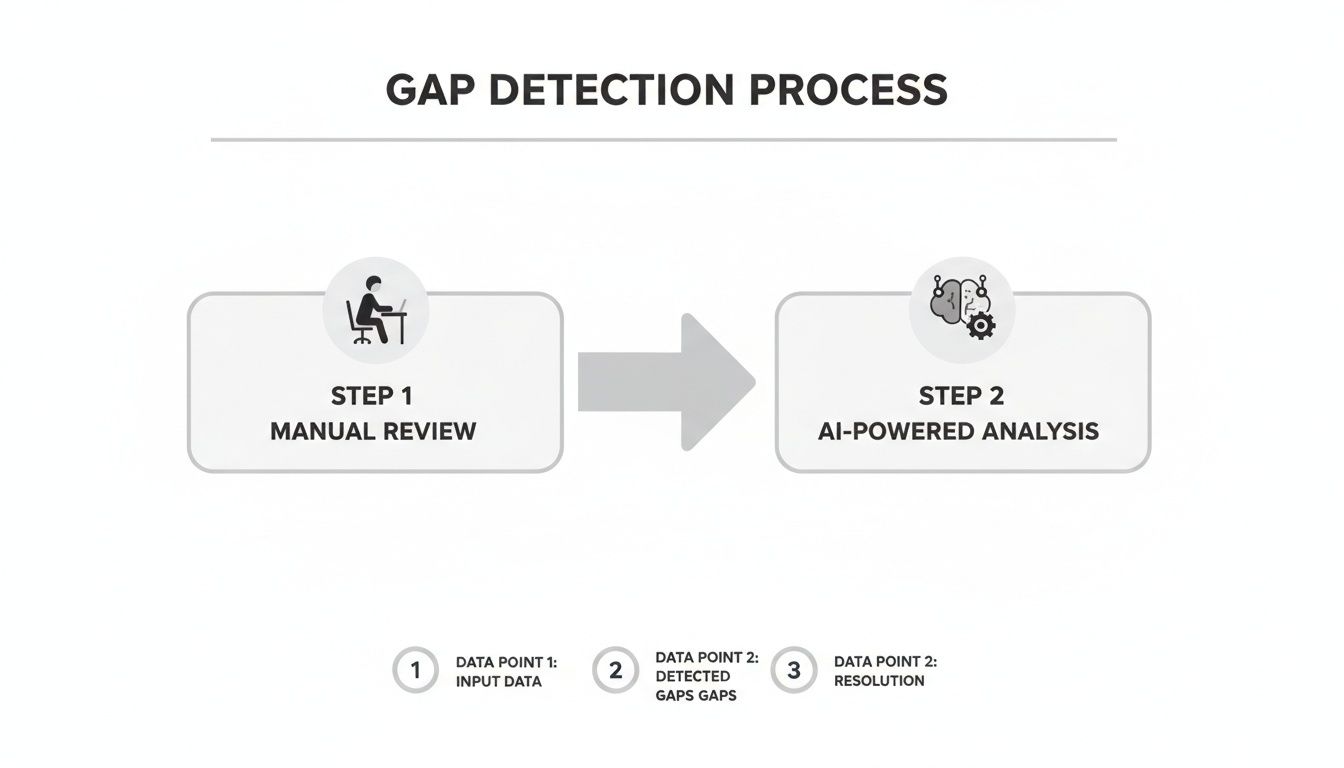
The key takeaway here is how AI collapses the timeline, turning what used to be days of manual triage into mere minutes of automated analysis and flagging.
Centralize Your Document Intake
The very first move in your playbook is to kill the fragmented intake process. Documents flying in through email, claimant portals, and direct uploads create a disorganized mess that makes finding anything a nightmare. A claims intelligence platform changes the game by pulling everything into one unified workspace.
Think of this centralized hub as your command center. Every new document gets automatically collected and logged. This gives you a clean, chronological record of what you have and—more importantly—what’s still missing. No more digging through inbox threads or shared drives just to piece together the basic story of a claim.
Automate Triage and Categorization with AI
Once all your evidence is in one spot, the next job is to make sense of it—and fast. This is where AI goes from being a simple organizer to a true analytical partner. Instead of adjusters burning hours manually sorting photos, PDFs, and forms, an AI-powered evidence refinery does the heavy lifting for them.
Just imagine the time this saves on a complex commercial property claim:
Photo Analysis: AI instantly recognizes and tags photos showing water damage, structural issues, or inventory loss, grouping them for an efficient review.
Document Recognition: It knows a police report from a contractor’s estimate or a medical bill, categorizing each one correctly without a human ever touching it.
Data Extraction: The system can even pull key info—like dates, names, and policy numbers—directly from the documents, making the data instantly searchable and usable.
This automated triage shrinks hours of manual work down to minutes. It frees up your adjusters to focus on high-value claim evaluation, not tedious clerical tasks.
Conduct a First-Pass Risk Assessment
With all the evidence neatly organized, you can finally get proactive with risk assessment. An AI platform can give you an immediate first-pass analysis, assigning each file a claim confidence score. This score is a powerful early warning signal, flagging the files that need immediate attention.
For example, a file with high-severity photos but a missing contractor invoice would get a lower confidence score. This instantly tells an adjuster that a critical gap in insurance documentation exists and needs to be plugged. It helps your team intelligently prioritize their caseload, ensuring the high-risk or complex claims get the senior attention they deserve from day one.
The goal is to surface risk proactively. By using AI to flag inconsistencies and missing items early, you transform your team from file processors into strategic risk managers who can anticipate problems before they derail a claim.
Building a strong, defensible file from the outset is crucial. For those who want to dig deeper into this, our guide offers a comprehensive look into practical enterprise claims management strategies.
Turn Requests for Information into a Proactive Strategy
Finally, your playbook needs a tool to actively close the gaps you’ve identified. The old way—drafting emails and making endless follow-up calls—is slow, inefficient, and nearly impossible to track. Modern platforms bake this entire process directly into the adjuster's workflow.
When the system flags a missing medical release or an unsigned proof of loss, the adjuster can use in-platform tools to take immediate action.
Example in Action
Let’s say you have a third-party liability claim where the claimant's initial statement is vague.
Gap Flagged: The AI immediately notes the absence of a detailed, signed statement.
Drafting Assistant: The adjuster uses an AI drafting tool to generate a clear, concise Request for Information (RFI) using pre-approved templates.
In-Platform Dispatch: The request is sent straight from the platform, and the system automatically tracks its status—sent, opened, and fulfilled.
This approach turns a reactive chore into a proactive, trackable strategy. You're no longer just chasing down information; you're systematically building a complete and defensible claim file. This structured process drives consistency, creates an audit-ready trail, and pushes every claim toward a faster, more accurate resolution.
How to Measure Your Gap Management Success
Let’s be honest: if you can’t measure your progress, you can’t prove your strategy is working. When it comes to closing gaps in insurance claims, you have to move beyond gut feelings and get into the hard data. This isn't about chasing vanity metrics; it's about tracking the KPIs that directly reflect the health of your operation and show a real return on your investment.
Having solid numbers is how you build a powerful business case for new tech and better processes. It’s how you show stakeholders exactly how being proactive about gaps translates into lower costs, faster resolutions, and a stronger bottom line.
Key Metrics for Gap Management
To get a true picture of your performance, you need to focus on a handful of high-impact metrics that actually tell a story. These go way beyond simple claim counts and get to the heart of how efficient and effective you really are.
Document Collection Velocity: How long does it take to get from the First Notice of Loss (FNOL) to a "complete" file with all the initial documents? A high velocity means you’re closing gaps quickly and keeping claims moving without those frustrating delays.
Claim Cycle Time Reduction: This is the big one. Track the total time from FNOL to claim closure. As your gap management improves, you should see this number consistently trend downward.
Cost Per Claim: Look at both indemnity payments and Loss Adjustment Expenses (LAE). Smart gap management hits LAE directly by cutting down the time adjusters waste on administrative follow-ups and chasing down paperwork.
Claim Confidence Score: This is a more advanced metric, often powered by AI platforms like Wamy. It scores a file based on the completeness and quality of the evidence, giving you a real-time snapshot of your portfolio's risk profile.
Tracking these indicators gives you a clear, data-backed view of how well your team is actually identifying and closing those documentation gaps.
Benchmarking and Setting Realistic Targets
Knowing what to track is only half the battle. You also need to know what "good" looks like. While industry benchmarks vary wildly by line of business, setting internal targets is the critical first step. Start simple: baseline your current performance over a 90-day period to see where you stand.
Once you have that baseline, you can set smart, incremental goals. For example, you might aim to reduce Document Collection Velocity by 25% in the first six months after bringing in a new system. This gives your team a tangible target to rally around.
A successful gap management strategy isn't just about finding what's missing. It's about creating a repeatable, measurable process that systematically reduces the time, cost, and risk tied to incomplete claim files.
This process becomes even more critical when you zoom out to global trends. By 2025, the worldwide insurance protection gap is forecasted to surge by 5%, with the Asia-Pacific region shouldering nearly 50% of all uninsured risks. AI solutions that centralize intake and flag gaps are enabling 77% faster document collection and 4x quicker resolutions, helping bridge the very operational gaps that feed these macro trends. You can learn more about how regional risks are shaping the global insurance landscape and see the bigger picture.
Demonstrating ROI to Stakeholders
At the end of the day, measuring these KPIs is all about proving a clear return on investment. When you can walk into a leadership meeting armed with concrete data, your story becomes impossible to ignore.
Frame your results in the language they care about: business impact.
Metric Improvement | Business Outcome |
|---|---|
30% faster document collection | Reduced adjuster administrative burden, allowing them to handle higher caseloads. |
20% reduction in cycle time | Improved customer satisfaction and lower operational costs per claim. |
15% decrease in LAE | Direct savings that flow straight to the bottom line, improving profitability. |
By consistently tracking these KPIs, you shift from simply managing claims to strategically optimizing your entire claims operation. You’re building a data-driven culture that’s always looking to close the next gap in insurance coverage, turning a huge source of friction into a real competitive advantage.
Navigating Compliance in Claims Management

When it comes to closing a gap in insurance, it’s not just about moving faster. It’s about being absolutely buttoned up on compliance. For carriers, TPAs, and law firms, every single decision needs a clear, defensible, and audit-ready trail backing it up. If it doesn't, you're leaving yourself wide open to regulatory headaches and legal fights.
This is a non-negotiable. Every action, from the first notice of loss to the final payment, has to be meticulously documented. An airtight claim file is your best defense; it proves every step was consistent, fair, and based on the evidence. All it takes is one missing document to call the entire file's integrity into question.
Building a Defensible Claim File from Day One
The strength of your legal standing in any dispute comes down to one thing: the quality of your claim file. A sloppy, incomplete file is a liability just waiting to happen. It signals a weak process and practically invites challenges from opposing counsel during pre-litigation or discovery.
On the flip side, a structured and consistent approach gives you a massive advantage. When every claim file is built using the same rigorous, evidence-based methodology, your legal teams are already starting from a position of strength. They have a detailed record that supports every decision, making it infinitely easier to defend how the claim was handled.
This is exactly where AI-driven platforms make a huge difference. They standardize how evidence is ingested, categorized, and analyzed, ensuring consistency is baked into the workflow from the start—not just an afterthought.
A well-documented claim file isn't just good practice—it's your most critical asset in risk management. It transforms a subjective process into an objective, defensible record that stands up to scrutiny.
Enterprise-Grade Security and Data Handling
Managing sensitive claimant data, from financial records to protected health information (PHI), is a massive responsibility. That means the security architecture of your claims platform is just as important as its features. Handling this kind of information requires an enterprise-grade solution, period.
Look for platforms that can prove their commitment to security through recognized certifications and readiness protocols:
SOC 2 Certification: This confirms a provider has established and follows strict information security policies and procedures.
HIPAA Readiness: Essential for any claim involving medical information, this shows the platform has the safeguards needed to protect PHI.
These aren't just badges to display on a website; they are proof of a robust security posture designed to protect both your organization and your claimants from data breaches and compliance failures.
The need for this level of precision is only getting more intense. In 2024, natural catastrophes caused $318 billion in economic losses, but insurance only covered 43%, leaving a staggering $181 billion protection gap. As these events fuel more complex subrogation and liability claims, the right AI platform can be a game-changer. By auto-tagging evidence and spotting what's missing, these systems can slash document collection time by 77% and help resolve claims up to 4x faster, ensuring every file is complete and defensible right from the beginning. You can discover more insights into the global insurance gap to see the full picture.
Your Top Questions About Closing Insurance Gaps, Answered
Any time you bring in a new way of working—especially one that touches something as core as claims handling—questions are bound to come up. From our conversations with P&C carriers, TPAs, and legal teams looking at AI, the concerns are always practical. Will this make my experienced adjusters obsolete? How painful is the rollout going to be? How does it even talk to our existing systems?
These are the right questions to ask. Let's tackle them head-on, based on what we've seen work in the real world. The idea isn't to just bolt on another piece of tech; it's to give your best people the tools they need to do their jobs better, faster, and with less frustration.
Does AI Replace the Need for Experienced Adjusters?
This is usually the first question, and the answer is an emphatic no. AI claims intelligence platforms are built to complement, not replace, the critical thinking, experience, and nuanced judgment of a skilled human adjuster. Think of it as giving your best people a superpower, not a pink slip.
An adjuster's true value isn't in spending 60-70% of their day on administrative drudgery—chasing down missing police reports or sorting through a mountain of medical records. Their value is in investigation, negotiation, and strategy. AI simply clears the deck so they can focus on what matters.
AI handles the grunt work: It automatically sorts, tags, and flags missing documents from the moment a claim comes in.
Adjusters handle the high-value work: With a complete, organized file ready to go on day one, they can immediately start assessing liability, evaluating the claim's merits, and moving toward a resolution.
The platform does the what—identifying missing evidence and flagging inconsistencies. Your adjusters do the why—understanding the context, talking to the people involved, and making the tough judgment calls. AI takes care of the science of the claim so your team can master the art.
By offloading the clerical burden, you let your adjusters operate at the top of their game. They can handle more complex cases with more confidence because they aren't bogged down in the administrative quicksand.
What Does the Onboarding and Implementation Process Look Like?
The mere thought of another massive, multi-year IT project is enough to kill a good idea before it starts. Thankfully, modern, cloud-based platforms are designed for speed and simplicity. The whole process is collaborative and phased to get you up and running smoothly with minimal disruption to your team's day-to-day.
A typical journey looks less like a marathon and more like a series of sprints:
Discovery & Workflow Mapping: First, we sit down with you to understand your current process. Where are the biggest headaches? What are the most common bottlenecks? We map your existing workflows to make sure the platform is configured to solve your specific problems, not someone else's.
System Integration: The platform is built to play nice with the systems you already have. Integration with your core Claims Management System (CMS) is usually handled through secure APIs, which just means data can flow smoothly between the two without manual workarounds.
Team Training & Adoption: Training is hands-on and tailored to different roles. Adjusters learn the practical, daily uses, while managers learn how to pull reports and track performance. The goal is to show immediate value so adoption happens naturally.
The entire process, from kickoff to go-live, is typically measured in weeks, not months or years. The key is to start with a focused pilot program—maybe with a single team or line of business—to prove the value quickly. This approach builds momentum and gets everyone comfortable before a broader rollout.
How Does This Integrate with Our Current Claims Management System?
This is a critical technical question. A claims intelligence platform isn't meant to be another data silo. It's designed to act as an intelligent "front door" for your claims process, feeding clean, structured, and complete information back into your system of record, whether that's Guidewire, an in-house CMS, or something else.
The integration really serves two main jobs:
Integration Function | How It Works | The Bottom-Line Benefit |
|---|---|---|
Data Ingestion | The platform automatically pulls new claim notifications and documents from your CMS as they arrive. | Eliminates manual data entry and ensures the AI is working on new claims in real-time. |
Data Synchronization | As documents are analyzed and gaps are identified, key findings and status updates are pushed back into the CMS. | Keeps your core system of record accurate and up-to-date, providing a single source of truth for every claim file. |
This seamless flow of information means no double entry and no confusion about where the "real" file lives. Your core system remains the ultimate source of truth. The AI platform just makes sure the data going into it is complete and verified from the start, closing any potential gap in insurance documentation before it can cause problems down the line.
Ready to see how AI can systematically close your claims gaps and create audit-ready files from day one? The Wamy platform centralizes intake, refines evidence, and flags missing items automatically, helping your team resolve claims up to 4x faster. Discover how Wamy can strengthen your claims operation today.