An AI paralegal isn’t a robot coming to take over the office. Think of it more like a powerful software co-pilot, purpose-built to handle the repetitive, data-heavy tasks that can bog down even the most efficient teams. This tech automates the grunt work—like sorting and analyzing thousands of documents—so your human paralegals can focus on high-value strategic work instead of manual processing.
This marks a fundamental shift from reactive, paper-pushing tasks to proactive legal strategy.
From Manual Processing to AI-Powered Strategy
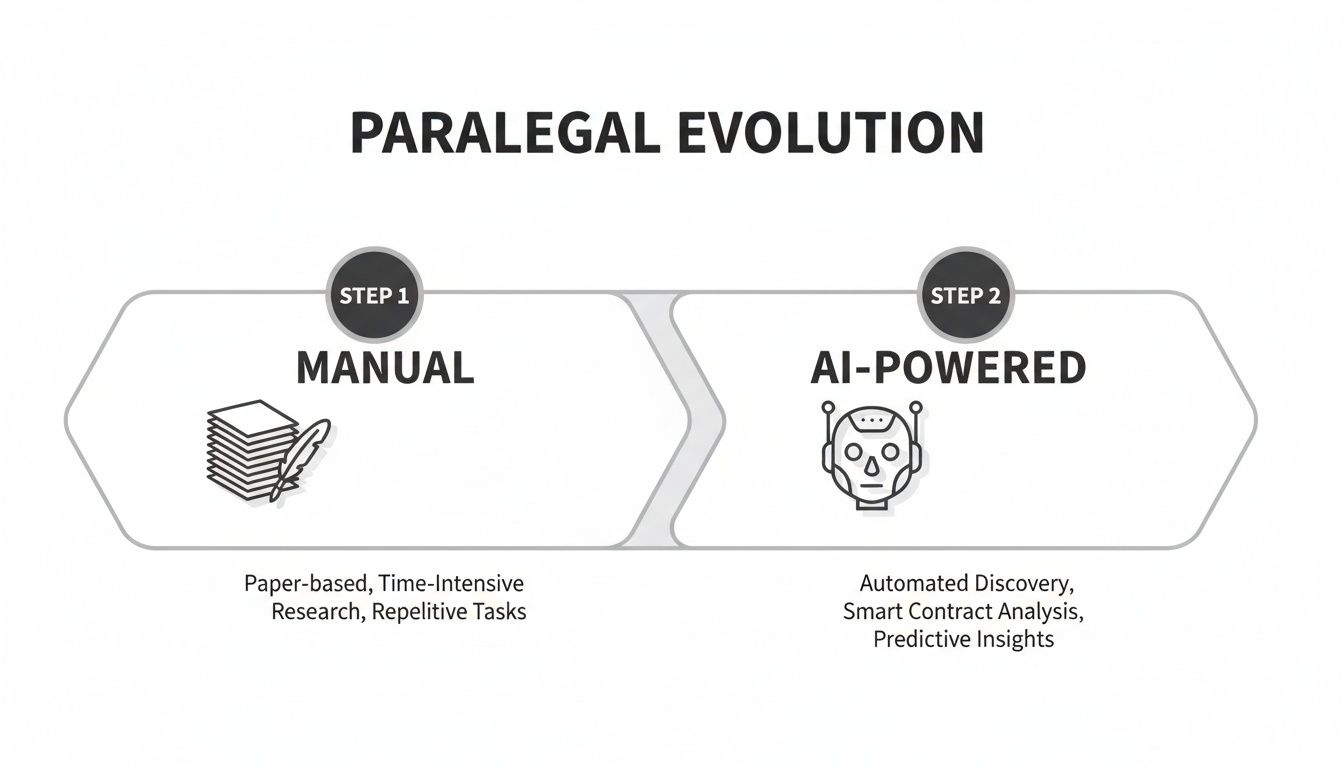
Picture the traditional paralegal’s desk, buried under stacks of paper. Every single page needs to be read, sorted, and manually entered into a system. It's a painfully slow process, and frankly, it’s wide open to human error.
Now, imagine a modern professional whose entire workflow is guided by an intelligent assistant that does all of that heavy lifting. This isn't science fiction; it’s the new reality made possible by the AI paralegal.
This evolution isn’t about replacing human expertise. It's about amplifying it. The AI acts as a tireless assistant, managing the monotonous but critical job of organizing immense volumes of documents in P&C claims and litigation. This frees up your team to dedicate their skills to what actually moves the needle: case strategy, nuanced legal analysis, and client communication.
Shifting Focus from Repetitive to Strategic Work
This partnership between human and machine allows legal and claims teams to move from a reactive posture—just trying to keep up with what comes in—to a proactive one. Instead of getting buried in administrative backlogs, professionals can pinpoint critical information faster, spot potential issues earlier, and make smarter, data-driven decisions.
Understanding why manual case document processing is no longer viable for law firms is the first step toward embracing this more efficient future.
The core idea is simple: let technology handle the volume and repetition, and let humans handle the judgment and strategy. This synergy is where the true value of an AI paralegal is unlocked, leading to greater efficiency and better outcomes.
The Future of the Paralegal Profession
It's natural to worry about job displacement, but the data tells a completely different story. Instead of making the role obsolete, AI is actually reshaping it and creating more robust job security backed by hard numbers.
There are currently 367,220 paralegals working in the U.S. Projections show an estimated 39,300 annual job openings through 2034, which points to sustained, healthy demand. This growth is fueled by AI's ability to automate the tedious work, allowing paralegals to pivot toward high-value tasks that require distinctly human skills like critical judgment, empathy, and strategic insight.
This shift sets the stage for smarter, faster decision-making in the high-stakes world of P&C claims.
How an AI Paralegal Transforms Claims Workflows
So, let's move past the theory. What does an AI paralegal actually do day-to-day in a real claims operation? It’s not a single tool you switch on; think of it as a set of capabilities that completely redesigns how work gets done. It takes the slow, manual steps we all know and turns them into fast, automated advantages.
It all starts with a much smarter way of handling documents. Forget manually downloading attachments from a chaotic inbox. An AI paralegal acts as a hyper-efficient digital mailroom, instantly organizing the flood of incoming information.
This shift from manual grunt work to intelligent automation is more than just an upgrade—it's a total evolution of the paralegal role.
Automated Intake and Intelligent Triage
First, an AI paralegal centralizes all incoming documents, automatically pulling them from emails, client portals, and direct uploads. But it doesn't just collect them—it intelligently triages everything on the spot.
The system can read and categorize thousands of documents in the time it takes to grab a coffee. It knows a police report from a medical record, instantly identifies what each document is, and organizes it perfectly. This step alone compresses hours of manual sorting into minutes.
Evidence Tagging and Analysis
Once the documents are in, the AI gets to work with intelligent evidence tagging. It dives into the content of photos, reports, and forms to pinpoint and label the information that matters most.
For example, it will spot the date of loss on an incident report, pull policy numbers from declarations pages, or even flag mentions of specific injuries in a medical summary. Suddenly, you have a structured, searchable, and instantly usable claim file instead of a pile of PDFs.
This is where the real power of an artificial intelligence paralegal shines, turning messy, unstructured data into clear, actionable insights.
A well-structured claim file is the foundation of an efficient claims process. By automating tagging and organization, an AI paralegal ensures consistency and completeness from the very first notice of loss, preventing downstream delays and errors.
Accelerated Draft Generation
We all know that drafting routine correspondence, summaries, and acknowledgments eats up a huge amount of time. An AI paralegal gives you that time back by generating accurate first drafts almost instantly.
Using the structured data it has already organized, the AI can produce template-based documents that a human professional can quickly review, tweak, and send. This isn't some far-off concept; it's happening right now. Recent analysis shows generative AI usage has climbed to 31% among legal professionals, with paralegals leading the pack. A massive 54% of them use AI for drafting correspondence, and 14% apply it to firm data analysis.
This trend is a perfect fit for insurance teams buried in high-volume claims, where tools that cut down manual triage and boost document collection by 77% deliver a clear competitive edge.
Proactive Gap Detection
One of the most valuable things an AI paralegal does is proactive gap detection. Instead of a human reviewer catching a missing document weeks into the process, the AI flags it immediately.
The system understands what a complete file looks like for different claim types and can instantly identify:
Missing Items: It will alert the team if a required police report or medical authorization hasn't been received.
Inconsistent Information: It cross-references dates, names, and other details across documents to flag discrepancies early on.
Unfulfilled Requests: The AI can even track document requests sent to third parties and follow up automatically.
This proactive approach stops bottlenecks before they start, keeping claims moving smoothly. You can learn more about how this works by reading our guide on automating routine legal and property and casualty claim workflows.
To truly grasp the shift in responsibilities, let's compare the old way with the new.
Manual vs AI-Powered Paralegal Tasks in Claims Processing
This table breaks down how specific paralegal tasks are transformed when augmented by AI, highlighting the move from administrative work to strategic oversight.
Core Task | Traditional Paralegal Approach (Manual) | Artificial Intelligence Paralegal Approach (Automated & Augmented) |
|---|---|---|
Document Intake | Manually download, name, and sort documents from emails and portals. | Automatically ingests documents from all sources and categorizes them instantly. |
File Organization | Create folders and manually organize files according to internal protocols. | Intelligently structures the entire claim file based on document type and content. |
Evidence Tagging | Read through every document to find and note key details like dates and names. | Scans content to automatically tag key evidence, entities, and data points. |
Drafting Documents | Write routine letters, summaries, and acknowledgments from scratch or templates. | Generates accurate first drafts for human review, pre-populated with claim data. |
Gap Analysis | Periodically review the file to see if anything is missing. | Proactively flags missing documents or data inconsistencies in real-time. |
Risk Assessment | Rely on experience and manual review to gauge a claim's complexity. | Provides an initial, data-driven risk score based on an analysis of all documents. |
As you can see, the AI doesn't replace the paralegal; it elevates them. It takes over the repetitive, low-value tasks, freeing up human experts to focus on analysis, strategy, and high-impact decisions.
Contextual Risk Scoring
Finally, an AI paralegal delivers contextual risk scoring. By analyzing the initial batch of documents, it gives adjusters and legal teams a data-driven first look at a claim's potential complexity, cost, and litigation risk. This score is a game-changer for caseload management, ensuring high-risk files get immediate attention while routine claims are processed efficiently. It's about allocating your best resources more effectively, right from day one.
The Business Case for AI in Legal and Insurance
Bringing an artificial intelligence paralegal into your workflow isn't just about adopting new tech—it's a strategic business decision with a clear and compelling return on investment. For carriers, third-party administrators (TPAs), and law firms, the results aren't theoretical. They're measurable, hitting the bottom line and making operations more resilient.
The most immediate and dramatic benefit is pure speed. By automating the soul-crushing manual work of collecting documents, sorting evidence, and doing initial analysis, you can light a fire under the entire claims lifecycle. This isn't a small tweak; it's a fundamental shift in velocity.
And, of course, that newfound speed translates directly into major cost reductions.

Driving Down Costs and Boosting Efficiency
When you resolve claims faster, the operational costs tied to them just melt away. An artificial intelligence paralegal gives your team the power to handle a much higher volume of work without needing to hire more people. This is a massive advantage, especially when dealing with catastrophic (CAT) events or complex subrogation cases.
The result is a significant drop in the average cost-per-claim.
This efficiency comes from cutting out thousands of non-billable hours that used to be burned on administrative grunt work. Instead of paying skilled professionals to sort emails and tag documents, their time is freed up for high-value activities that actually move the needle—like negotiation, strategy, and client communication. In high-stakes situations, AI's ability to process discovery files can shrink tasks that took hours down to minutes. Some teams are seeing up to four times faster claim resolution without adding a single person to their payroll.
Achieving Audit-Ready Consistency at Scale
Beyond speed and cost, a huge business advantage is achieving audit-ready consistency. Let's be honest: manual processes are messy. Different people organize files in slightly different ways, and that inconsistency can turn into a nightmare during an audit or when a case gets handed off.
An AI-driven workflow imposes a standardized, logical structure on every single claim file. Every document is categorized, tagged, and organized using the same rules, every single time. No exceptions.
This creates a clean, predictable, and easily defensible record. For anyone in a risk or compliance role, this is gold. It guarantees that every action is documented and that the entire file can be reviewed, audited, or produced during discovery without any last-minute panic.
An AI paralegal acts as a guardian of process, ensuring every claim file is built on a foundation of structured, consistent data. This not only speeds up resolution but also hardens an organization's compliance and risk posture.
Gaining a Sustainable Competitive Advantage
Ultimately, the business case boils down to building a more resilient and competitive operation. Firms and carriers that embrace an artificial intelligence paralegal can simply offer faster service, handle bigger caseloads, and operate with a level of precision their competitors can't match.
This creates a powerful competitive moat. While other teams are buried in administrative backlogs, AI-powered teams are already focused on their next strategic move. They can scale up to meet a surge in demand during a crisis and still maintain high-quality standards without burning out their staff.
The benefits all feed into each other, creating a powerful cycle of improvement:
Faster Intake: Automating document collection immediately slashes the time it takes to get a file ready.
Lower Operational Costs: More efficiency means a lower cost-per-claim and, ultimately, higher profitability.
Improved Compliance: Consistent, structured files make audits smoother and reduce regulatory headaches.
Enhanced Scalability: Your team can manage sudden spikes in claim volume without sacrificing quality.
By moving past manual methods, organizations unlock more than just savings—they unlock a more strategic, data-driven way to manage claims. For a deeper dive into these advantages, check out our guide on the top benefits of artificial intelligence claims processing for insurance. This isn't some far-off future concept; it's the new standard for high-performing legal and insurance teams.
Your Practical Roadmap for AI Implementation
Bringing an AI paralegal into your workflow isn’t some massive, complicated IT project. Think of it less like building a new system from the ground up and more like onboarding a highly specialized, pre-trained expert for your team. A successful rollout follows a simple, logical path focused on preparation, connection, oversight, and adoption.
We've broken it down into a straightforward, four-step roadmap. This isn't about theory; it's a practical guide to get you from your current state to a smarter, AI-assisted operation without blowing up your existing workflows.
Step 1: Prepare Your Data
First things first: you have to get your data ready. An AI is only as good as the information it can see and understand. This doesn't mean you need to launch a massive data-cleansing project. It's much simpler than that.
Just start by mapping out where your claim documents actually live. For most firms, that means:
Email Inboxes: Those specific mailboxes where new claims, medical records, and correspondence first land.
Client Portals: The secure sites where clients upload their documents.
Claims Management Systems (CMS): Your main system of record where the core file lives.
The goal here is just to give the AI a map, telling it exactly where to look for new information. Modern platforms like Wamy are designed to plug directly into these common sources, so this step is more about configuration than a heavy technical lift.
Step 2: Integrate Your Core Systems
Next, you need to connect the AI to your team's daily tools. The real magic happens when an AI paralegal isn’t a separate, clunky application but works seamlessly inside the software your people already use every day. This creates a single source of truth and stops the frustrating back-and-forth between different programs.
A good integration connects the AI platform to your email client and your CMS. When a new claim comes in, the AI can automatically grab the documents, organize them, and then push that structured, clean data right back into your main system. It creates a smooth, uninterrupted flow where the AI handles the grunt work, feeding your adjusters and paralegals perfectly organized information right where they expect to find it.
This isn't about ripping and replacing your current tech. It's about making it smarter. A well-integrated AI acts as an intelligent layer over your existing infrastructure, supercharging its capabilities without forcing your team to learn a whole new way of working.
Step 3: Establish Governance and Oversight
With the tech pieces connected, the focus shifts to control and quality. Bringing in AI doesn’t mean you hand over the keys and hope for the best. It’s actually the opposite—it's about setting up clear rules of the road to ensure accountability. A non-negotiable part of this is a human-in-the-loop process.
Here’s how it works: the AI does the initial heavy lifting—the triage, the tagging, the first-pass analysis. But a human expert always has the final say. Your team is there to review the AI’s output, validate its conclusions, and make the critical judgment calls. You get the speed of automation paired with the nuanced, strategic thinking of your best people. It's the best of both worlds.
Step 4: Drive Adoption with Change Management
Finally, and this is the step people often forget, you have to manage the change. The most powerful tool in the world is useless if nobody on your team wants to use it. Real adoption comes from clear communication, good training, and showing people how this makes their jobs better, not harder.
Start with the "why." Explain how the AI paralegal is going to kill off the tedious, soul-crushing tasks they hate—like manually sorting through hundreds of emails or tagging documents one by one. Show them how it frees them up to focus on the more interesting, high-value work.
Then, give them hands-on training that’s relevant to their specific roles. When your team sees for themselves how the AI can turn three hours of administrative drudgery into ten minutes of review, they won't need much more convincing. That’s when you get real buy-in and a true return on your investment.
Measuring the Success of Your AI-Enhanced Team
Bringing an AI paralegal into your workflow is a major move, and you've got to prove its worth with hard numbers. It’s not enough to just feel more efficient. To make a compelling business case, you need to show a clear, data-backed return on your investment.
The secret is to start before you even begin. You need to capture a baseline of your team's current performance before flipping the switch on a platform like Wamy. Only by comparing the before and after can you tell a powerful story about the impact on your bottom line.
Identifying Your Core Metrics
To get a real sense of the ROI, you need to focus on metrics that matter: time, cost, and workload. These are the numbers that resonate with leadership and show the practical value of adding an AI paralegal to the team.
Start by tracking these four essential KPIs:
Claim Intake Velocity: How long does it take from the moment a claim is reported (FNOL) until the file is fully organized, triaged, and sitting on an adjuster's desk for its first real review? Shortening this window means your team gets to the strategic work faster.
Manual Triage Reduction: This one is straightforward. Count the hours your team sinks each week just downloading, opening, reading, and sorting new documents. Your goal is to see this number plummet as the AI takes over the grunt work.
These initial metrics paint a clear picture of the efficiency gains right at the front door of your claims process, showing how much faster and with less manual effort a file gets action-ready.
Capturing a baseline for these KPIs before you go live creates an undeniable before-and-after narrative. This data-driven approach shifts the conversation from subjective feelings to an objective demonstration of value.
Tracking Downstream Business Impact
While front-end speed is a great start, the real win is improving the entire claims journey. To see the full picture, you also need to measure KPIs that show how efficiently files are handled from start to finish and where you're saving money.
These metrics connect the time saved upfront to real business outcomes, proving the technology doesn't just make work faster—it makes it smarter and more cost-effective.
Claim Resolution Cycle Time: This is the big one. Track the average number of days from when a claim opens to when it's fully closed. For any claims operation, driving this number down is a primary objective.
Cost Per Claim: This KPI gets right to the bottom line. By calculating the internal operational costs to handle a claim (mostly staff time), you can show a clear drop as automated workflows become the norm. A lower cost per claim is one of the most powerful signs of a successful AI implementation.
Key Performance Indicators for AI Paralegal Integration
To prove the tangible ROI of an AI claims intelligence platform, you need to track the right metrics before and after implementation. This table breaks down the essential KPIs that tell the story of your success.
KPI | What It Measures | Metric Example |
|---|---|---|
Claim Intake Velocity | The speed from first notice of loss to a fully prepared claim file. | Average time reduced from 48 hours to 6 hours. |
Manual Triage Reduction | The decrease in human hours spent sorting and organizing documents. | 75% reduction in time spent on manual document review. |
Resolution Cycle Time | The average time from opening to closing a claim. | Average cycle time shortened from 90 days to 60 days. |
Cost Per Claim | The direct operational cost associated with handling one claim file. | Average internal handling cost lowered by 30%. |
By consistently tracking these specific, measurable outcomes, you can move beyond simple anecdotes. You'll have a clear, data-driven story that proves the value of your AI paralegal program and justifies continued investment in smarter claims technology.
Navigating Security and Compliance in an AI Environment
When you're handling sensitive claimant information and confidential legal documents, security isn’t just a feature—it's the foundation of everything. Bringing an artificial intelligence paralegal into your workflow means you're entrusting it with your most critical data. For leaders in the legal and insurance sectors, this is where the conversation has to start.
Vetting a potential AI partner demands a sharp eye for their security posture. Look for providers who can back up their claims with rigorous, independent verification. Certifications like SOC 2 are a strong indicator, confirming a vendor meets high standards for security, availability, and confidentiality. In the same vein, HIPAA readiness is non-negotiable if you're dealing with any protected health information (PHI).

Core Security Pillars for AI Platforms
Beyond the badges and certifications, your due diligence needs to dig into the specific security controls the platform actually has in place. Think of these measures as a layered defense, protecting data at every single stage of the claims process.
Here are the key security controls to verify:
Data Encryption: All data absolutely must be encrypted, both while it's moving between systems (in transit) and while it's sitting on servers (at rest). This ensures that even if data were somehow intercepted, it would be completely unreadable.
Role-Based Access Controls (RBAC): Let's be real—not everyone on your team needs to see every piece of information. RBAC locks this down, ensuring users can only view and interact with data directly relevant to their role. It’s a simple way to minimize internal risk.
Regular Security Audits: The platform should be undergoing frequent, third-party penetration testing and vulnerability scans. This is about proactively finding and fixing potential security weaknesses before they can ever be exploited.
Choosing a Purpose-Built Solution
Finally, there’s immense value in choosing a platform built from the ground up for the tough compliance demands of the legal and insurance industries. Generic AI tools, as powerful as they might seem, often lack the domain-specific security architecture needed to handle the unique nuances of P&C claims and litigation files.
A purpose-built AI paralegal understands the context of the data it processes. This allows for far more intelligent and secure handling of sensitive information—a specialization that is absolutely crucial for creating defensible, consistent, and audit-ready outcomes at scale.
Platforms like Wamy were designed from day one for this exact environment, building security into every single feature. When you adopt an AI that actually strengthens your security posture, you can innovate with confidence, knowing your data is protected by industry-leading standards.
Your Questions About AI Paralegals, Answered
Stepping into the world of artificial intelligence paralegals naturally brings up some important questions. Here are some of the most common ones we hear from legal and insurance pros who are thinking about making the shift, along with some straight-ahead answers.
Will an AI Paralegal Replace Our Staff?
Not a chance. The goal here is to augment your team, not replace it. Think of an AI paralegal as a powerful assistant that handles the tedious, repetitive work—sorting documents, tagging evidence, and creating initial drafts.
This frees up your human paralegals to do what they do best: focus on high-value, strategic work that demands critical thinking. We're talking about complex case analysis, nuanced client communication, and final decision-making. The tech empowers your people, letting them handle more claims with greater efficiency and contribute more meaningfully to the outcome.
How Does an AI Handle Confidential Information?
For any platform built for legal and insurance, security isn't just a feature; it's the foundation. The leading systems are designed with enterprise-grade security from the very start to protect sensitive claim information.
When you're looking at different options, there are a few non-negotiables to check for:
SOC 2 Certification: This is the gold standard, proving a vendor is serious about security, availability, and confidentiality.
HIPAA Readiness: Absolutely essential if the platform will touch any protected health information (PHI). It ensures strict privacy rules are followed.
Robust Data Encryption: Your information must be locked down tight, both when it's moving (in transit) and when it's stored (at rest).
Strict Access Controls: This means people only see what they need to see. Role-based access ensures team members can only view data relevant to their job.
These measures aren't just buzzwords; they’re how you ensure all sensitive information is protected according to the highest industry standards.
What Does Implementation Look Like?
It’s more of a phased rollout than a disruptive overhaul. The process is designed to integrate smoothly with the tools you already use, like your claims management system and designated email inboxes.
A good partner will work with you to configure the AI to understand your specific workflows and document types right from the get-go. While every company is different, most teams start seeing early wins within weeks—often a huge drop in manual triage time. The bigger ROI, like a lower cost-per-claim, typically becomes clear within the first few quarters.
The core idea is to enhance your existing systems, not force you to rip and replace everything. A successful implementation makes your current workflow smarter and faster, without making your team learn a whole new process from scratch.
Can an AI Adapt to Our Specific Documents?
Yes, absolutely. Adaptability is what makes a purpose-built artificial intelligence paralegal so effective. These platforms come pre-trained on a massive library of legal and P&C insurance documents, so they already speak your language.
During setup, the system is fine-tuned to recognize your organization’s unique forms, letters, and evidence types. It quickly learns to tell the difference between a police report, a medical bill, and a property damage estimate, then tags and sorts them exactly how you would. This ensures the AI's output is always relevant and perfectly aligned with how you operate.
Ready to see how an AI-powered co-pilot can transform your claims process? Wamy turns raw data into confident, audit-ready decisions, helping teams resolve claims up to four times faster. Schedule a demo today to learn more.