Introduction
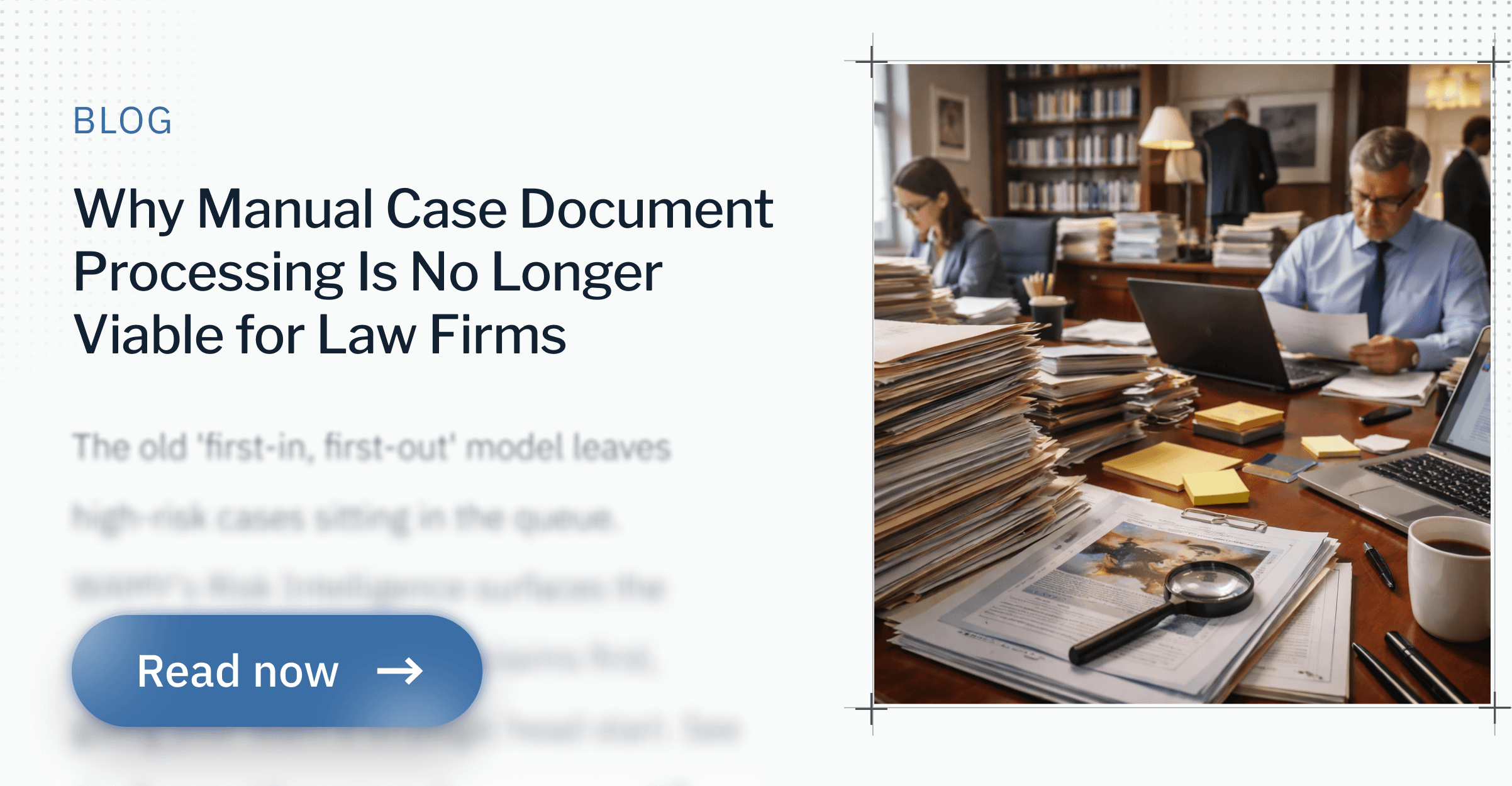
Law firms today operate in a fundamentally different environment than they did even a decade ago. Case files—especially in property damage, insurance, and complex civil litigation—have grown dramatically in size and complexity. A single case can include thousands of photographs, inspection reports, estimates, policies, court filings, emails, and third-party documents.
Despite this shift, many firms still rely on largely manual workflows to intake, review, organize, and process case documents. What once worked for smaller, slower-moving cases has become a structural weakness. Manual case document processing is no longer just inefficient—it actively limits a firm’s ability to assess case value, manage risk, and grow sustainably.
Inefficiency Across the Entire Case Lifecycle
Manual processing creates friction at every stage of a case, starting from intake.
At the intake stage, firms often receive documents through email, shared links, portals, or physical files. These materials arrive unstructured and inconsistent—photos without context, PDFs without clear naming, and documents mixed across timelines. Before a case can even be evaluated, staff must manually download, rename, sort, and categorize everything.
As the case progresses, additional inefficiencies compound:
Documents must be reviewed one by one
Photos must be interpreted visually to determine relevance and severity
Key data points must be manually extracted
Information must be re-entered into CRMs and case management systems
By the time this work is completed, firms sometimes realize that the claim or case is not economically viable to pursue. The result: hours or days of administrative effort invested into a case that ultimately isn’t worth handling.
Human Error Becomes Inevitable
Manual workflows depend heavily on human attention and memory—both of which degrade under volume and time pressure.
Errors can originate from multiple sides:
Clients may send incomplete, duplicate, or incorrect documents
Administrative staff may mislabel or misfile evidence
Paralegals may overlook inconsistencies or missing materials
A common example occurs with court documents and deadlines. When dates are manually extracted from filings and entered into calendars, a single typo or misread date can result in missed deadlines, scheduling conflicts, or unnecessary risk exposure. These errors are rarely intentional—they are a natural outcome of repetitive manual tasks performed at scale.
Limited Accessibility and Weak Collaboration
Manual document processing often leads to fragmented information. Case materials live across email threads, shared drives, local folders, and multiple software tools. This makes it difficult for teams to maintain a shared, up-to-date understanding of a case.
For legal professionals, this means:
Time wasted searching for the “right” version of a document
Re-sending files that already exist elsewhere
Inconsistent case knowledge between team members
Slower onboarding of new staff or external experts
Remote work and multi-office collaboration only magnify these challenges. When access to documents is slow or incomplete, collaboration suffers and decision-making slows down.
Rising Administrative Costs
Manual document handling is expensive—often more expensive than firms realize. As document volumes grow, firms must dedicate more staff time to non-billable administrative tasks such as organizing files, reviewing evidence, and entering data.
To keep up, firms frequently:
Hire additional administrative or paralegal staff
Accept longer case preparation timelines
Absorb higher operational overhead
In an environment where margins are under constant pressure, continuing to allocate skilled labor to manual processing becomes increasingly difficult to justify.
Scaling Case Volume Becomes a Hard Limit
One of the biggest weaknesses of manual processing is its inability to scale. A firm’s capacity to handle cases becomes directly tied to staff availability. There is a fixed ceiling on how many files a team can realistically process without sacrificing speed or quality.
As intake increases:
Review backlogs grow
Turnaround times slow
Quality becomes inconsistent
This creates a growth bottleneck. Demand may exist, but operational limitations prevent firms from confidently taking on more cases.
Compliance and Security Risks
Manual handling of sensitive legal and client information increases exposure to compliance and security risks. Physical files, email attachments, and local storage all increase the chances of unauthorized access, data loss, or accidental disclosure.
Meeting data protection and confidentiality requirements becomes harder when document control relies on manual discipline rather than structured systems. The consequences—legal, financial, and reputational—can be significant.
Conclusion
Manual case document processing was built for a different era. In today’s document-heavy legal environment, it introduces inefficiency, error, cost, and risk at nearly every stage of a case. It limits collaboration, restricts growth, and forces legal professionals to spend valuable time on work that doesn’t require legal judgment.
This is why many modern firms are reassessing how they handle documents and evidence, and why technology-driven approaches—such as those enabled by platforms like Wamy AI—are becoming a strategic necessity rather than a nice-to-have.
The firms that adapt are not replacing legal expertise; they are protecting it—by removing the manual burden that no longer makes sense.