
That first phone call is a moment of truth. A potential client is reaching out, often in a moment of crisis, looking for an expert they can trust. For far too many law firms, though, that call is a massive missed opportunity.
Your intake process isn't just another administrative step—it's the very gateway to new business. If that gateway is slow, disorganized, or unresponsive, you are actively turning away revenue every single day.
How Your Intake Process Is Quietly Losing Clients
Think of all the money you spend on marketing—the ads, the SEO, the referrals. You're pouring all that effort into a bucket, trying to fill it with promising leads. But a clunky, outdated intake process is like having a dozen holes in that bucket. Good clients are leaking out before you ever get a chance to speak with them.
Every missed call, every delayed email, every fumbled data entry is another crack widening. This isn't some abstract problem; it's a measurable financial drain that's silently killing your firm's growth. While your team is busy with billable hours, the very system meant to bring in that work is failing.
The Staggering Cost of Unanswered Calls
The scale of this problem across the legal industry is almost hard to believe. U.S. law firms get an estimated 557 million calls each year, yet a jaw-dropping 35% of them go unanswered.
This isn't just bad service; it's a core driver of what experts call the industry's '$109 billion dollar problem' in missed revenue. That massive figure comes from millions of lost client opportunities every year, a topic explored in depth on LawLeaders.com.
This points to a fundamental disconnect. When a potential client calls, they need help now. If they hit voicemail or have to wait hours for a follow-up, they don't sit by the phone. They just move on to the next firm on their list—the one that was ready to answer.
A modern law firm intake service turns this huge vulnerability into your biggest competitive advantage. It’s not just about answering phones. It’s about creating a proactive, efficient system that captures every single lead, qualifies them instantly, and delivers a seamless first impression.
Making the shift from a reactive, manual process to a strategic, tech-driven one is no longer just an operational upgrade. In today's legal market, it's a non-negotiable strategy for financial stability and growth.
Designing a Client-Winning Intake Workflow
Let's move from theory to practice. A world-class law firm intake service isn't just one thing you do; it's a sequence of carefully designed stages that guide a potential client from their first phone call to a signed retainer. The whole point is to make this journey seamless, professional, and impressively fast.
The process kicks off the second a lead reaches out—whether that’s a call, a web form, or a text message. A winning workflow grabs every single inquiry the moment it comes in, regardless of the channel. This is where so many firms drop the ball. Even a small delay can send a great client straight to a competitor who was just a little quicker on the draw.
This flow shows just how fast a missed call turns into a lost client and wasted marketing dollars.
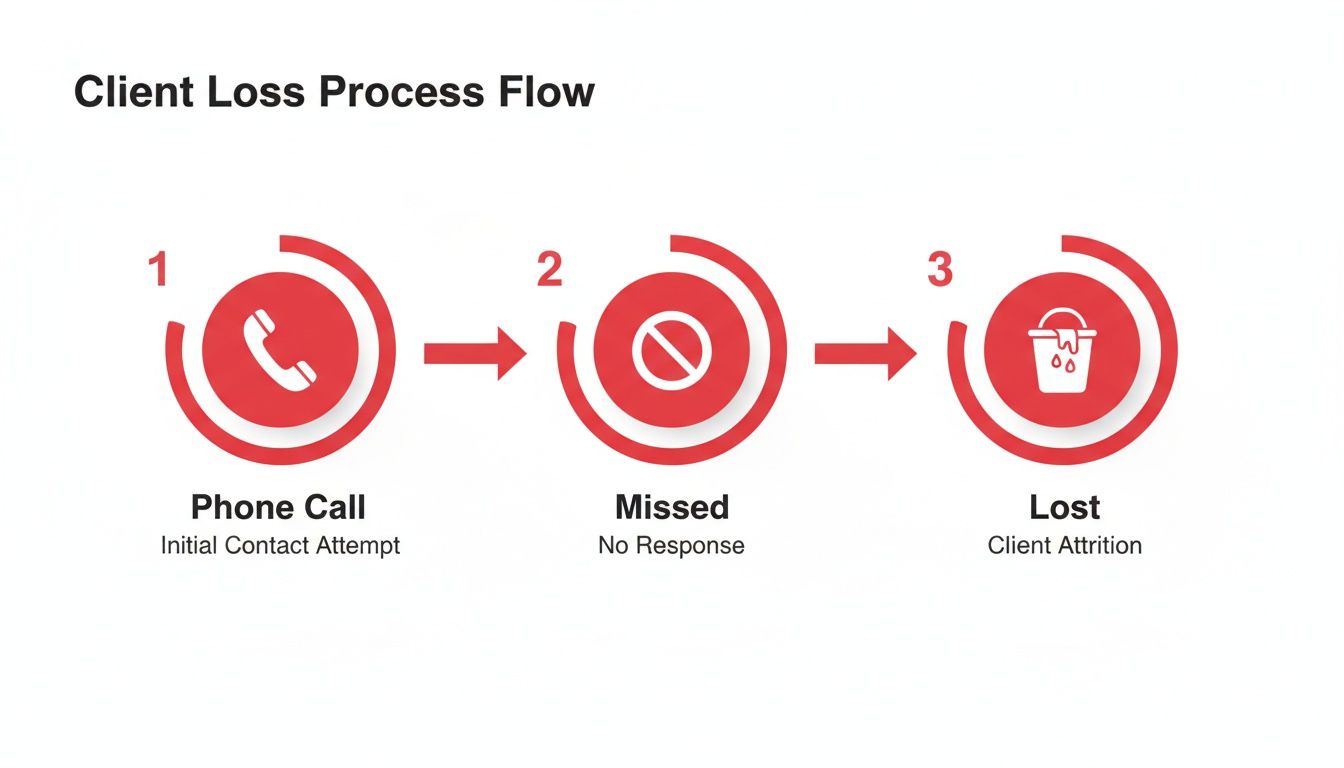
As you can see, the path from a potential client calling to that lead going cold is dangerously short. It really drives home the need for an immediate, effective response system.
The Core Stages of an Effective Intake System
Once you’ve captured that lead, the workflow needs to move them systematically through a few crucial checkpoints. Think of each stage as an opportunity to build trust and show off your firm's efficiency.
Automated Qualification: The system should instantly ask a few key questions to see if the potential client is a good fit. This stops your legal team from wasting time on unqualified leads and gives the prospect a quick answer.
Conflict Checks: Before you get too far, an automated check against your firm's database is non-negotiable. It’s a critical risk management step that technology can knock out in seconds, protecting your firm from potential conflicts of interest.
Secure Document Gathering: The system should offer a secure, easy-to-use portal for clients to upload their documents. This gets rid of the frustrating email back-and-forth and keeps all their sensitive data in one protected, centralized spot. You can dive deeper into optimizing this with our guide on AI intake forms for property casualty claims management.
Effortless Scheduling: Once qualified, leads should be able to book a consultation directly on your calendar without anyone needing to intervene. They find a time that works for them, and it’s done.
E-Signature and Retainer: The final step is sending the retainer agreement for a secure electronic signature. Modern e-signature platforms make this dead simple, letting you lock in new clients in minutes, not days.
By mapping out these distinct stages, you can audit your current process and see exactly where the bottlenecks are causing friction and costing you clients.
A modern law firm intake service uses technology to stitch these stages together, creating a smooth and professional experience that flat-out wins more business.
The Role of AI in Modern Legal Intake
In today's legal world, the firms that thrive are the ones embracing technology. Think of Artificial Intelligence not as a robot replacement for your team, but as a tireless ‘digital paralegal.’ It’s the team member who flawlessly handles the repetitive, time-consuming intake tasks, 24/7, without ever needing a coffee break.
This frees up your human staff to do what they do best: focus on high-value client interaction, build relationships, and tackle complex legal work. AI isn't some futuristic concept anymore; it's a practical tool that dramatically expands a firm's capacity and cuts down on human error.

How AI Powers a Better Intake Experience
A modern law firm intake service uses AI to make sure no lead ever feels ignored or falls through the cracks. It works in a few key ways:
Instantaneous Response: AI-powered agents can answer calls, texts, and web forms the second they arrive. They provide immediate acknowledgment and gather the initial case details, giving your firm a massive competitive advantage.
Intelligent Document Analysis: Instead of paralegals spending hours sifting through files, smart systems can scan and analyze uploaded documents in minutes. They automatically identify key information, tag evidence, and even flag what’s missing from the file.
Automated Scheduling and Follow-Up: AI syncs with your firm's calendars to offer qualified leads available consultation slots, booking them on the spot. It also handles the follow-up sequences, ensuring consistent communication without anyone lifting a finger.
This isn’t about making your firm impersonal. It’s about making it radically more responsive and efficient—which is exactly what clients demand. You can learn more about how this technology reshapes the entire legal journey in our article on how Wamy AI transforms the legal process.
The Critical Impact of Speed
When it comes to legal intake, speed is everything. It's not just a nice-to-have; it's a dealbreaker.
In fact, 67% of legal clients pick a firm based on how quickly it responds to their first inquiry. Firms that answer within the first five minutes see a staggering 400% higher conversion rate compared to those that wait. That’s the difference between fleeting interest and a signed retainer.
One study found that personal injury practices using AI-driven intake slashed their response times to under 30 seconds, which led directly to a 40% jump in client conversions.
By handling the first, repetitive steps of the intake process, AI ensures every potential client gets a prompt, professional, and consistent experience. This doesn't just capture more leads; it sets a positive, modern tone for the entire relationship, positioning your firm as a client-focused leader from the very first touchpoint.
So, What's the Business Case for Upgrading Your Intake Service?
Thinking about a modern law firm intake service as just another expense is like comparing a paralegal's salary to the cost of a photocopier. It completely misses the point. This isn't about replacing a receptionist; it's a strategic move to build a more profitable and stable law firm.
The decision to upgrade really comes down to a clear-eyed look at the numbers. The return on this kind of investment rests on three solid pillars: capturing more revenue, slashing operational costs, and tightening up on compliance risks.
Too many firms get stuck in a flawed comparison: the cost of a service versus an in-house salary. A dedicated service isn't just answering phones. It's a scalable, 24/7 growth engine for your firm—something a single person, no matter how good they are, can never be.
Stop Leaking Cases and Start Converting More Clients
The most direct financial win comes from plugging the leaks in your client pipeline. Every call that goes to voicemail or every web form that sits unanswered for hours is a potential client you just handed over to your competition. It's that simple.
A modern intake service engages every single lead the moment they reach out, which dramatically boosts your chances of converting them into a paying client.
Think about where your lawyers are spending their time. Research shows that attorneys waste nearly half their day on administrative tasks that don't make the firm any money. By automating the first steps of intake, you free up your skilled legal team to focus on what they do best: high-value work like consultations and case strategy.
Here's a simple way to frame it: if an upgraded intake service helps you sign just one additional high-value case each quarter that you otherwise would have lost, it has likely paid for itself for the entire year. The goal is to turn your marketing dollars into actual profit, not just leads that go nowhere.
Cut Costs by Boosting Your Team's Efficiency
Beyond bringing in new business, a well-oiled intake process delivers some serious cost savings. Handling intake manually isn't just slow; it's incredibly expensive when you factor in the hidden costs. It burns through countless staff hours that could be put to much better use.
Let's break down where the money is really going in a manual system:
Wasted Paralegal Time: How many hours do your paralegals spend chasing down documents, playing phone tag, and just doing basic data entry?
Costly Attorney Involvement: Are your senior attorneys getting pulled into screening calls that a junior staffer or an automated system could easily handle?
The High Price of Human Error: A simple mistake, like a typo in a client's information or a missed conflict check, can lead to hours of rework or, in the worst-case scenario, a malpractice claim.
An automated law firm intake service swaps all those expensive, unpredictable manual hours for a fixed, predictable cost. You can handle a much higher volume of potential clients without having to hire more people. The result is a leaner, more profitable firm where technology handles the repetitive grunt work, letting your team focus on practicing law.
Measuring the Metrics That Matter for Intake Success
If you can’t measure your intake process, you can’t improve it. It’s that simple. To really understand the impact of an upgraded law firm intake service, you need to look past basic call counts and zero in on the key performance indicators (KPIs) that actually drive your firm’s revenue.
Tracking the right numbers is what turns intake from a necessary expense into a measurable growth engine. It gives you the hard data to see what’s working, spot bottlenecks before they cost you clients, and show partners the clear financial upside. Without this data, you’re just guessing.
Core KPIs for Intake Performance
These aren’t just vanity metrics; they give you a complete picture of your intake team’s efficiency and effectiveness. They tell you not just how busy your team is, but how good they are at converting a potential client’s interest into a signed retainer.
Lead Response Time: This is the clock that starts ticking the second a lead contacts you. It measures the average time it takes for your firm to make that first, critical engagement. In a world where clients hire the first firm that responds, this is arguably your most important metric. A low response time—measured in minutes, not hours—is the hallmark of a competitive intake process.
Consultation Booking Rate: This KPI shows the percentage of qualified leads who actually book an initial consultation. A high booking rate is a sign that your intake specialists are doing a great job of communicating your firm’s value and making it easy for people to take that next step.
Lead-to-Client Conversion Rate: This is the bottom line. It’s the percentage of all leads that ultimately become signed, paying clients. This number connects your intake efforts directly to revenue, giving you a real-time health check on your entire client acquisition pipeline.
To get a handle on how your intake service is performing, you need a clear way to measure its effectiveness and return on investment.
Here is a breakdown of the most essential KPIs every law firm should be tracking:
Essential KPIs for Law Firm Intake Performance
KPI | What It Measures | Industry Benchmark |
|---|---|---|
Lead Response Time | The average time from initial contact to first meaningful engagement. | Under 5 minutes for web forms/chats; immediate for calls. |
Consultation Booking Rate | The percentage of qualified leads that schedule a consultation. | Varies by practice area, but 70-85% is a strong target. |
Lead-to-Client Conversion Rate | The percentage of total leads that become signed clients. | 10-15% is a common baseline; top firms aim for 20%+. |
Cost Per Acquired Client (CPAC) | Total marketing and intake costs divided by new clients signed. | Aim for this number to consistently decrease over time. |
Tracking these numbers gives you an undeniable, data-backed view of your intake performance. When you see your response times drop and your conversion rates climb, you know your investment is paying off.
Calculating the ROI of Your Intake Service
Understanding these KPIs is step one. The real magic happens when you use them to calculate a clear return on investment (ROI). A simple framework is all you need to prove the financial value of your system.
The core idea is to compare the cost of your intake service against the value of the new business it generates. If your improved system helps you sign just one additional client you would have otherwise lost, it often pays for the service for months.
A great place to start is by calculating your Cost Per Acquired Client (CPAC). Just add up all your marketing and intake expenses for a given period and divide that total by the number of new clients you signed. A modern law firm intake service should drive your CPAC down significantly by converting more leads with less wasted time and effort, proving its value in cold, hard cash.
Your Implementation Roadmap for a New Intake System
Making the switch to a new law firm intake service can feel like a massive project, but a clear plan makes all the difference between a painful transition and a smooth, successful one. A structured roadmap removes the guesswork, helping your firm sidestep common pitfalls and get enthusiastic buy-in from your team from day one.

The journey starts with an honest look at your current process. Map out every single step, from that first client phone call to the moment a retainer is signed. Where are the biggest bottlenecks? Is it slow response times? Disorganized data and missing documents? These pain points aren't just frustrations; they're the blueprint for your new system’s requirements.
Vetting the Right Technology Partner
Once you know what problems you’re actually trying to solve, you can start looking at potential vendors. This is about so much more than comparing price tags. You’re looking for a true partner who gets the unique demands of the legal world. To get a feel for the landscape, it’s worth exploring the top legal tech companies to watch in 2025 and seeing how the innovators are tackling these challenges.
As you evaluate your options, make sure you ask these critical questions:
Security and Compliance: How exactly do you protect our clients' sensitive data? Are you HIPAA-ready or SOC 2 certified? Get specific.
Software Integrations: Does your platform play nice with our existing case management software, like Clio or MyCase?
Onboarding and Training: What does your implementation process look like from your end? How will you help get our team up to speed?
Ongoing Support: What happens after we go live? What level of customer support can we realistically expect when we run into an issue?
A successful implementation isn't just about the technology. It’s about choosing a provider who offers rock-solid security, integrates with the tools you already use, and provides comprehensive training to make your team feel confident from the start.
Launching and Optimizing Your New System
The final stage is rolling out the new system and getting your team trained up. Don't go for a firm-wide launch on day one. Start with a small pilot group to iron out any kinks first. Give them clear documentation and hands-on training sessions that focus on how this new service directly solves their biggest past frustrations.
After the launch, the work isn’t over. Gather feedback regularly and keep a close eye on your key performance indicators. The goal here is continuous improvement—fine-tuning the system to squeeze out every bit of efficiency and deliver a client experience that sets you apart.
Common Questions About Modern Intake Services
Anytime you bring a new system into the firm, questions are bound to come up. When that system touches something as fundamental as your client intake, you need clear, straightforward answers. From our vantage point, we see the same concerns surface again and again when firm leaders consider upgrading their process.
Let's cut through the noise and tackle those questions head-on.
Can Small Firms Realistically Afford This Technology?
Yes, absolutely. This isn't the old world of massive, on-premise software with six-figure price tags. Modern intake platforms are built to be scalable and accessible. Most operate on flexible pricing models—think pay-per-lead or tiered monthly subscriptions—that eliminate the high, fixed cost of hiring another full-time staff member.
The ROI often shows up almost immediately. Think about it: signing just one or two new clients who would have otherwise been lost to a missed call can easily cover the service cost for an entire month. Because these platforms are cloud-based, there's no expensive hardware to buy or maintain, making advanced intake technology a practical investment for firms of any size.
Will an Automated Service Feel Impersonal to Clients?
Quite the opposite. A well-designed intake system actually makes the client experience better and more professional. Today's clients expect speed and efficiency. When a potential client reaches out, an instant, intelligent response that allows them to book a consultation right away doesn't feel robotic—it feels respectful of their time and their urgency.
The point of this automation isn't to replace the human touch. It's to handle the administrative grind so your legal team can have more meaningful, high-value conversations during the actual consultation. You're not outsourcing empathy; you're fast-tracking the paperwork to get to the real legal work faster.
How Can We Ensure Client Data Is Secure?
Data security is non-negotiable, and it should be a primary filter when you evaluate any vendor. Reputable providers in the legal tech space build their platforms with security as a core pillar, not an afterthought.
Here are the table stakes—the absolute minimum protections you should look for:
End-to-End Data Encryption: This ensures client information is protected whether it's being sent to you or stored on a server.
Compliance Certifications: Look for proof of security standards, like SOC 2 certification or HIPAA-readiness for firms handling health information.
Strict Access Controls: You need to know that only authorized people can view sensitive case files.
Before you sign anything, ask tough questions about their security protocols, where their servers are located, and what kind of background checks their employees undergo. A serious vendor will welcome this scrutiny and will willingly sign a robust confidentiality agreement. This isn't just about compliance; it's about protecting your firm's reputation and your clients' trust.
Ready to transform your intake process from a cost center into a growth engine? Wamy provides an AI-driven claims intelligence platform that automates document collection, evidence tagging, and risk assessment, helping you resolve cases up to four times faster. Discover how Wamy can streamline your firm's intake today.