Drafting in law isn't just about putting words on a page; it's the precise art of creating legally binding documents. Think of it less like writing and more like constructing a logical, airtight framework that clearly defines rights, obligations, and outcomes to shut down disputes before they can even start.
Why Legal Drafting Is Critical for P&C Claims
Imagine legal drafting as the architectural design for resolving a claim. A well-drafted document is the blueprint that ensures a claim is handled successfully and predictably. But if that blueprint is flawed? The entire structure of the resolution can collapse, leading to costly litigation, compliance headaches, and serious financial losses.
In the high-stakes world of Property and Casualty (P&C) claims, the precision of a demand letter, a reservation of rights, or a settlement agreement has a direct and immediate impact on the outcome. Just one ambiguous word or a poorly constructed clause can create a loophole big enough for opposing counsel to drive a truck through, turning a straightforward claim into a drawn-out legal battle.
The High Cost of Ambiguity
In legal drafting, ambiguity is the ultimate enemy. When terms are unclear, it opens the door to multiple interpretations—and that’s where most legal fights are born. For example, a settlement agreement that vaguely releases “all future claims” without specifying the scope could easily be challenged down the road, cracking open a case everyone thought was closed. The goal is to build a fortress of clarity that leaves zero room for misinterpretation.
This is where meticulous drafting becomes a powerful risk management tool. It forces every party to understand their exact position and responsibilities. The consequences of getting this wrong are steep:
Increased Litigation: Vague language almost always ends up in court, where a judge is forced to guess what the parties originally intended. That process is both expensive and unpredictable.
Financial Leakage: A poorly worded document can lead to overpaying on a claim or, just as bad, failing to recover funds in subrogation.
Compliance Penalties: Regulatory bodies often mandate specific language in certain communications. Miss it, and you could be facing hefty fines and sanctions.
A well-drafted document preemptively answers the questions that might be asked in a courtroom years from now. It acts as a silent, ever-present witness to the original intent, leaving no room for doubt.
From Reactive to Proactive
Mastering this skill shifts an organization’s entire posture from reactive—putting out fires as they pop up—to proactive. Every document becomes a chance to control the narrative, define the terms of engagement, and steer the claim toward a favorable and final resolution. This is especially true as claim volumes grow; manual drafting inevitably introduces inconsistencies that create widespread risk. You can explore more on why manual case document processing is no longer viable for law firms and see how it undermines consistency.
Ultimately, strong legal drafting is the bedrock for achieving consistent, compliant, and predictable outcomes for carriers, third-party administrators (TPAs), and law firms operating in the P&C space.
The Anatomy of Essential Claims Documents
To really get a handle on drafting, you have to see each document in the claims lifecycle for what it is: a specialized tool with a unique job. Let's move past generic definitions and dissect the core documents that drive P&C claims forward, from the first notice of loss to the final handshake. Each one is a strategic move, setting the stage for everything that follows.
Think of it like a mechanic's toolbox. You wouldn't use a wrench to hammer a nail. In the same way, you don't send a simple claim acknowledgment when what you really need is a Reservation of Rights letter. The subtle but critical differences in language are what separate a routine claim from a potential legal disaster.
Understanding the purpose and critical parts of these documents is the first step toward building a bulletproof claims file. This knowledge is the bedrock of effective communication, preserving your legal defenses, and ultimately, getting to the right outcome.
The process itself relies on a tight connection between precision, structure, and the final result, as this chart shows.
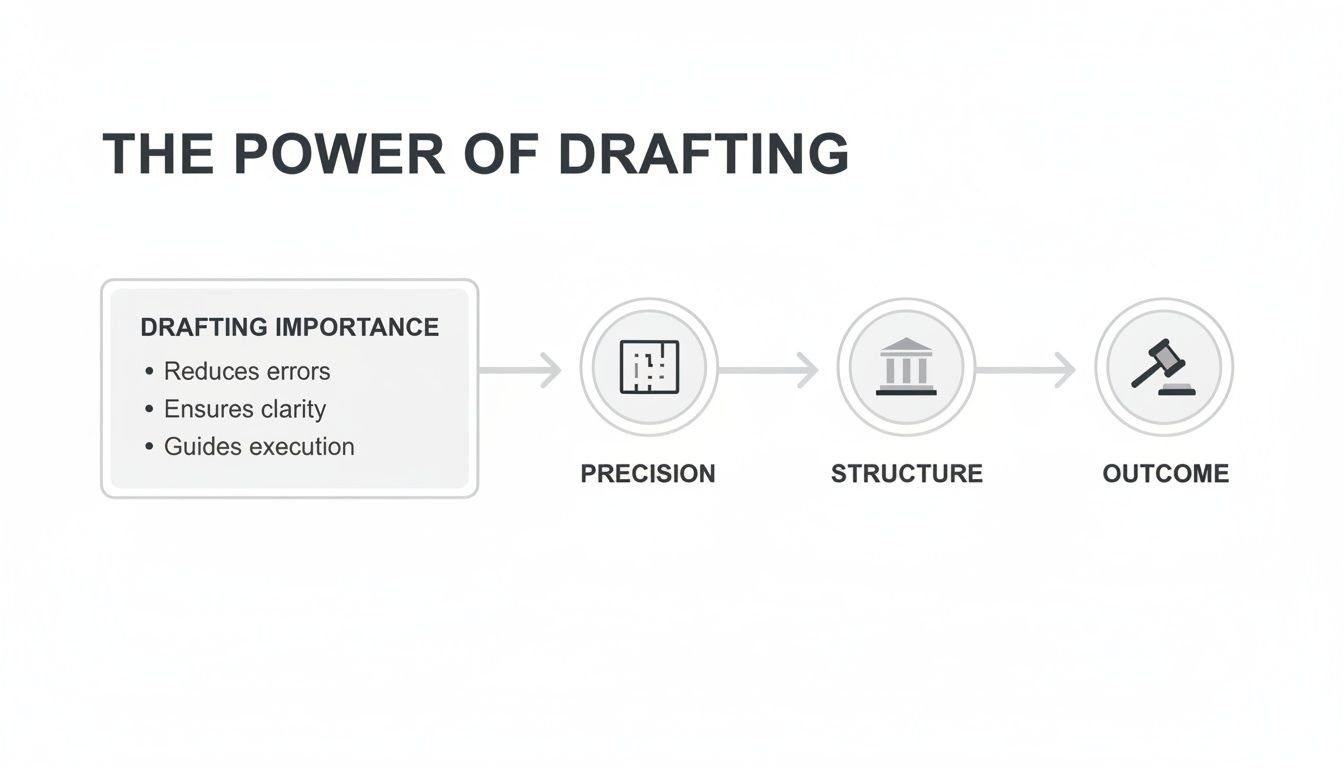
This visual gets to the heart of the matter: a document’s power comes from its precise language (the blueprint), its logical structure (the building), and its ability to lock in a final, enforceable outcome (the gavel).
To put this into practice, let's compare some of the most common documents you'll encounter in the P&C claims lifecycle. Each has a distinct role, and getting the details right is non-negotiable.
Key Legal Documents in the P&C Claims Lifecycle
Document Type | Primary Purpose | Critical Elements to Include | Common Drafting Pitfall |
|---|---|---|---|
Reservation of Rights (ROR) | Investigate a claim without waiving the right to deny coverage later. | Specific policy language, known facts of the claim, clear statement reserving rights. | Being too generic or vague, which makes the letter easy to challenge. |
Demand Letter | Formally demand payment for damages and initiate settlement talks. | Factual narrative of the incident, clear basis for liability, itemized damages. | Making an unsupported demand or failing to provide a logical damages calculation. |
Settlement & Release Agreement | Finalize settlement terms and release the insurer from all future liability. | All parties, scope of release (known & unknown claims), confidentiality, no admission of liability. | Ambiguous language that fails to fully release all parties from future claims. |
As the table illustrates, while each document aims to move a claim toward resolution, its specific function dictates what must be included—and what can go wrong if drafted carelessly.
Reservation of Rights Letters
A Reservation of Rights (ROR) letter is one of the most critical early-stage documents in any insurer's playbook. While it confirms the insurer is looking into a claim, its main job is to put the policyholder on notice that certain parts of the claim might not be covered. This document is what allows an insurer to investigate fully without accidentally waiving its right to deny coverage down the road.
The key to a solid ROR is specificity. A generic, boilerplate letter is practically an invitation for a legal challenge. A strong one must:
Quote the specific policy language that could prevent coverage.
Connect the known facts of the claim directly to that policy language.
State clearly that the insurer reserves its right to deny the claim based on those exact provisions.
Failing to issue a timely and specific ROR can trigger estoppel, a legal doctrine where the insurer is "estopped"—or blocked—from denying coverage later because its earlier actions suggested it would cover the claim.
Demand Letters
As a claim moves along, a Demand Letter almost always shows up. This document, usually from the claimant's attorney, formally demands a specific sum for damages. It’s a strategic play designed to frame the claimant's case in the best possible light and kickstart settlement negotiations.
A persuasive demand letter does more than just ask for money; it builds an argument. It methodically lays out the facts, pins down liability, details the claimant's injuries or damages, and presents a clear, calculated demand. When you're on the receiving end, you need a sharp eye to spot both the strengths and the weak points in their position.
A well-drafted demand letter is more than a request; it's a pre-litigation narrative. It tells a story intended to convince the opposing side that settling now is far more advantageous than facing the risks and costs of a courtroom battle.
Settlement and Release Agreements
The final act for many claims is the Settlement and Release Agreement. This legally binding contract is the end goal. Its purpose is to lock in the settlement terms and—most importantly—release the paying party from any and all future liability tied to the incident.
This is where absolute precision is non-negotiable. Any ambiguity can unravel the entire resolution. Every detail must be airtight, including:
The Parties: Clearly identifying every single person and company being released.
The Scope of the Release: Defining exactly which claims—both known and unknown—are being waived for good.
Confidentiality Clauses: Specifying if the settlement terms must be kept private.
No Admission of Liability: Stating that the payment isn't an admission of fault.
A poorly drafted release could easily fail to protect the insurer from future lawsuits, turning a closed claim file into a recurring legal nightmare. Each document has its moment and its purpose, and mastering them is fundamental to navigating the claims process.
Avoiding Common and Costly Drafting Mistakes
Every seasoned claims pro has a story about a single, poorly chosen word that ended up costing their company a fortune. In the world of legal drafting, tiny mistakes can have massive consequences. We’re not talking about simple typos; these are structural weaknesses that can cause an entire claim resolution to crumble under pressure.
It’s one thing to list out common errors, but it's another to truly grasp their real-world impact. Ambiguity, inconsistency, and relying on outdated language don’t just weaken a document—they actively invite disputes, delay settlements, and create financial risks you never saw coming. Getting good at drafting in law means learning to spot and kill these problems before they ever leave your desk.
The Peril of Ambiguity and Vague Language
Ambiguity is probably the most common—and dangerous—drafting mistake out there. When you use subjective or undefined terms, you’re essentially creating loopholes that opposing counsel will happily drive a truck through. Words like "reasonable," "promptly," or "materially" are litigation magnets unless you define exactly what you mean inside the document.
Think about a settlement agreement requiring a party to pay within a "reasonable time." What on earth does that mean? The paying party might think it means 30 days. The person waiting for the check could believe it means 72 hours. With one vague term, a document designed to end a conflict has just created a brand new one.
To fight this, you have to adopt a mindset of extreme clarity:
Define Your Terms: Always include a "Definitions" section for any word or phrase that could be interpreted in more than one way.
Use Concrete Timelines: Don't say "promptly." Say "within ten (10) business days."
Quantify Vague Concepts: Instead of "substantially complete," specify "95% completion as certified by a neutral third-party inspector."
This level of precision shuts down debate and ensures everyone is working from the same playbook.
The Hidden Dangers of Boilerplate Language
Grabbing old templates—what we call boilerplate—feels efficient, but it's a huge source of risk. Laws change, court interpretations evolve, and a clause that was perfectly fine five years ago might be completely unenforceable today. Copying and pasting from a past document without a deep, critical review is a recipe for disaster.
For example, a release of liability clause pulled from an old file might not account for a new state statute governing consumer rights. If that outdated clause gets challenged in court, a judge could toss out the entire agreement, reopening a claim everyone thought was closed for good.
The biggest risk with boilerplate isn't just that it might be outdated; it’s that it might be totally wrong for the specific facts of your current case. Every claim has its own unique fingerprint, and your documents must reflect that.
The Domino Effect of Inconsistency
When your claim documents contradict each other, you’re creating confusion and torching your own credibility. If a demand letter describes an incident one way, but a later settlement agreement paints a different picture, you’ve just handed the other side an argument that there was no true "meeting of the minds."
This problem gets much worse as teams grow and claim volumes explode. Between regulatory pressures and crushing caseloads, manual processes are buckling. From 2022 to 2023, the volume of legal documents needing digital handling shot up 38%, completely overwhelming traditional P&C claims workflows. You can learn more about the trends in legal document automation to see just how big this challenge is.
The only way to maintain consistency at scale is with a centralized system. Using a solid clause library and AI-assisted drafting tools ensures every document your team produces uses the same approved language for recurring situations. These tools act as a single source of truth, eliminating the dangerous variations that sneak in with manual drafting. To see how this works in practice, check out our guide on why general AI tools can be risky for property and casualty firms and what to demand from a specialized solution.
By sidestepping these common drafting mistakes, you're not just writing better documents—you're fortifying your legal position and paving the way for faster, more predictable resolutions.
Best Practices for Clear and Enforceable Drafting
Crafting a legally sound document isn't about using the most complex, archaic language you can find. Far from it. The best drafting in law is all about clarity and precision. The goal is to build documents that are not only enforceable but also easy for everyone involved to actually understand. When you take a systematic approach, you start to eliminate the ambiguity that causes problems down the road, strengthening your legal position from day one.
Think of this framework as a practical checklist. These are actionable principles you can apply right away to produce higher-quality legal documents, every single time. From sticking to plain English to structuring your arguments logically, these practices are the real foundation of drafting excellence.
Embrace Simplicity and Plain Language
The most effective legal documents are often the simplest. It can be tempting to fall back on convoluted jargon or "legalese," but if a straightforward term works, use it. Your goal is communication, not confusion. Using plain English ensures that everyone—from clients and adjusters to opposing counsel and judges—understands their rights and obligations without needing a translator.
This practice is your best defense against the kind of ambiguity that fuels disputes. For instance, instead of writing "prior to the aforementioned date," just say "before that date." It’s a small change, but it makes the document more accessible and cuts down the risk of misinterpretation.
A document is not truly strong until it is clear. Clarity is the ultimate defense against litigation, as it removes the gray areas where disputes are born. Make it your primary objective in every sentence you write.
Structure for Maximum Readability
A well-organized document is a persuasive one. It guides the reader through your logic, making your points easy to follow and much harder to challenge. Think of your document's structure as a roadmap—without clear signposts, your reader is guaranteed to get lost.
Use these structural elements to make your documents instantly more readable:
Logical Headings and Subheadings: Break down complex information into digestible sections. Descriptive titles help readers find exactly what they're looking for without having to hunt for it.
Numbered Lists and Bullet Points: When you're outlining criteria, obligations, or steps in a process, use a list. It's far easier to scan and comprehend than a dense block of text.
Short Paragraphs: Keep your paragraphs tight, ideally no more than three sentences. This creates welcome white space, prevents reader fatigue, and ensures your key points land with real impact.
Define Key Terms Upfront
Never, ever assume a term has a universally understood meaning. One of the most powerful tools in drafting in law is a dedicated "Definitions" section, placed right at the beginning of the document. This section serves as a glossary, locking in the precise meaning of critical terms you'll use throughout the agreement.
By defining terms like "Confidential Information," "Effective Date," or "Claim," you shut down any potential for future arguments over what something really means. This single practice can prevent countless hours of costly legal battles.
This kind of discipline is becoming even more vital as technology reshapes the legal field. Law firms are seeing huge productivity gains from AI-assisted drafting. In fact, Clio's 2023 Legal Trends Report found that legal professionals now handle 40% more cases and bill 70% more hours than in 2016, with revenue doubling—largely because of automation in document workflows. You can see the highlights from the 2023 Legal Trends Report for more details.
Maintain Meticulous Version Control
Over the life of any legal document, drafts will be revised, shared, and negotiated. Without a strict version control system, it’s dangerously easy to lose track of changes, leading to confusion, errors, and blown deadlines. This is especially true when multiple stakeholders are weighing in.
A clear naming convention (e.g., "Settlement_Agreement_v1.1_InitialDraft," then "Settlement_Agreement_v2.0_ClientReview") creates a clean and reliable audit trail. This isn't just about good housekeeping; it’s crucial for compliance, internal audits, and being ready for litigation. It ensures you can always trace the evolution of a document and prove which version was the final, agreed-upon iteration. If you want to dive deeper into this, you might find our article on automating routine legal and property and casualty claim workflows interesting.
How AI Is Reshaping Legal Document Drafting
Let’s be clear: the future of legal drafting isn’t about replacing skilled professionals. It's about giving them an intelligent co-pilot. Modern AI platforms are a world away from the clunky templates of the past. Think of them less as a word processor and more as a central nervous system for the entire drafting workflow, turning a messy, manual process into a structured, data-driven operation.
This is a direct answer to the classic pitfalls that create risk—things like inconsistency and ambiguity. Instead of relying on human memory or hunting through scattered files, these systems centralize intake data, analyze evidence automatically, and suggest contextually relevant clauses based on the specific facts of a claim. This creates a powerful loop where data informs drafting, and the drafting process refines the data.
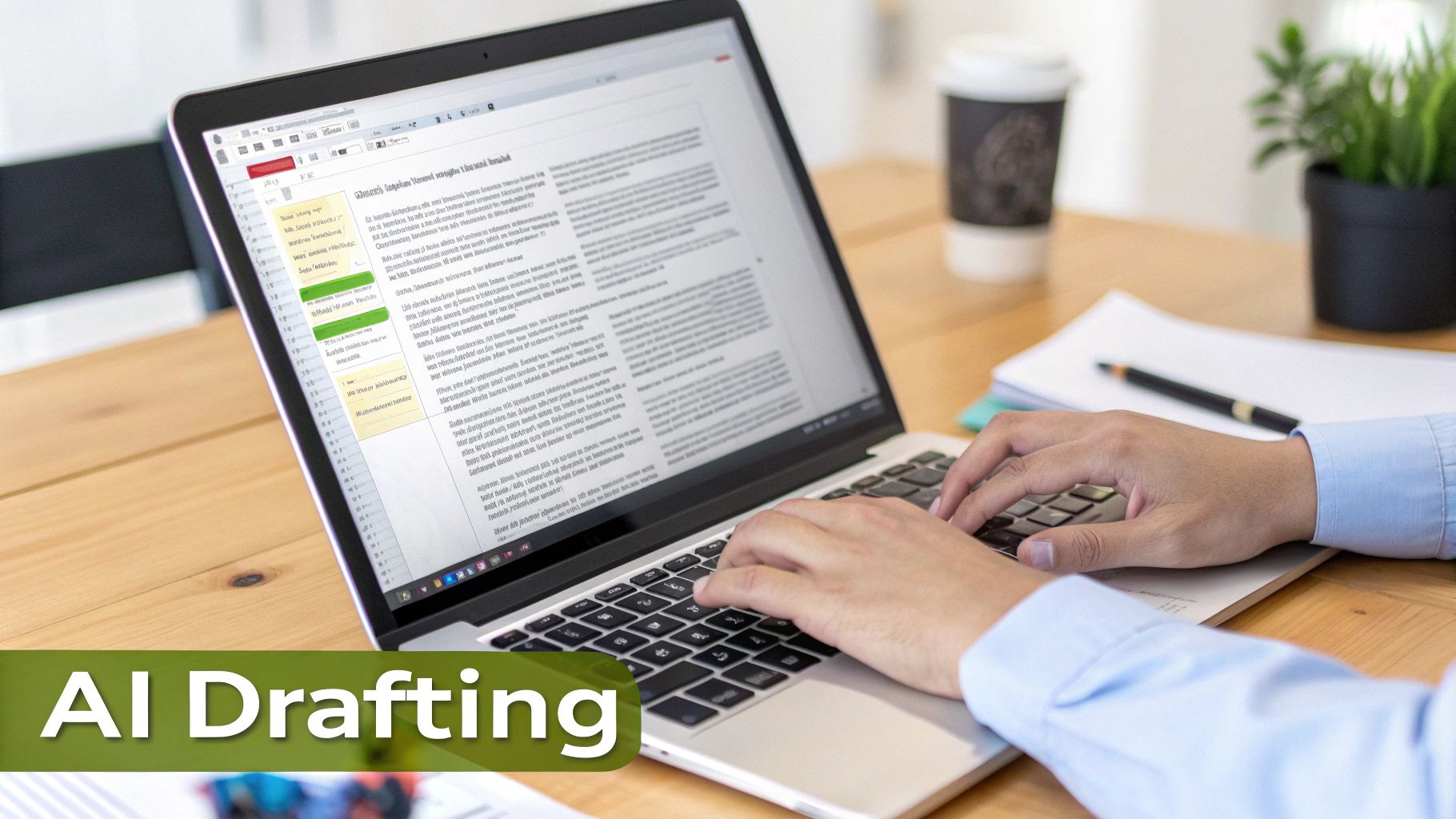
This screenshot from Wamy shows how a modern claims intelligence platform can automatically structure and present evidence for review, which is the foundation for more accurate drafting. By pulling all the claim information into one place, these tools create the single source of truth needed for AI to generate precise, context-aware documents.
Moving Beyond Sophisticated Templates
Traditional document generation tools are basically just fancy mail-merge systems. They plug names and dates into a static template and call it a day. True AI-powered drafting in law goes much, much further by actually understanding the context behind the data.
Imagine a system that ingests a claimant's medical records, police reports, and witness statements. Instead of just pulling basic facts, it can:
Analyze Evidence: The AI doesn’t just see words; it identifies key information, like specific injuries noted in a medical report or points of impact shown on a police diagram.
Suggest Relevant Clauses: Based on that analysis, the system recommends specific legal clauses that are most applicable to the facts. This ensures the document is truly tailored to the unique circumstances of the claim.
Flag Missing Information: If the evidence doesn’t support a certain legal argument or if a critical document is missing, the AI can alert the user, stopping a weak or incomplete draft before it’s even created.
This analytical ability is what separates modern AI from outdated templates. It’s an active participant in building the document’s logic, acting as a genuine partner for the legal or claims professional.
Achieving Unprecedented Consistency and Audit Readiness
For any organization handling thousands of claims, consistency feels like an impossible goal. Manual drafting always leads to variations in language, style, and legal positioning, creating a quiet but widespread systemic risk. AI solves this by establishing a single source of truth.
By using a centralized, AI-managed clause library, every document generated—from a reservation of rights to a complex settlement agreement—adheres to the organization's approved legal standards. This ensures that every communication is consistent, compliant, and legally sound.
This completely changes the audit process. Instead of wading through thousands of unique, manually drafted documents, auditors can review a system that guarantees uniformity. Every decision point and every piece of language is traceable and defensible. It creates an audit-ready trail by design. This isn't just about efficiency; it's about fundamentally de-risking the entire organization.
The financial world has taken notice. The global Legal AI Software Market, which includes these advanced drafting tools, ballooned from USD 1.5 billion in 2023 and is projected to hit USD 19.3 billion by 2033. The document drafting and review segment alone was valued at USD 206.4 million in 2024 and is expected to reach USD 549.5 million by 2030 as more organizations automate these critical tasks. You can explore more about the AI Legal Drafting Tools Market and see just how fast this space is growing.
Freeing Professionals for High-Value Strategic Work
Maybe the biggest win from AI in legal drafting is how it frees up skilled professionals from the drudgery of low-value, repetitive tasks. All those hours once spent manually searching for files, copying and pasting boilerplate language, and proofreading for basic errors can now be put toward work that actually matters.
This includes:
Developing case strategy
Engaging in complex negotiations
Providing nuanced legal counsel
Focusing on client relationships
By automating the mechanical parts of drafting, AI empowers claims adjusters, paralegals, and attorneys to operate at the top of their game. They can focus their expertise on judgment, strategy, and critical thinking—the exact places where human intelligence delivers the most value. This shift doesn’t just make the drafting process faster; it makes the entire legal and claims operation smarter and more strategic.
Common Questions About Drafting in P&C Claims
As the claims world evolves with new tech and tighter rules, it’s only natural to have questions about how legal drafting fits into the day-to-day. Here are some answers to the most common queries we hear from P&C pros, TPAs, and legal teams trying to navigate this new terrain.
Clarifying Roles and Responsibilities
While a licensed attorney is always on the hook for the final legal sign-off on complex documents, many other pros in the insurance world are drafting things all the time. Claims adjusters, paralegals, and TPAs are constantly writing routine notices, letters, and basic agreements.
The secret is knowing where the lines are. The right tools can empower non-lawyers by giving them standardized, pre-vetted language for everyday documents. This keeps everything consistent and automatically flags the tricky stuff that needs a lawyer’s eyes, creating a workflow that’s both scalable and safe.
The most effective modern workflow is a partnership. It combines AI's efficiency for repetitive tasks with the critical thinking, strategic judgment, and legal expertise that only a human professional can provide.
Ensuring Compliance and Soundness
Is legal drafting only for lawyers? Not at all. While attorneys need to handle the heavy lifting on complex legal arguments and filings, claims professionals draft critical communications every single day. The key is using tools with built-in compliance guardrails to make sure their work lines up with jurisdictional rules and company standards.
How can AI drafting tools ensure compliance? Think of it like a smart checklist. Advanced AI platforms are constantly updated with the latest state-specific rules, statutes, and case law. When you generate a document, the AI checks the claim details against its legal database to pop in the required state-mandated language and disclosures. This massively cuts down the risk of using a generic, non-compliant template.
Can AI completely replace a human drafter? Nope. AI is an incredibly powerful assistant, not a replacement for a professional. Its real strength is in crushing repetitive work, making sure everything is consistent, and spotting patterns in data at a speed no human can match. But when it comes to strategy, nuanced negotiation, and final legal judgment, you absolutely need a person in the driver's seat.
Accelerate your claims resolution with an AI intelligence platform built for P&C. Wamy centralizes your intake, refines evidence, and provides AI-powered document drafting to create consistent, audit-ready outcomes. Learn more about Wamy's AI-driven platform.