Picture this: a team of legal assistants who can work 24/7 without a break, reading and understanding thousands of complex documents in minutes. That’s the real promise of AI for law. It isn't about replacing seasoned lawyers but arming them with powerful tools that cut through the noise of data-heavy tasks, giving them a sharp, strategic edge.
What Is AI for Law and How Does It Work?

At its heart, artificial intelligence for law is technology built to amplify human expertise, not make it obsolete. Think of it as an incredibly capable co-pilot for lawyers, claims adjusters, and paralegals. This tech excels at one thing above all else: processing enormous amounts of information far faster and more consistently than any human team possibly could.
The legal and insurance worlds are built on a mountain of documents—contracts, police reports, medical records, emails, and claim photos. Most of this is unstructured data, meaning it doesn’t fit neatly into a spreadsheet. It's messy, complicated, and a massive time sink to analyze manually. This is exactly where AI makes its biggest impact.
Transforming Data Into Decisions
AI for law essentially acts as a sophisticated translation engine. It takes all that chaotic, unstructured information and turns it into organized, actionable insights.
For instance, it can scan thousands of pages of medical records in seconds to pinpoint evidence of a pre-existing condition. Or it can analyze a folder of claim photos to instantly classify the severity of vehicle damage.
This frees up legal and insurance professionals from hours of painstaking manual review. Instead of being buried in documents, they can jump straight to the high-value work:
Developing case strategy: They can see the strengths and weaknesses of a claim right from the start.
Negotiating settlements: They walk into negotiations armed with data-driven insights to back up their positions.
Advising clients: They can offer faster, more informed counsel because they have the complete picture.
AI's real value is its ability to handle the sheer scale and complexity of modern legal data. It finds the "needle in the haystack" in seconds, letting the human experts decide what to do with it.
Augmenting Human Intelligence
The ultimate goal here is to build a smarter, more efficient legal and insurance ecosystem. When AI handles the foundational data analysis, professionals can devote their time and skill to the tasks that truly require critical thinking, empathy, and seasoned judgment. In fact, recent research shows an overwhelming 96% of legal professionals are already using AI tools to get work done faster.
This partnership between human intellect and machine intelligence leads to better outcomes across the board. Claims get resolved more quickly, litigation strategies are more robust, and organizations can operate with far greater consistency and accuracy.
It's a fundamental shift from reactive document management to proactive, data-driven decision-making. You can see this synergy in action and learn more about how AI transforms the legal process from intake to trial in our comprehensive guide.
Understanding the Core Technologies Driving Legal AI

To really get how AI for law is changing the game in claims and legal work, it helps to look under the hood. These aren't just buzzwords; they're powerful engines, each built to solve a very specific kind of problem.
Think of them as a specialist team you’d bring in on a complex case. One is an expert reader who never misses a detail, another is a sharp-eyed observer who can spot things humans can't, and the third is a master strategist who learns from every move. Together, they’re a force multiplier for your own expertise.
Natural Language Processing: The Expert Reader
At the heart of almost every legal AI tool is Natural Language Processing (NLP). Put simply, NLP is what gives software the ability to read and make sense of human language—whether it’s in contracts, medical records, deposition transcripts, or emails.
Imagine an adjuster gets a 300-page medical file for a complex injury claim. The old way involved hours of painstaking, line-by-line reading. With NLP, an AI system can ingest that entire document in seconds. It doesn’t just read; it understands, instantly finding and tagging critical phrases like “pre-existing condition,” “soft tissue injury,” or specific treatment dates. The adjuster can then jump straight to the facts that matter.
NLP acts like a super-powered paralegal, reading and comprehending vast amounts of text to highlight the exact clauses, facts, and phrases that matter most to a case or claim.
This is the foundational technology for tasks like evidence classification and automated document review. To see exactly how this works in practice, check out our practical guide to AI document review for P&C claims.
Computer Vision: The Sharp-Eyed Observer
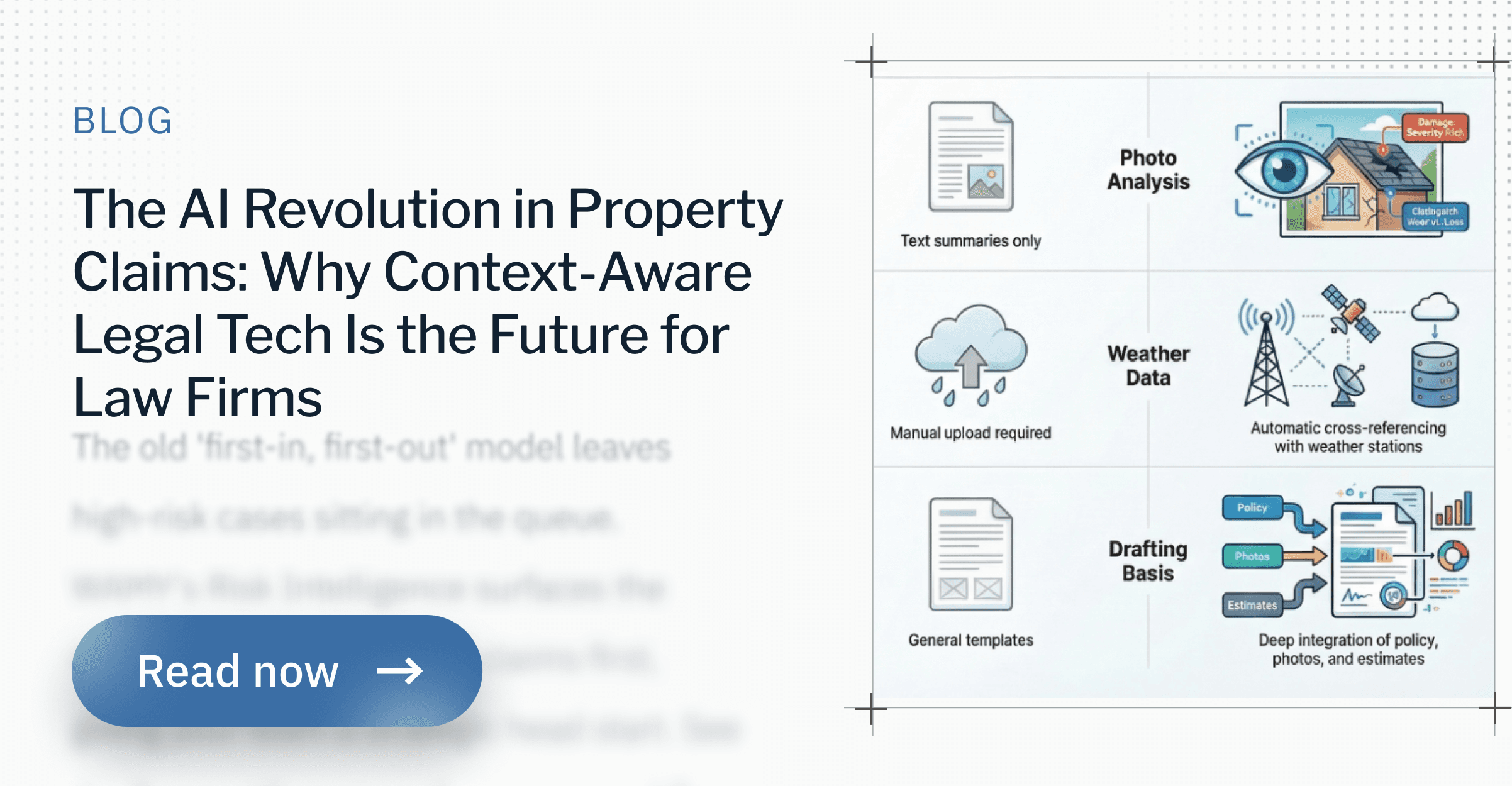
While NLP handles the text, Computer Vision is all about interpreting the visual world. It’s the "eyes" of the AI, trained to analyze photos and videos with incredible precision.
This is a game-changer in a P&C claims setting. Take a property damage claim after a hailstorm. An adjuster might have to sift through dozens, sometimes hundreds, of photos to piece together the extent of the damage. It's tedious and prone to inconsistency.
With Computer Vision, the AI can:
Identify specific damage types, like dents in a car roof, cracks in a foundation, or water stains on a ceiling.
Measure the scale of the damage, often down to the pixel level.
Flag potential fraud by spotting images that have been digitally altered or look inconsistent with the rest of the evidence.
This technology turns a mountain of unstructured visual evidence into clean, structured data, cutting the assessment process from hours down to minutes.
Machine Learning: The Master Strategist
If NLP and Computer Vision are the specialists collecting intel, Machine Learning (ML) is the "brain" of the operation. It’s what allows legal AI to learn from data, spot patterns, and make predictions. It works by analyzing huge volumes of historical data to uncover connections a human reviewer might never see.
For instance, an ML model can be trained on thousands of past litigation files. By analyzing the unique characteristics of cases that led to high settlement costs, it learns to recognize those same red flags in new claims as they come in.
This enables the system to generate a risk score for each new claim, helping teams focus their limited time and resources on the highest-exposure cases first. And it never stops learning. The more data the ML model processes, the smarter and more accurate its predictions become. It’s this adaptive learning that makes AI a truly intelligent partner.
Practical Use Cases for AI in Claims and Litigation

Understanding the technology behind AI for law is one thing, but seeing it deliver real-world results is what truly matters. For P&C carriers, TPAs, and law firms, the lightbulb moment happens when AI turns daily workflows from a manual slog into a smart, automated process.
These aren't abstract, futuristic concepts. They are practical applications actively reshaping how claims and litigation are managed right now. The shift is happening fast, too. A recent survey of legal professionals revealed that 42% of U.S. law firms now use AI, a huge jump from just 26% previously. Another 42% intend to ramp up their AI usage, moving beyond simple experiments to genuine operational change. You can get a deeper look at these legal tech and AI trends to see the momentum building.
Automated Evidence Triage and Classification
Picture this: a new claim lands, and with it comes a digital avalanche of documents. You've got emails, police reports, medical bills, and a folder packed with photos. Traditionally, a claims handler or paralegal would have to open every single file, figure out what it is, rename it, and manually sort it into the right place. It’s tedious and time-consuming.
AI-powered triage completely automates this. Using a mix of Natural Language Processing and Computer Vision, the system can:
Instantly tell the difference between a medical invoice and a property damage estimate.
Sort evidence into relevant categories, like "liability," "damages," or "medical treatment."
Pull out and tag key information, such as names, dates, and policy numbers, making everything instantly searchable.
A task that once burned half a day can now be done in minutes. This immediate organization gives teams a clear, structured view of a case from day one, setting the stage for faster, smarter decisions.
Intelligent Gap Detection
One of the biggest culprits behind claim delays is missing information. Maybe it’s a crucial medical record, a signed release form, or a clear photo of the incident scene. The problem is, you often don't realize it's missing for weeks, bringing the entire file to a screeching halt.
Intelligent Gap Detection acts as a proactive safety net for your claim file. Instead of discovering what's missing when you hit a roadblock, the AI flags it upfront, turning weeks of potential delay into a simple, immediate action item.
AI systems trained on thousands of completed claim files learn what a "complete" file should look like for any given claim type. As soon as a new file comes in, the AI checks it against this baseline and instantly flags anything that’s missing or inconsistent. This lets your team request the needed information right away, preventing bottlenecks before they even start.
Accelerated Draft Generation
Writing routine legal documents—summaries, chronologies, initial discovery requests—is essential but drains valuable time. These documents follow predictable patterns, but they require someone to painstakingly pull facts from a massive pile of source material.
AI for law tools put this process on fast-forward. By analyzing all the organized evidence in a claim file, an AI assistant can generate a first draft in seconds. It can, for instance, produce a complete medical treatment chronology by pulling dates, provider names, and procedures directly from the records it just ingested.
This doesn't replace the legal professional; it elevates them. The human expert is still in the driver's seat to review, edit, and add the strategic nuance that only comes from experience. The AI just handles the grunt work, freeing up your best people for high-value strategic thinking.
Data-Driven Risk Scoring
Let's be honest, not all claims are created equal. Some are simple and can be closed out quickly. Others have the potential to spiral into complex, high-exposure litigation. The challenge has always been spotting the high-risk ones early.
This is where AI-driven risk scoring becomes a game-changer. By analyzing a new claim's unique details against historical data from thousands of similar cases, machine learning models can assign a "risk" or "complexity" score. The AI looks at factors like injury types, liability indicators, or even specific words used in the claimant's correspondence.
This gives team leaders the power to assign resources more effectively, ensuring their most experienced adjusters and attorneys are on the files that need their expertise the most. You can dive deeper into this topic by reading our article on how AI accelerates case resolutions.
AI-Powered vs Traditional Legal and Claims Workflows
Seeing these use cases in action really highlights the difference between the old way and the new. Let's compare them side-by-side to see just how dramatic the shift can be.
Task | Traditional Method (Manual) | AI-Powered Method | Impact |
|---|---|---|---|
Initial File Triage | 2-4 hours per file sorting documents, renaming, and categorizing. | 5-10 minutes. AI automatically identifies, tags, and sorts all evidence. | 95%+ reduction in administrative setup time; immediate case clarity. |
Evidence Review | 8-10 hours reading through hundreds of pages to find key facts. | 15-20 minutes. AI extracts key entities, dates, and concepts. | Frees up legal professionals for strategic analysis instead of manual review. |
Gap Detection | Weeks or months later, when a key document is needed for a deadline. | Immediate. AI flags missing or inconsistent information upon ingestion. | Prevents costly delays and keeps the claim moving forward proactively. |
Drafting a Medical Chronology | 3-5 hours manually pulling dates and events from medical records. | Under 2 minutes to generate a comprehensive first draft. | Drastically accelerates preparation for demands, depositions, and settlement talks. |
The table makes it clear: this isn't about small, incremental improvements. Integrating AI introduces a fundamental change in speed, accuracy, and efficiency, letting your team focus on what they do best—making strategic decisions.
Of course. Here is the rewritten section, crafted to sound like an experienced human expert and match the provided examples.
The Business Case for Investing in Legal AI
Let's cut through the tech hype. At the end of the day, adopting AI for law is a hard-nosed business decision. The only question that matters for a P&C carrier, TPA, or law firm is this: what’s my return on this investment?
The answer isn’t found in flashy features, but in measurable gains across the board—from operational efficiency and financial performance right through to client satisfaction.
At its core, legal AI drives profitability by attacking the biggest cost centers in claims and litigation: time and manual labor. When you automate routine work like document intake, evidence classification, and first-draft generation, you’re directly cutting costs. Think about it: a task like risk profiling a case, which might traditionally take weeks of someone's time, can now be done in as little as 15 minutes with a disciplined AI approach.
Driving Down Operational Costs
The most immediate and tangible benefit is watching your claim processing costs drop. By taking repetitive, low-value work off your team’s plate, AI lets you handle a higher volume of files without having to hire more people. That kind of operational leverage is exactly how you scale a business efficiently.
Slash Labor Costs: AI minimizes the hours your skilled professionals spend on administrative grunt work, freeing them up for the strategic thinking you actually hired them for.
Accelerate Resolution Times: By speeding up every step from intake to analysis, AI helps you close files faster. And faster files almost always mean a lower total cost per claim.
Smarter Resource Allocation: Good AI provides data-driven risk scoring. This ensures your most experienced adjusters and attorneys are focused on the high-exposure files where they can make the biggest impact.
This isn’t just a theory; it’s a massive industry shift. We’ve seen legal tech investments surge, with some years showing double-digit hikes in spending, all fueled by the generative AI arms race. But that spending comes with intense pressure to show real results. As one recent analysis pointed out, organizations without a clear ROI plan risk getting burned if client budgets tighten. You can get a deeper look into this market dynamic and the potential for an AI bubble in the legal sector.
Enhancing Decision Quality and Compliance
While the cost savings are compelling, the true value of AI for law goes well beyond the balance sheet. AI brings a level of consistency and precision to decision-making that directly improves outcomes and tightens up your risk management.
By analyzing every piece of evidence against established rules and historical data, AI eliminates the guesswork and minimizes the chance of human error. An AI system doesn't have a bad day. It applies the same rigorous logic to the first file in the morning as it does to the last one on a Friday afternoon.
AI acts as a system of record, creating a clear, immutable, and auditable trail for every action taken on a file. This enhances compliance and provides a powerful defense against bad-faith claims.
This consistency doesn't just produce fairer, more predictable outcomes—it fortifies your entire compliance posture. Every automated step is logged, building a detailed record that proves you ran a thorough and unbiased process.
When you combine this improved governance with faster claim resolution, you get a direct lift in client satisfaction and retention. In a cut-throat market, that’s a critical advantage. Ultimately, investing in legal AI isn't just about tweaking a process; it's about building a more resilient, efficient, and intelligent operation from the ground up.
Navigating Ethical and Regulatory Challenges
Adopting powerful technology like AI for law isn't just an operational upgrade; it's a strategic move that brings serious responsibilities. For anyone handling sensitive information—carriers, TPAs, and law firms—getting the ethics, privacy, and governance right is non-negotiable. Building real trust in these systems means tackling the hard questions head-on.
The conversation starts, and frankly ends, with data security. In our world, you are the custodian of incredibly confidential information, from medical records to proprietary business details. A data breach isn't just a financial problem; it's an existential threat that can obliterate client trust and your reputation overnight.
Fortifying Your Data Defenses
This is exactly why choosing the right AI partner is so critical. Your vendor's security posture is, for all intents and purposes, an extension of your own. When you're vetting potential platforms, a few credentials aren't just nice-to-haves—they are absolute table stakes.
SOC 2 Certification: Don't just see this as a checkbox. It’s a grueling, third-party audit that proves a vendor has serious controls in place for securing, processing, and storing client data.
HIPAA Readiness: If you're touching anything that involves protected health information (PHI), ensuring your AI platform meets HIPAA standards isn't a choice. It's a legal and ethical imperative.
Choosing a vendor without these foundational security commitments is like building a bank vault with a screen door. It fundamentally misunderstands the value of what you're protecting and the sophistication of the threats you face.
The Evolving Regulatory Landscape
Let's be clear: the rulebook for artificial intelligence is being written in real time. As AI becomes more influential, regulators are paying closer attention. This creates both opportunities and a ton of uncertainty. In fact, recent market analysis shows that AI-driven disruptions and regulatory shifts are a key reason for the surge in demand for legal services, with firms reporting a striking 3.9% year-over-year growth in a single quarter. You can read more about how AI is fueling new litigation waves on Esquire Solutions.
Navigating this means finding a partner who isn’t just compliant with today’s laws but is already thinking about tomorrow's. You need systems that are transparent, explainable, and auditable. You have to be able to answer the question, "How did the AI get to this conclusion?" with a clear and defensible audit trail.
Mitigating Bias and Maintaining Oversight
Perhaps the thorniest ethical issue is the risk of algorithmic bias. If you train an AI model on historical data that contains hidden biases—and most historical data does—the model will learn and potentially amplify them. For instance, if past claims data reflects an unconscious prejudice in settlement outcomes, an AI trained on that data could easily perpetuate those unfair patterns.
This is where the idea of a "human-in-the-loop" is absolutely essential. AI should always be a tool to augment human intelligence, not replace it. The final judgment calls and strategic decisions have to rest with a qualified professional. Period.
Here are the core principles for doing this responsibly:
Continuous Monitoring: Actively watch your AI models for performance drift or signs of biased outcomes.
Human Review: Build mandatory human review checkpoints for critical decisions, especially things like liability determinations or large settlement recommendations.
Transparent Processes: Make sure the AI's reasoning is explainable, so your professionals can understand, gut-check, and validate its suggestions.
By embedding these principles into your workflow, you can get all the incredible efficiency of AI without compromising the integrity and fairness that are the bedrock of our professions. It’s a balanced approach that lets you harness the technology without sacrificing your soul.
A Practical Roadmap for AI Implementation
Bringing AI for law into your operations isn't a "big bang" event. It’s a journey, best taken one step at a time. The good news is, moving from an idea to a real-world tool doesn't have to be overwhelming. By breaking it down into manageable phases, any carrier, TPA, or law firm can build a solid foundation for success. This roadmap will guide you from initial planning to a successful rollout, making sure your investment actually pays off.
The journey starts not with technology, but with your biggest operational headaches. What are the bottlenecks slowing your teams down? Where do the inconsistencies create the most risk? Answering those questions is the first, and most important, step.
Define Your Core Objectives
Before you even think about looking at vendors, you need to get crystal clear on the specific problems you want AI to solve. Is your claims intake process a chaotic mess of emails and attachments? Are your adjusters spending more time sifting through documents than they do negotiating settlements?
Defining your objectives gives you a yardstick to measure success. You have to focus on outcomes, not just features. For instance, instead of saying, "We want an AI document reader," a much better goal is, "We need to slash the time it takes to triage a new claim file by 75%."
Evaluate Potential Vendors Carefully
Once you know what you’re trying to achieve, it’s time to find the right partner. The market is noisy, and not all platforms are created equal—especially when it comes to handling sensitive legal and claims data. Use a structured checklist to vet your options.
Industry Expertise: Does this vendor actually get the nuances of P&C claims or third-party litigation? A generic AI tool just won't cut it.
Security and Compliance: Are they SOC 2 certified and HIPAA-ready? Ask for the reports. This is a deal-breaker.
Integration Capabilities: How well will this platform play with your existing claim management system (CMS) or document storage? A clunky integration is a recipe for failure.
Support and Training: What kind of support are you going to get during and after the launch? A real partner is invested in making your team successful.
Running through this process ensures you end up with a tool that fits your unique workflow and meets your strict security standards.
Run a Focused Pilot Program
Never, ever commit to a full-scale rollout without testing the technology first. A pilot program is your chance to see if the vendor's promises hold up and to measure the AI's real-world impact in a controlled setting.
Pick a small, dedicated team and a specific use case that ties directly back to your main objective. For example, have the team use the AI platform to process a set number of new claims over a 60-day period.
A successful pilot isn’t just about proving the tech works; it’s about building internal champions. When your own team sees firsthand how AI eliminates their manual grunt work and helps them close files faster, they become the most powerful advocates for wider adoption.
Track your key metrics before, during, and after the pilot. Look at claim cycle times, processing costs, and even feedback from your team. That data will build a rock-solid business case for expanding the rollout across the entire organization. It's how you turn an interesting idea into a proven strategic asset.
This visual shows the essential governance steps for maintaining control throughout the process.
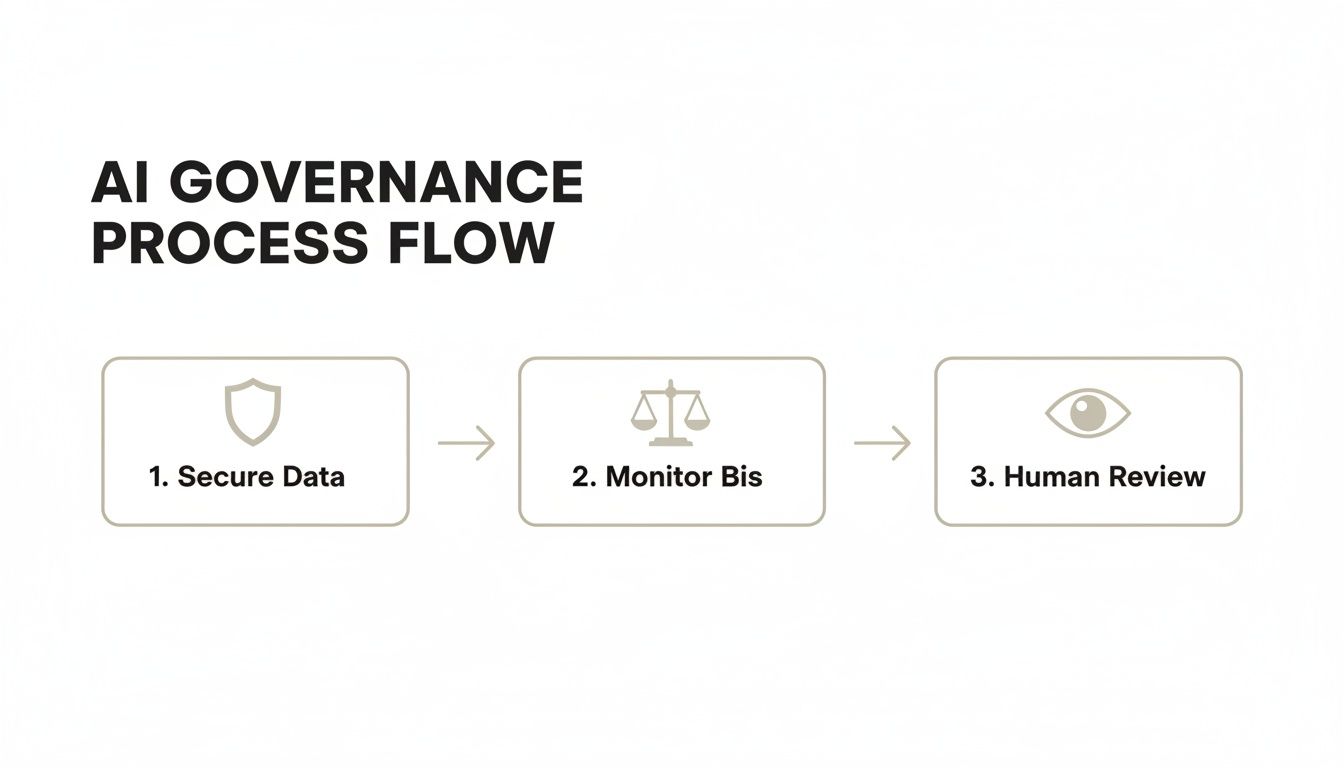
This process flow highlights that securing data, monitoring for bias, and ensuring human review are not one-time tasks. They're part of an ongoing cycle that's absolutely critical for using AI responsibly.
Frequently Asked Questions About AI for Law
As more legal and insurance pros start exploring AI, a lot of practical questions naturally come up. Getting straight, honest answers is the only way to feel confident about bringing this kind of technology into your practice. Here are a few of the most common questions we hear from carriers, TPAs, and law firms.
Will AI Replace Lawyers and Claims Adjusters?
Absolutely not. The goal of AI for law isn't to replace seasoned professionals, but to give them a massive upgrade. Think of it less like a replacement and more like a powerful co-pilot handling the tedious, data-heavy work—like sifting through thousands of documents or flagging a piece of missing evidence.
This frees up your best people to focus on the high-value work that actually requires human judgment and experience. Things like:
Crafting a complex, winning case strategy.
Negotiating a settlement with nuance and empathy.
Building the kind of client relationships that are based on real trust and counsel.
AI takes on the administrative slog, letting your experts apply their skills where they truly matter. It’s about augmenting human intelligence, not making it obsolete.
Is It Secure to Use AI with Sensitive Client Data?
Security isn't just a feature; it's the absolute foundation. Any reputable AI platform built for the legal and insurance world has to be designed with enterprise-grade security from day one. You simply can't afford to partner with a vendor who treats security as an afterthought.
When you're looking at AI platforms, top-tier security certifications aren't just nice-to-haves. They are the bare minimum for protecting your clients' information and your firm's reputation.
Look for the non-negotiable signs that a vendor takes this seriously. SOC 2 certification and HIPAA-readiness are the gold standards. They prove the provider meets strict, independently audited requirements for data security, confidentiality, and privacy. Always ask for proof before you even think about moving forward.
How Long Does It Take to Implement and See Results?
This is where things have gotten much better. Modern, cloud-based AI platforms are built for surprisingly fast deployment. We're often talking about getting up and running in a matter of weeks, not the months-long projects of the past. The key is choosing a solution designed to integrate smoothly with the systems you already rely on.
As for results, many teams start seeing a real return almost immediately. By running a focused pilot program, it’s common to see significant improvements—like faster document intake or more consistent evidence classification—within the first 60 to 90 days. The impact is felt right away where it counts: cutting down on manual work and getting claims resolved faster.
Ready to see how AI can transform your claims process? Wamy turns raw data into confident, audit-ready decisions, helping teams resolve claims up to four times faster. Learn more about Wamy and request a demo today.