Choosing the right partner from a sea of electronic discovery companies is a critical decision for legal and insurance professionals. The wrong choice can lead to missed deadlines, budget overruns, and crucial evidence slipping through the cracks during high-stakes litigation, subrogation claims, or catastrophic event responses. This guide cuts through the marketing noise to provide a detailed, practical analysis of today's leading e-discovery platforms and service providers. We move beyond generic feature lists to give you actionable insights for your specific needs.
This resource is designed for P&C carriers, TPAs, law firms, and claims administrators who need to manage massive volumes of electronically stored information (ESI) efficiently and defensibly. We understand that your requirements go beyond simple document review. You need robust data ingestion, AI-powered analysis for early case assessment, and an unbreakable chain of custody to withstand scrutiny. This roundup directly addresses these challenges, helping you find a solution that accelerates claims triage, strengthens your legal position, and delivers defensible, audit-ready outcomes.
In the sections that follow, we will break down 12 of the top solutions, including RelativityOne, Reveal, Everlaw, and DISCO. For each entry, you will find:
A concise description of their core offerings and ideal user profile.
An analysis of key features like AI-driven document tagging and security protocols.
Specific use cases for insurance and legal workflows.
Direct links and platform screenshots to inform your evaluation.
Our goal is straightforward: to equip you with the information needed to select the best electronic discovery company for your organization, ensuring you invest in a platform that truly supports your operational and legal objectives.
1. Wamy
Best For: AI-Powered Claims Intelligence & Evidence Management
Wamy stands out among electronic discovery companies by offering a purpose-built AI claims intelligence platform specifically for the property and casualty (P&C) insurance ecosystem. Instead of a general-purpose e-discovery tool, Wamy provides a specialized solution designed to turn chaotic, unstructured claim evidence into structured, audit-ready case files. Its core strength lies in its ability to automate the entire front-end of the claims process, from intake to initial assessment.
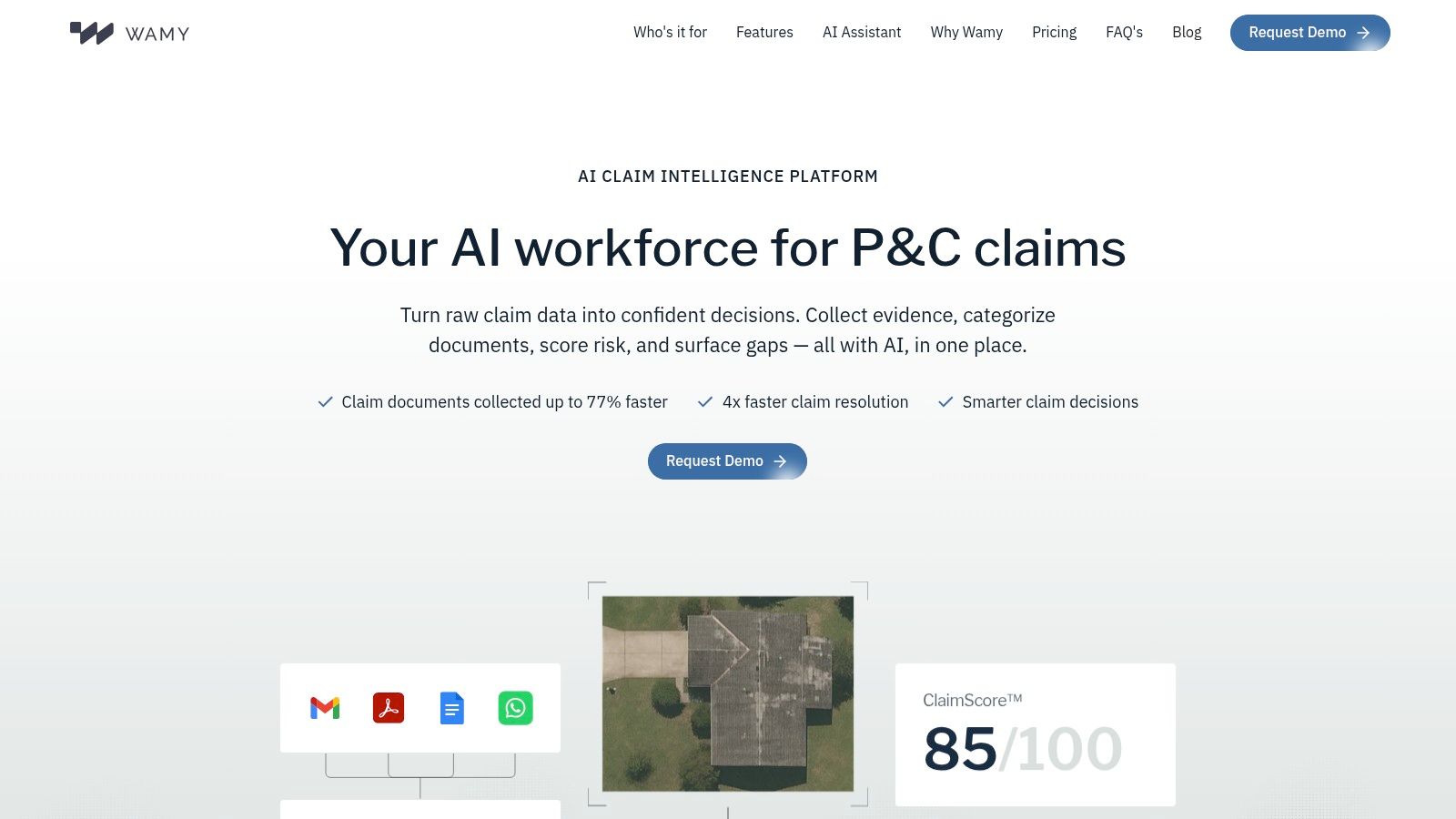
The platform centralizes evidence collection from disparate sources like emails and portals, then applies its domain-trained Evidence Refinery to automatically tag and categorize everything from photos to complex legal forms. This process feeds into its Risk Intelligence engine, which generates a contextual ClaimScore™ for immediate risk assessment and flags missing documents with its Gap Detection feature. This proactive triage is a significant advantage for teams handling subrogation, catastrophic event claims, or pre-litigation reviews. For instance, a TPA managing a high volume of CAT claims can use Wamy to instantly identify high-risk files and ensure all necessary documentation is present before assigning an adjuster, dramatically cutting down on manual review time.
Wamy is engineered for enterprise-level deployment, boasting SOC 2 certification and a HIPAA-ready framework. Teams can be onboarded in under a week, a remarkably fast timeline for this category.
Core Strengths & Use Cases
Accelerated Resolution: Customers report collecting claim documents up to 77% faster and achieving claim resolutions up to four times faster. This transforms intake timelines from over a month to less than two weeks.
AI-Driven Triage: The platform’s specialized AI automates evidence categorization, risk scoring, and identification of missing items, replacing inconsistent manual reviews with a repeatable, defensible workflow.
Audit-Ready Outputs: Wamy produces structured, consistently tagged case files ideal for legal, compliance, and regulatory scrutiny. Law firms find this invaluable for building defensible cases from the outset.
Scalable Capabilities: The platform's modular design, featuring AI assistants like Wamy Companion and optional add-ons (aerial imagery, court notifications), allows organizations to tailor the solution to their specific needs and pay only for the advanced features they use.
Pricing: Wamy operates on a custom, volume-based pricing model. Premium add-ons are available through a flexible credit-pack system, allowing teams to scale capabilities as needed.
Website: https://www.wamy.com
2. Relativity (RelativityOne)
RelativityOne is an industry-standard, cloud-based eDiscovery platform designed for complex litigation and large-scale investigations. It provides a comprehensive, end-to-end solution that covers the entire Electronic Discovery Reference Model (EDRM), from data collection and early case assessment (ECA) through to processing, review, and production. This integrated SaaS platform is favored by large law firms and corporations that require robust, scalable tools for managing massive data volumes.
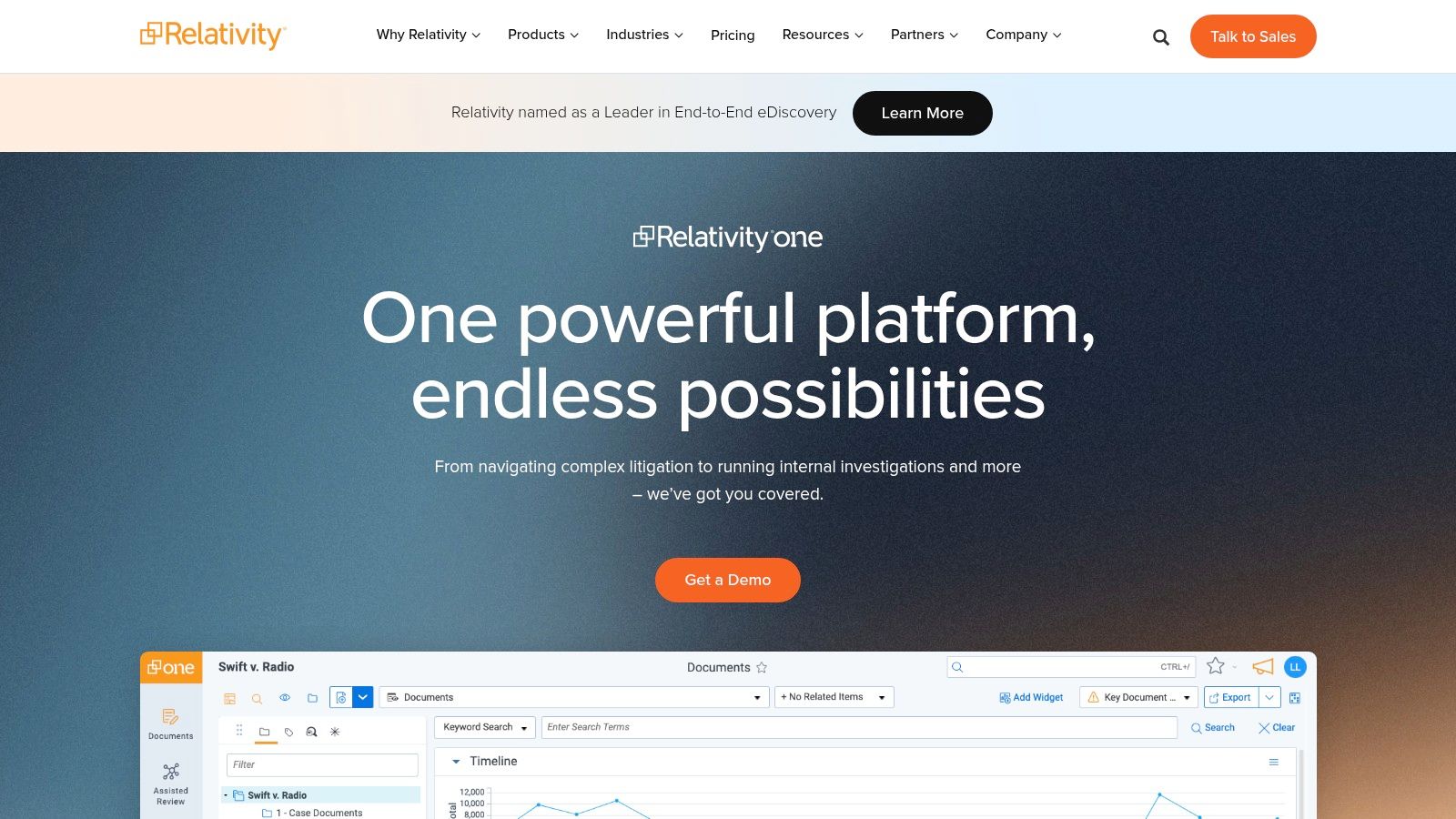
What truly sets Relativity apart is its powerful AI-assisted review capabilities and its extensive ecosystem of third-party partners and applications. Its advanced analytics, such as conceptual clustering and communication analysis, help legal teams quickly identify key documents and patterns. As one of the most established electronic discovery companies, its mature workflows and global data hosting options make it ideal for multi-jurisdictional matters requiring strict data residency and compliance. For a closer look at how firms leverage these AI tools, you can explore the transformation of the discovery process.
Key Platform Insights
Feature | Details |
|---|---|
Ideal Use Cases | Complex litigation, multi-jurisdictional investigations, large-scale corporate matters, and government inquiries. |
Pricing Model | Custom, typically per-gigabyte (GB) monthly fee. Can become costly for extremely large, long-term data sets. |
Core Strengths | Deep market penetration, robust security (ISO 27001, SOC 2, HIPAA), extensive partner network, and mature AI/analytics features. |
Limitations | The platform has a significant learning curve for advanced administration, and its pricing model requires careful data management to control costs. |
Website: https://www.relativity.com/ediscovery-software/relativityone/
3. Reveal
Reveal is a rapidly growing AI-powered eDiscovery and investigations platform designed to accelerate legal review and uncover insights quickly. The platform, which also owns the popular self-service tool Logikcull, offers a comprehensive suite of features covering data processing, visual analytics, supervised learning, and production. Its user-friendly interface is built to provide fast time-to-insight, making it a strong choice for legal teams that prioritize speed and efficiency in their workflows.
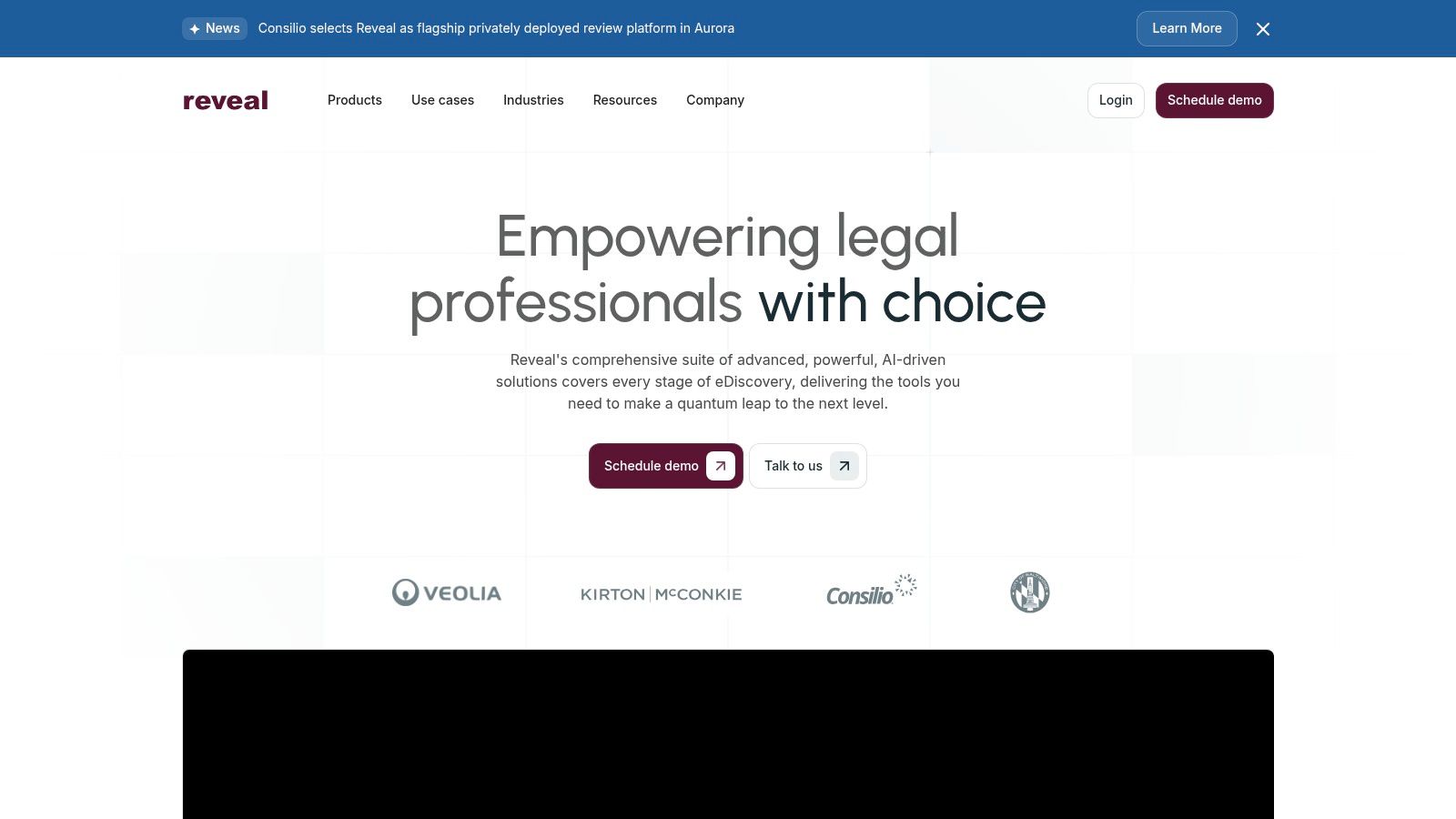
What truly distinguishes Reveal is its aggressive push into Generative AI with its "aji" review engine. By offering no-cost access to this GenAI tool through the end of 2025, the company encourages firms to pilot and evaluate next-generation review capabilities without a major financial commitment. This makes Reveal one of the more accessible electronic discovery companies for teams eager to explore AI's potential for defensible review and analysis. Flexible deployment options, including private cloud instances through its extensive network of service provider partners, add to its appeal for organizations with specific data residency or security needs.
Key Platform Insights
Feature | Details |
|---|---|
Ideal Use Cases | Mid-sized litigation, internal investigations, insurance claims analysis, and firms seeking to pilot advanced AI workflows. |
Pricing Model | Custom, with promotional no-cost access to its "aji" GenAI engine through December 31, 2025. Post-2025 pricing is not yet public. |
Core Strengths | Powerful AI toolset (including concept search and supervised learning), intuitive user interface, and innovative GenAI evaluation opportunities. |
Limitations | Future cost of the "aji" GenAI engine is uncertain, requiring budget planning for 2026 and beyond. Advanced AI features may require developing new internal governance policies. |
Website: https://www.revealdata.com/
4. Everlaw
Everlaw is a modern, cloud-native eDiscovery and litigation platform designed to simplify complex legal work through intuitive design and powerful, integrated technology. It provides a comprehensive, end-to-end solution that emphasizes collaboration, usability, and cost predictability. The platform is built to handle the entire discovery lifecycle, from data ingestion and early case assessment to advanced review, analysis, and production, making it a strong choice for law firms, government agencies, and corporate legal teams seeking efficiency.
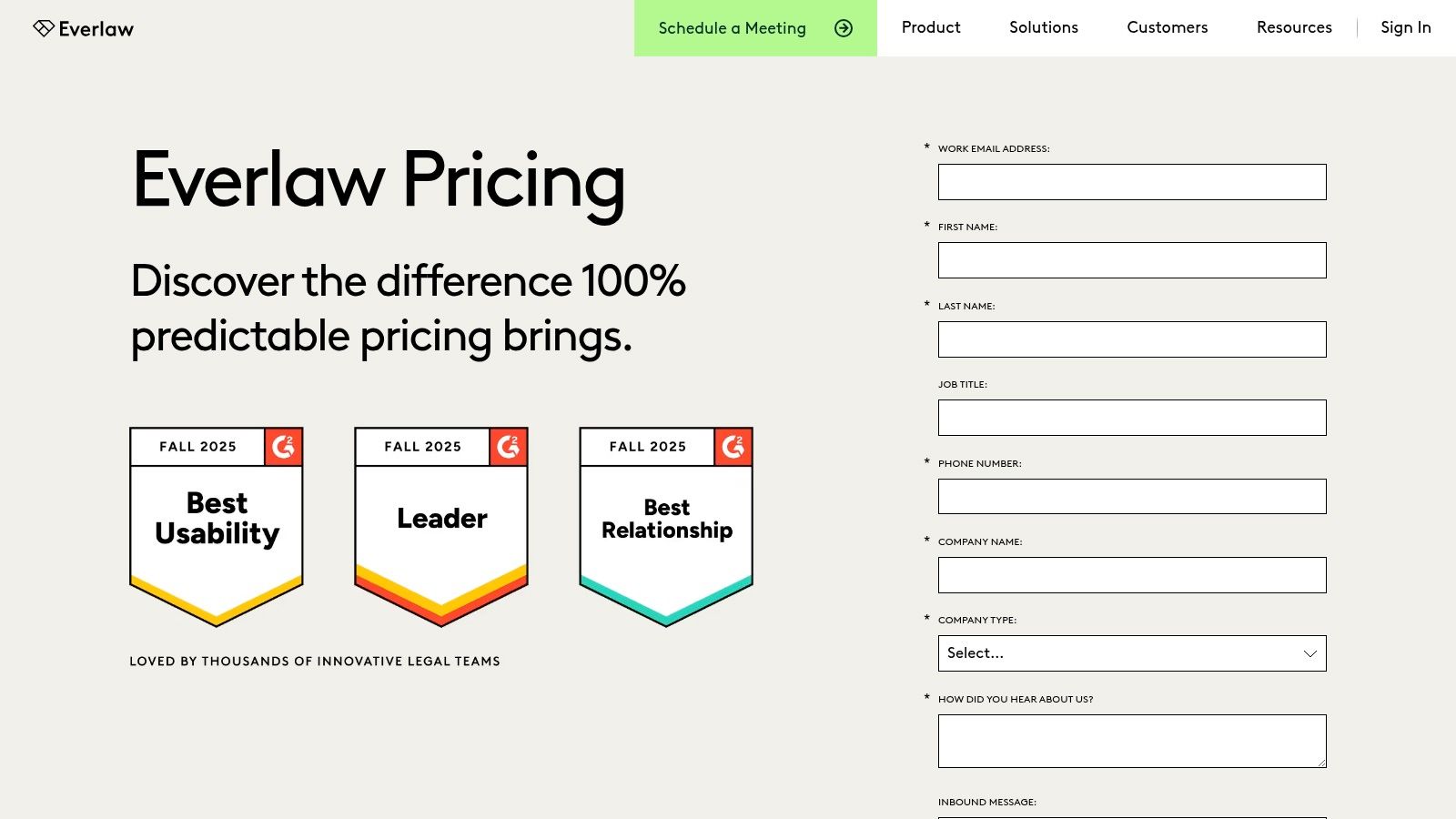
What distinguishes Everlaw is its focus on a seamless user experience combined with integrated GenAI capabilities and a transparent pricing framework. Its "pay-for-what-you-use" subscription model, tied to managed data volume with unlimited users and uploads, helps teams avoid unexpected costs. As one of the more innovative electronic discovery companies, Everlaw’s frequent platform updates and active customer education make it a compelling option for teams prioritizing ease of use and cutting-edge features. To see why it is gaining recognition, you can learn more about top legal tech companies.
Key Platform Insights
Feature | Details |
|---|---|
Ideal Use Cases | Mid-sized to large litigation, internal investigations, class actions, and matters requiring extensive team collaboration. |
Pricing Model | Pay-for-what-you-use subscription tied to managed data. Offers predictable costs with unlimited users and data uploads. |
Core Strengths | Strong usability and fast onboarding, integrated GenAI tools, transparent pricing structure, and robust collaboration features. |
Limitations | While the pricing framework is clear, total cost scales directly with data volume. Maximizing the ROI on advanced analytics may require some user training. |
Website: https://www.everlaw.com/pricing/
5. DISCO
DISCO offers a unified, cloud-native legal platform designed to simplify the entire litigation lifecycle. The platform integrates eDiscovery with legal hold, case building, and generative AI capabilities, including its Cecilia AI suite. This all-in-one approach appeals to organizations looking to streamline their technology stack by sourcing both powerful software and professional services from a single, cohesive vendor. Its focus on speed and a lawyer-friendly interface makes it a strong contender in the market.
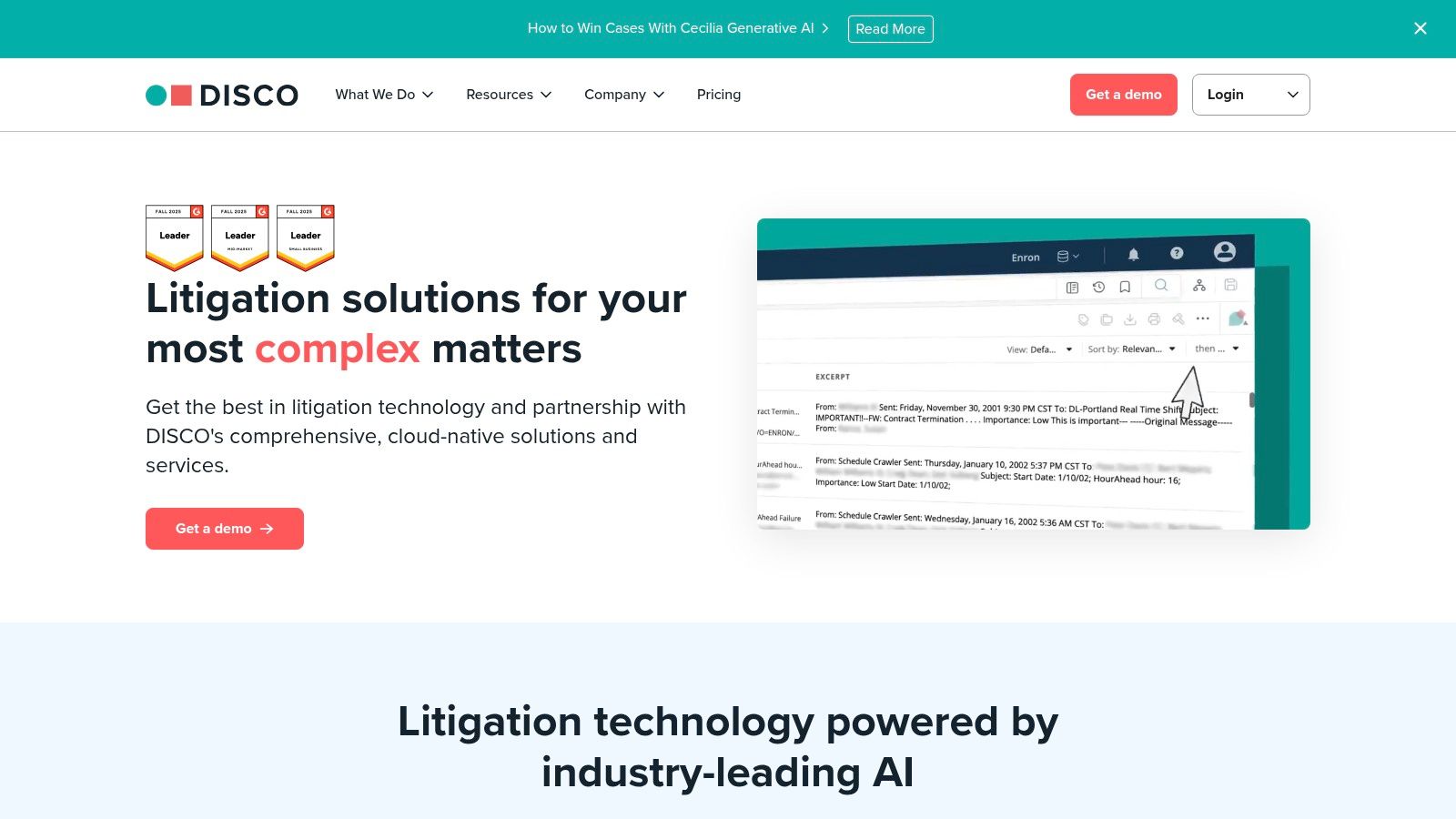
What makes DISCO a standout among electronic discovery companies is its emphasis on user experience combined with rapid innovation. The platform’s sub-second search speeds and AI-driven features like topic clustering and Auto Review significantly accelerate document analysis for claims adjusters and legal teams. For insurance carriers managing high-volume claims or law firms handling complex liability cases, the ability to bundle technology with managed services like forensics and document review provides a seamless, efficient path from data collection to case resolution.
Key Platform Insights
Feature | Details |
|---|---|
Ideal Use Cases | Mid-sized to large law firms, corporate legal departments, and insurance carriers needing an intuitive, all-in-one platform for discovery and case management. |
Pricing Model | Custom quote-based, typically structured per-gigabyte (GB) or on a per-matter basis. Bundled software and service packages are available. |
Core Strengths | Extremely fast performance, user-friendly interface, integrated managed services, and a strong focus on generative AI and workflow automation. |
Limitations | Pricing is not publicly available, and the rapid pace of product updates may require organizations to invest in ongoing internal training and change management. |
Website: https://csdisco.com/
6. Logikcull (by Reveal)
Logikcull offers a powerfully simple, self-service eDiscovery platform designed for corporate legal teams and law firms that need speed and autonomy. Its drag-and-drop interface and automated workflows empower users to handle tasks like subpoena responses, internal investigations, and public records requests without extensive vendor reliance. The platform streamlines the process from legal holds and data collection through to review and production, making it accessible for users who are not eDiscovery specialists.
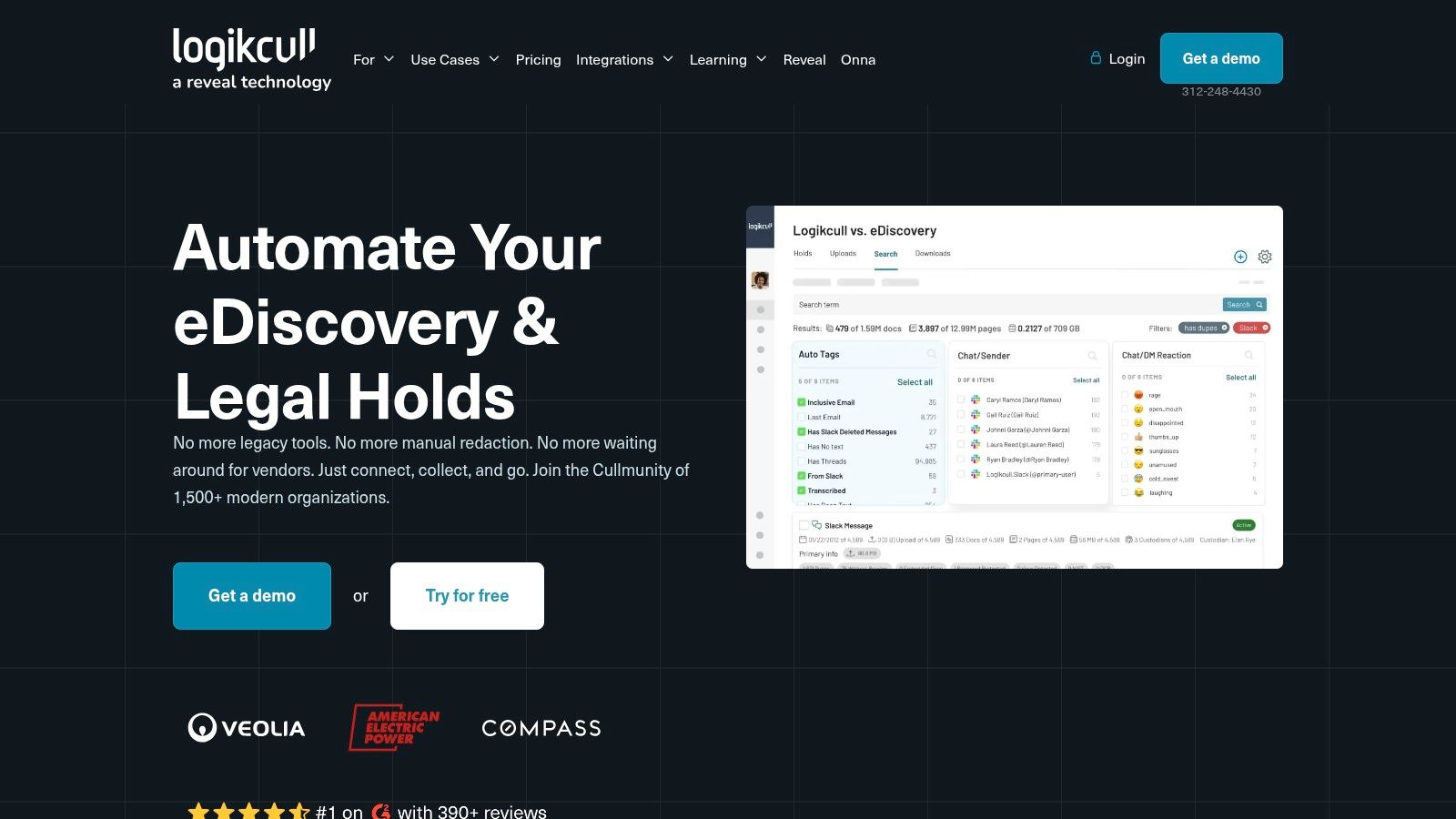
What makes Logikcull a standout choice is its emphasis on ease of use and rapid deployment. Direct connectors to modern data sources like Slack, Google Vault, and Microsoft 365 allow for targeted, efficient collections. The platform automates tedious steps like deduplication, PII detection, and privilege tagging, significantly reducing manual effort. As one of the more user-friendly electronic discovery companies, its intuitive design and 24/7 support make it a go-to for teams needing to get a project started immediately with predictable, subscription-based pricing.
Key Platform Insights
Feature | Details |
|---|---|
Ideal Use Cases | Subpoena responses, internal investigations, public records requests (FOIA/PRR), and smaller litigation matters handled by in-house teams. |
Pricing Model | Subscription-based, often "pay-as-you-go" or annual plans tied to data volume and matters, offering predictability for budgeting. |
Core Strengths | Extremely user-friendly with a minimal learning curve, fast automated processing, integrated legal holds, and excellent 24/7 live chat support. |
Limitations | Less suited for highly complex, multi-jurisdictional litigation requiring advanced analytics, which are more robust in Reveal’s enterprise platform. |
Website: https://www.logikcull.com/
7. OpenText eDiscovery (Axcelerate/Core eDiscovery)
OpenText offers an enterprise-grade eDiscovery suite that includes Axcelerate and Core eDiscovery, designed for corporations and large law firms that need deep analytical capabilities from the outset. Its platform excels at early case assessment (ECA), leveraging AI-powered tools like concept analysis and predictive search to significantly reduce data volumes before the costly review stage. With flexible deployment options, including on-premise, managed services, and cloud, it caters to organizations with specific security or infrastructure requirements.
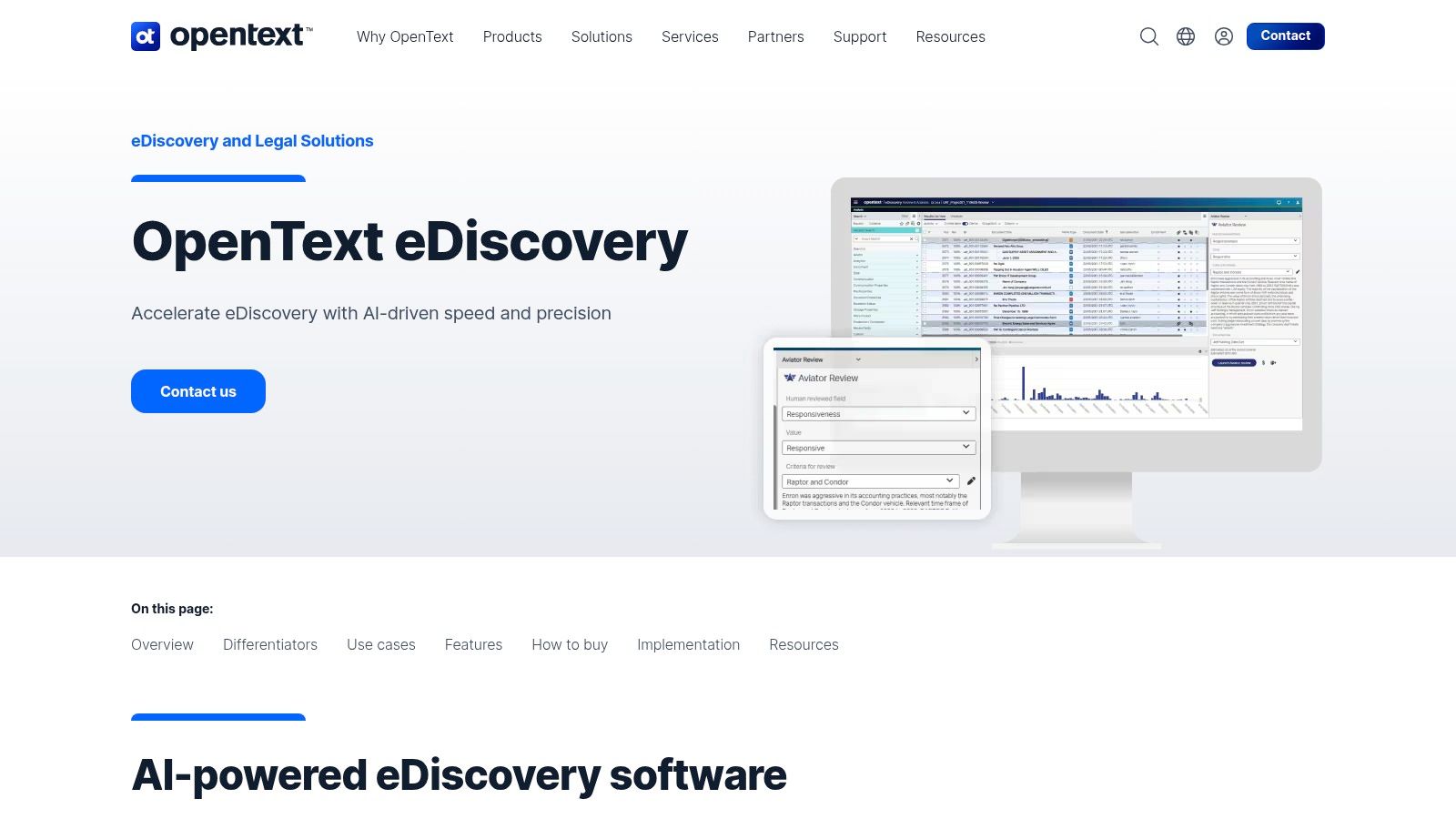
What distinguishes OpenText is its mature analytics engine applied during the ECA phase, which provides measurable data reduction and cost savings. This focus on front-end investigation allows legal teams to quickly grasp case facts, identify key custodians, and make strategic decisions. As one of the more established electronic discovery companies, its strong enterprise footprint and comprehensive professional services ensure it can handle complex, large-scale matters that demand a robust, end-to-end solution with integrated review, production, and automated redaction features.
Key Platform Insights
Feature | Details |
|---|---|
Ideal Use Cases | Enterprise-level corporate investigations, large-scale litigation, regulatory compliance, and matters requiring significant data culling at the ECA stage. |
Pricing Model | Enterprise quote-based model. Pricing is customized and typically requires a discovery call and implementation planning. |
Core Strengths | Powerful ECA and analytics for early data reduction, flexible deployment models (on-prem, cloud, managed), strong professional services and support network. |
Limitations | The platform's interface and extensive toolset can be complex for new users, and its enterprise-focused pricing is less suitable for smaller firms or one-off cases. |
Website: https://www.opentext.com/products/ediscovery
8. Microsoft Purview eDiscovery (Premium)
Microsoft Purview eDiscovery Premium is an integrated solution built directly into the Microsoft 365 ecosystem, offering an end-to-end workflow for internal investigations and litigation. It allows organizations to manage preservation, collection, review, and export of data residing within M365 sources like Teams, SharePoint, and Exchange without moving it outside the security perimeter. This native integration is a significant advantage for companies heavily invested in Microsoft technologies, simplifying data governance and reducing third-party licensing needs.
What makes Purview stand out is its ability to leverage advanced analytics and machine learning directly within a familiar corporate environment. Features like theme detection, email threading, and near-duplicate identification accelerate the review process for legal teams. As one of the most accessible electronic discovery companies for M365-centric businesses, it provides a powerful, in-place toolset that minimizes data transfer risks and streamlines the initial phases of the EDRM. Its transparent pricing for premium features also offers predictable cost management for processing and analysis.
Key Platform Insights
Feature | Details |
|---|---|
Ideal Use Cases | Internal investigations, HR inquiries, early case assessment (ECA) for litigation involving M365 data, and corporate compliance monitoring. |
Pricing Model | Included with certain M365/O365 licenses (e.g., E5/A5/G5). Premium features may have per-user or pay-as-you-go pricing for advanced processing. |
Core Strengths | Native integration with M365 reduces data movement and risk, strong security posture within the Microsoft ecosystem, and transparent unit pricing for advanced features. |
Limitations | Primarily designed for Microsoft data; connecting to non-M365 sources can be complex and may require third-party connectors. Users have also reported occasional service incidents. |
Website: https://www.microsoft.com/en-us/security/business/risk-management/microsoft-purview-ediscovery
9. Nuix (Nuix Neo Discover)
Nuix Neo Discover is built on the foundation of the powerful Nuix processing engine, renowned for its ability to ingest and analyze massive, complex data sets with unparalleled speed. It provides a comprehensive eDiscovery solution that scales from on-premises deployments to a secure, FedRAMP-ready cloud environment. This platform is particularly well-suited for organizations dealing with diverse and challenging data types, including forensic images and unstructured communications, making it a favorite in government and corporate investigations.
What distinguishes Nuix is its patented processing technology that can handle over 1,000 file types, giving legal teams deep visibility into their data from the earliest stages. Its flexible deployment models (SaaS, hybrid, or on-prem) cater to strict data sovereignty, security, or infrastructure requirements. As a leader among electronic discovery companies, Nuix excels in environments where raw processing power and the ability to handle non-traditional data sources are critical. The platform’s robust automation and AI features, such as PII identification and predictive coding, help streamline review workflows for complex matters.
Key Platform Insights
Feature | Details |
|---|---|
Ideal Use Cases | Government investigations, complex corporate litigation, forensic data analysis, and matters requiring strict on-premises data control. |
Pricing Model | Enterprise-focused and sales-led. Custom pricing based on data volume, deployment model, and feature set. |
Core Strengths | Best-in-class processing engine, extensive file type support, flexible deployment options (including FedRAMP), and strong automation. |
Limitations | The full technology stack has a significant learning curve, often requiring specialized training. Its pricing model is geared toward larger enterprise engagements. |
Website: https://www.nuix.com/technology/nuix-discover
10. Consilio (Services + Aurora Platform)
Consilio stands out as a global eDiscovery leader by combining its extensive managed services with a powerful, unifying technology layer. The upcoming Aurora platform with its DataCore technology is designed to provide portfolio-level control and data enrichment upstream of review. This model is ideal for large corporations and law firms that need a partner to manage the entire eDiscovery lifecycle, from data collection and processing to hosting and large-scale managed review.
What differentiates Consilio is its "platform plus services" approach, offering predictable private-cloud deployment options and deep expertise in complex, multi-jurisdictional matters. Rather than a pure self-service tool, Consilio acts as a strategic partner, leveraging its global scale for complex antitrust (HSR) and regulatory investigations. This integrated approach helps streamline the entire legal process, ensuring consistency from intake to trial. You can see how modern legal workflows are evolving to understand the benefits of such an integrated system. As one of the most experienced electronic discovery companies, Consilio offers a robust solution for clients who prioritize expert guidance alongside powerful technology.
Key Platform Insights
Feature | Details |
|---|---|
Ideal Use Cases | Large-scale corporate litigation, HSR/antitrust second requests, global investigations, and complex multi-jurisdictional matters. |
Pricing Model | Enterprise-focused pricing based on services and data volume, typically defined in a Statement of Work (SOW) with project minimums. |
Core Strengths | Global service delivery footprint, deep expertise in regulatory matters, a flexible model supporting multiple review platforms, and strong project management. |
Limitations | Access is typically tied to managed service engagements, making it less suitable for teams seeking a pure self-service SaaS platform. |
Website: https://www.consilio.com/aurora
11. Epiq (Epiq Discovery + Services)
Epiq delivers a hybrid approach to eDiscovery, combining its proprietary Epiq Discovery platform with a full suite of managed services. This model provides legal and insurance teams with flexibility, offering an end-to-end solution that handles collections, processing, review, and production. The platform is designed for efficiency, integrating AI-driven tools directly into the workflow to streamline complex data challenges like large-scale claims investigations and pre-litigation analysis.
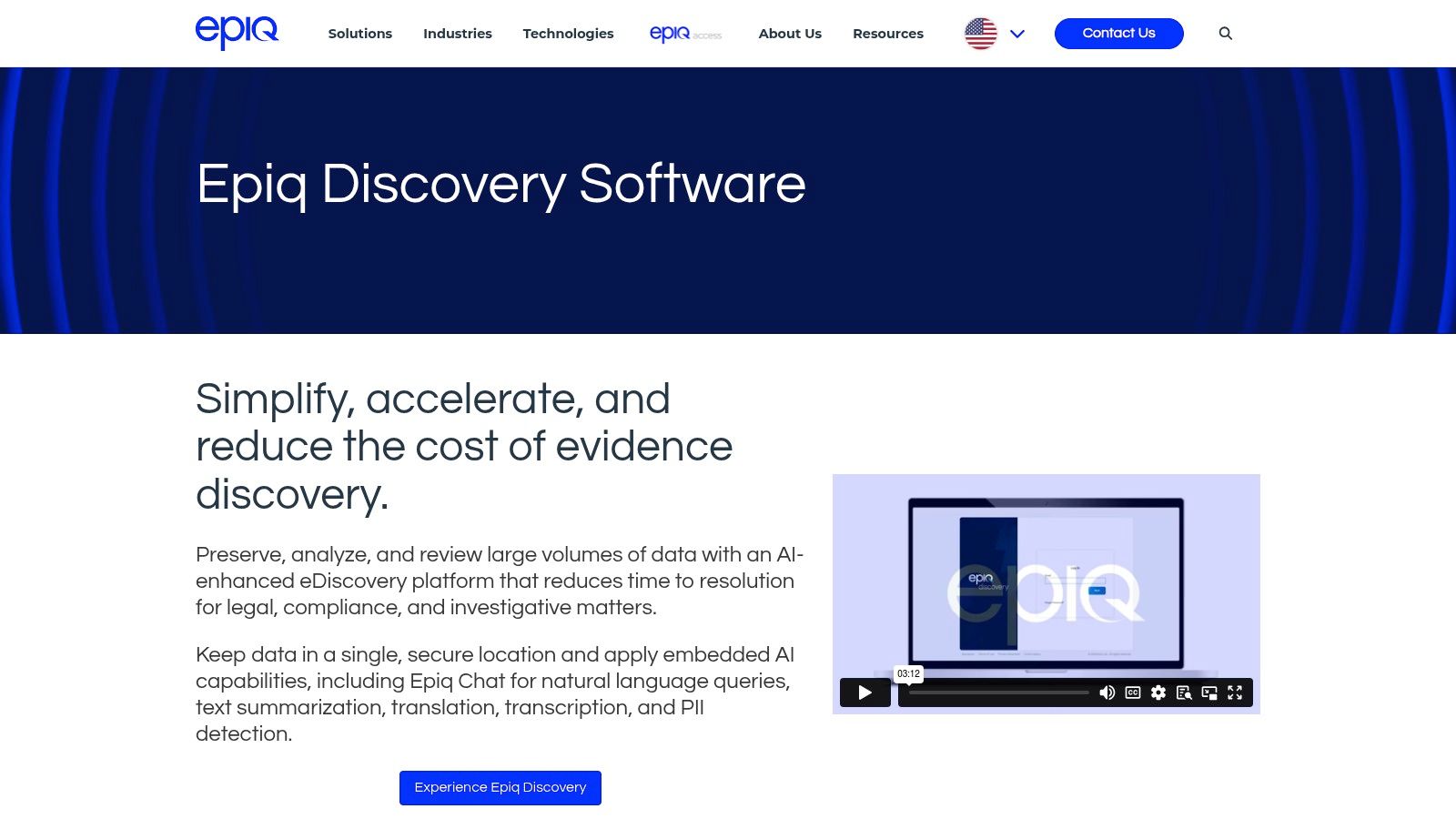
What makes Epiq a compelling choice is its adaptable service model and modern feature set. Users can leverage Epiq Discovery for its intuitive chat-style queries, automated PII detection, and in-platform translation and transcription. For matters requiring more complex workflows, Epiq provides a seamless transition into Relativity, backed by its deep bench of project managers and technical experts. As one of the most versatile electronic discovery companies, its availability on the AWS Marketplace also simplifies procurement for enterprise and public-sector clients, offering a familiar purchasing channel.
Key Platform Insights
Feature | Details |
|---|---|
Ideal Use Cases | Corporate legal departments, government agencies, and law firms needing both a modern SaaS platform and expert services. |
Pricing Model | Quote-based; features and pricing vary by package, often requiring custom consultation to determine costs. |
Core Strengths | Flexible platform options (Epiq Discovery or Relativity), strong managed review services, and simplified AWS procurement. |
Limitations | Pricing is not transparent, and some advanced analytics capabilities may be licensed as separate add-on modules. |
Website: https://www.epiqglobal.com/en-us/technologies/legal-solutions/epiq-discovery
12. KLDiscovery (Nebula + Services)
KLDiscovery provides a versatile eDiscovery solution by offering both its proprietary end-to-end platform, Nebula, and managed Relativity hosting. This dual-offering approach allows organizations to choose the technology that best fits their specific matter requirements, team expertise, and budget. The company combines its powerful software with comprehensive managed review services, leveraging a global infrastructure to support large, complex cases across multiple jurisdictions.
What makes KLDiscovery stand out is its extensive capacity for high-volume data processing and its unique U.S. franchise network, providing localized, on-site assistance for collections and support. This combination of global reach and local presence makes it a strong contender among electronic discovery companies for matters requiring hands-on data handling. The Nebula platform itself integrates everything from data preservation and collection to advanced analytics like predictive coding and communication analysis, providing a unified workflow from start to finish.
Key Platform Insights
Feature | Details |
|---|---|
Ideal Use Cases | High-volume corporate litigation, government investigations, and matters requiring a choice between Nebula or Relativity platforms. |
Pricing Model | Enterprise-grade pricing based on project scope and a formal Statement of Work (SOW). |
Core Strengths | High-capacity data processing, technology flexibility (Nebula or Relativity), 24/7 "follow-the-sun" support, and a U.S. franchise network for local reach. |
Limitations | Enterprise pricing requires detailed scoping, and choosing between two distinct platforms (Nebula and Relativity) can introduce complexity during vendor selection. |
Website: https://www.kldiscovery.com/
Top 12 eDiscovery Platforms Comparison
Product | Core features | UX & performance | Value proposition / ROI | Target audience | Pricing & deployment |
|---|---|---|---|---|---|
Wamy (recommended) | Centralized intake; Evidence Refinery (domain-trained AI) for tagging; ClaimScore™ & Gap Detection; AI assistants & add‑ons | Collect docs ~77% faster; resolve claims up to 4x faster; deploys in <1 week; SOC 2 & HIPAA-ready | Faster approvals/negotiations; audit-ready, consistent case files; lowers cost-per-claim without adding headcount | P&C carriers, TPAs, adjusters, law firms, compliance teams | Flexible volume-based pricing; custom plans + credit-pack add-ons; SaaS deployment |
Relativity (RelativityOne) | End-to-end eDiscovery (collection→production); AI-assisted review; global data residency options | Mature enterprise workflows; 24/7 support; large partner ecosystem | Scales for large/complex matters; enterprise security & compliance | Large law firms, enterprise legal, government | Custom pricing; per-GB models; cloud SaaS (RelativityOne) |
Reveal | Processing, visual analytics, supervised learning; GenAI “aji” review engine | Intuitive UI; fast time-to-insight; good for pilots | Strong AI toolset; attractive GenAI trials (aji free through 2025) | Mid–large firms, teams evaluating GenAI workflows | Cloud & private-cloud options; post-2025 aji pricing TBD |
Everlaw | End-to-end workflows; integrated GenAI actions; collaborative review | Clear pricing guidance; strong usability; fast onboarding | Predictable costs; fast time-to-value; frequent releases | Law firms, corporate legal teams | Pay-for-what-you-use subscription tied to managed data; quote-based |
DISCO | Sub-second search; AI-assisted review & topic clustering; legal hold & case tools | Fast, lawyer-friendly UI; active feature cadence | Bundle software + managed services; strong GenAI features | Litigation teams, law firms needing managed review | Quote-based enterprise pricing; SaaS |
Logikcull (by Reveal) | Self-serve drag-and-drop ingestion; legal holds; connectors (Slack, Google, M365) | Very quick to deploy; 24/7 chat support; simple onboarding | DIY, low-friction discovery for fast matters | In-house legal, small firms, rapid-response matters | Free trial; simple subscription; best for small–mid matters |
OpenText eDiscovery (Axcelerate) | ECA/investigation analytics; TAR & automated redaction; flexible deployments | Mature analytics for data reduction; more complex tooling | Deep ECA-stage analytics; enterprise references | Large law firms, corporations with heavy data | Enterprise/quote-based; cloud, managed services, or on-prem |
Microsoft Purview eDiscovery (Premium) | Native M365 preservation, search, review; privilege detection models | Reduces data movement for M365; integrated compliance controls | Best for Microsoft-centric stacks; published unit pricing for Premium | Organizations standardized on Microsoft 365 | Published unit pricing for Premium processing/storage; M365-native |
Nuix (Nuix Neo Discover) | High-scale processing (1,000+ file types); predictive coding & PII redaction | Very strong ingestion & processing; admin learning curve | Handles complex/large datasets; government-ready options | Enterprises, government, forensics teams | Sales-led enterprise pricing; SaaS/hybrid/on-prem options |
Consilio (Aurora + services) | End-to-end services; Aurora DataCore enrichment; private-cloud review options | Global delivery and managed services; platform plus hands-on support | Platform + services for multijurisdictional, complex matters | Global corporations, antitrust/HSR, cross-border investigations | SOWs and engagement minimums; enterprise pricing |
Epiq (Epiq Discovery + Services) | Chat-style queries, translation, transcription; end-to-end managed services | Flexible procurement (AWS Marketplace); industry-recognized support | Option to use platform or transition to Relativity; vendor-backed services | Enterprises, public sector, law firms needing managed service | Quote-based packages; available via AWS Marketplace |
KLDiscovery (Nebula + services) | Nebula ecosystem & archiving; Relativity hosting; predictive coding/CAL | High capacity & 24/7 support; local franchise network | Throughput for massive matters; multiple tech choices | Very large matters, enterprises needing local on-site reach | Enterprise pricing with SOWs; cloud & hosted options |
Making Your Final Decision: Key Takeaways for Selecting an eDiscovery Partner
Navigating the crowded market of electronic discovery companies can feel overwhelming, but the right partner can transform your legal and claims operations from a reactive cost center into a proactive, data-driven engine. As we've explored, the landscape is diverse, offering everything from all-in-one SaaS platforms designed for speed and simplicity to comprehensive, service-heavy solutions built for the most complex, high-stakes litigation. Your final decision should not be about finding the "best" platform in a vacuum, but about identifying the best-fit solution for your specific operational realities, case profiles, and strategic goals.
For insurance carriers, TPAs, and law firms focused on high-volume, lower-complexity matters like subrogation or catastrophic event claims, the key is efficiency. Platforms like Wamy and Logikcull are designed for this world, prioritizing rapid data ingestion, AI-powered triage, and intuitive workflows that empower claims adjusters and paralegals without requiring deep forensic expertise. Their value lies in accelerating pre-litigation intelligence and reducing the cycle time from incident to resolution.
Conversely, for large-scale, multi-jurisdictional litigation or internal investigations, the robust, highly customizable ecosystems of Relativity, Reveal, and Everlaw become paramount. These platforms are built for deep analysis, intricate review workflows, and advanced analytics. Partnering with service providers like Consilio, Epiq, or KLDiscovery, who often leverage these powerful platforms alongside their own proprietary technology and managed review services, provides an essential extension of your team when internal resources are limited.
Your Action Plan for Vendor Selection
Choosing the right eDiscovery partner is a strategic investment. To ensure you make an informed decision that delivers long-term value, follow a structured evaluation process. Avoid being swayed by flashy demos and focus on how a solution solves your core business challenges.
Here are the critical next steps to take:
Define Your Primary Use Case: Are you primarily focused on early case assessment (ECA) for insurance claims, managing complex multi-party litigation, or handling government investigations? Your primary need dictates the features that matter most. An ideal subrogation tool is not necessarily the ideal tool for a massive class-action lawsuit.
Map Your Data Sources: Identify where your critical evidence resides. Is it primarily in Microsoft 365, mobile device data, claims management systems, or custom-built databases? Ensure your shortlisted vendors demonstrate seamless and defensible collection capabilities for your specific data ecosystem.
Conduct a Pilot Project: The single most effective evaluation tool is a real-world test. Select a small, representative case or claim file and run it through your top two or three vendors. This will reveal true performance, usability, and the quality of customer support far better than any canned demonstration.
Scrutinize the Pricing Model: Understand the total cost of ownership. For platforms with usage-based pricing like DISCO or Relativity, model your costs based on historical data volumes. For subscription models, clarify what is included and what constitutes an extra fee (e.g., processing, production, user licenses).
Evaluate Integration and Implementation: How will this tool fit into your existing tech stack? Consider integrations with your claims management software, case management system, or cloud storage. Discuss the implementation process, data migration, and the training required to get your team fully operational.
Ultimately, the goal is to find a partner that not only provides powerful technology but also aligns with your team's workflow and business objectives. The best electronic discovery companies act as an extension of your team, providing the tools, expertise, and support needed to uncover the truth in your data efficiently and defensibly. This journey from data chaos to clear, actionable intelligence begins with choosing the right partner for the road ahead.
Ready to see how AI-driven eDiscovery can specifically accelerate insurance claims and pre-litigation workflows? Wamy is purpose-built to help carriers, TPAs, and law firms surface critical evidence in minutes, not weeks. Explore Wamy to see how our platform can reduce claim cycle times and improve outcomes.